Cook County state's attorney's office reviewing legality of Chicago mayor's immigration executive order
Published in News & Features
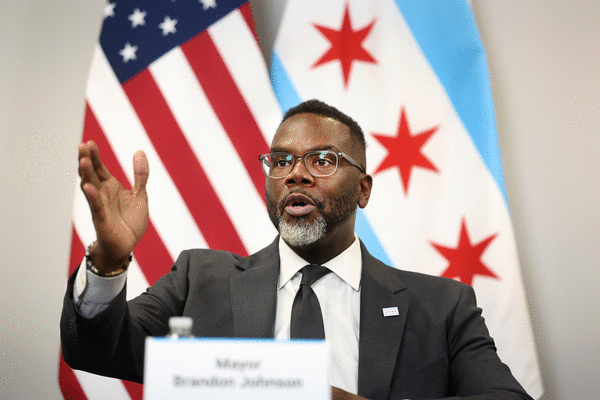
CHICAGO — The Cook County state’s attorney’s office on Monday said “a thorough analysis is being conducted” to assess the legality of a mayoral executive order that directs Chicago police to investigate potential wrongdoing by immigration agents, after the weekend signing was overshadowed by a political brouhaha due to social media pushback from the county’s top prosecutor.
For months, advocacy groups have pushed city, county and state officials to investigate and potentially prosecute immigration agents in connection with confrontations with civilians during the Trump administration’s aggressive “Operation Midway Blitz” this fall.
“These rogue federal agents are taking us backwards as a city,” Mayor Brandon Johnson said Saturday. “The people of Chicago asked me to do more, so I’ve done more.”
But the announcement quickly led to a back-and-forth between Johnson and Cook County State’s Attorney Eileen O’Neill Burke, who posted on the social media platform X that her office “did not receive the Executive Order until it was released to the public. We do not provide legal approval of any matter until we’ve reviewed it.”
In response, Johnson’s office said the mayor’s team received feedback on some of the order’s language from Burke’s policy chief, Yvette Loizon. But Burke’s office fired back again, saying it “never received draft or final language from the Mayor’s office.”
Of particular note in the executive order is a passage that says: “CPD supervisors must ensure preservation of evidence relating to the incidents and reports described above and, at the direction of the Mayor’s office, make a referral of felony matters to the Cook County State’s Attorney.”
When seeking felony charges, detectives seek approval from the state’s attorney’s office’s Felony Review Unit. Involvement from the mayor’s office would be unusual.
In the prosecutor’s office’s statement, officials said they are reviewing the order for legality “because this order changes the process for how felony charges are evaluated.”
In a statement to the Tribune, the mayor’s office said that prosecutors have discretion on whether to file charges.
“The Mayor’s Office will review evidence with CPD when referring cases; however, the State’s Attorney will decide whether or not to bring charges,” the statement said.
Sheila Bedi, Johnson’s policy chief, told the Tribune on Saturday that referral decisions “would not be political” and she said the office is currently in the process of putting together the procedures.
“It’s going to be based on the facts of the underlying crime and an evaluation of whether or not the referral is the appropriate use of criminal justice resources,” Bedi said. “So we’re going to be looking big picture at the investigation that CPD pulls together, and whether or not that is an offense that should be referred.”
The Chicago Police Department declined to answer questions about how the order will be implemented. The department has one month to come into compliance.
As of Monday, CPD had yet to communicate to officers any potential changes to department policy.
The order — “ICE On Notice” — requires police to verify the names and badge numbers of immigration agents in leadership roles when responding to the scene of immigration enforcement actions. If federal agents do not comply, police should capture that denial with their body cameras, the order states.
It does make clear, though, that CPD officers will continue to not interfere with federal immigration arrests.
“Nothing in this Order imposes any duty on CPD members to arrest federal agents during civil immigration enforcement operations,” the order reads. “Nothing in this Executive Order is intended to alter any of the Collective Bargaining Agreements between the City and the labor unions representing CPD members.”
John Catanzara, president of the Fraternal Order of Police Lodge 7, the union that represents rank-and-file CPD officers and detectives, derided the order in a statement over the weekend:
“The same guy who hates the police now wants to use (them) for his own personal and political relevance,” Catanzara said on social media. “We will be exploring the legal jeopardy Brandon Johnson might be placing our members into.”
Johnson’s executive order comes as the matter of accountability for federal agents accused of wrongdoing in the wake of Operation Midway Blitz weighs heavily, especially amid attempts by Minnesota officials to investigate the shooting deaths of Renee Good and Alex Pretti.
In Cook County, immigration agent Adam Saracco became the first known federal agent to face charges in connection with a confrontation with a protester.
He is facing a misdemeanor battery charge after he allegedly threw a man who was filming him to the ground at a gas station while off-duty.
____
(The Tribune’s Jake Sheridan and Caroline Kubzansky contributed.)
____
©2026 Chicago Tribune. Visit at chicagotribune.com. Distributed by Tribune Content Agency, LLC.



Comments