Homeland Security blasts judge's decision to pause termination of Haitian TPS
Published in News & Features
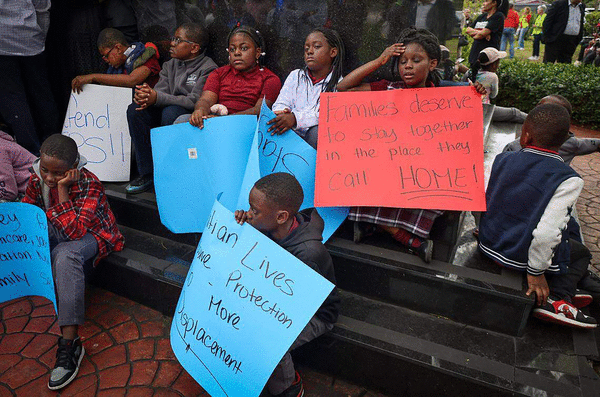
The Department of Homeland Security on Tuesday sharply criticized a federal judge’s decision to pause the administration’s effort to end deportation protections for Haitians, signaling that the dispute could soon reach the nation’s highest court.
“Supreme Court, here we come,” DHS spokeswoman Tricia McLaughlin said in response to a ruling late Monday by Judge Ana C. Reyes of the U.S. District Court in Washington, D.C.
Reyes ordered a stay of the administration’s decision to terminate temporary protected status, or TPS, for more than 300,000 Haitians living in the United States. The order temporarily nullifies DHS Secretary Kristi Noem’s announcement that Haiti would lose its designation at 11:59 p.m. Eastern time Tuesday, which would have stripped beneficiaries of work authorization and put them at risk of detention and deportation.
In a sharply worded ruling, issued in a two-page order and an accompanying 83-page decision, Reyes found that the termination of Haiti’s TPS designation was motivated, at least in part, “by racial animus” and was “not the product of reasoned decision-making, but of a preordained outcome justified by pretextual reasons.”
The plaintiffs in the case argued that the decision was made because they are Black, and while they cited numerous comments made by President Donald Trump, Reyes focused particularly on comments made by Noem. The DHS secretary has described Haitians — and people from 18 from other nonwhite countries — as “leeches,” “entitlement junkies,” and “foreign invaders” who “suck dry our hard-earned tax dollars” and has expressly claimed that “WE DON’T WANT THEM. NOT ONE.”
Reyes noted that post on X from the secretary where she recommended that Trump “ban anyone from Haiti coming into the U.S.” also occurred a mere three days after she made the termination decision. She noted that “Noem has terminated every TPS country designation to have reached her desk—twelve countries up, twelve countries down.”
“Even if the Court ignored President Trump’s statements altogether,” Reyes wrote, “Secretary Noem’s expressed animus towards nonwhite foreigners would support a stay.”
McLaughlin denounced both the ruling and the judge.
“This is lawless activism that we will be vindicated on,” she said in a post on X. “Haiti’s TPS was granted following an earthquake that took place over 15 years ago, it was never intended to be a de facto amnesty program, yet that’s how previous administrations have used it for decades.”
“Temporary means temporary,” she went on to say, “and the final word will not be from an activist judge legislating from the bench.”
TPS was created by Congress for countries where conditions are such that their nationals cannot safely return home. While Haiti’s designation was given after a 7.0 magnitude earthquake nearly destroyed Port-au-Prince and left more than 300,000 dead and 1.5 million homeless.
Since then, conditions in Haiti have continued to deteriorate. The country has no elected president or parliament, and criminal gangs — designated by the Trump administration as global and foreign terrorists — control large swaths of Port-au-Prince and are expanding elsewhere. Violence, mass displacement, widespread sexual assault, hunger and malnutrition are rampant.
Advocates say the court order is a victory for the rule of law over a termination that was “unjustified, illegal, and racist.”
“This case is dangerous precisely because DHS knew that its factual assertion—that it was safe to return to Haiti—was preposterous, and it did not even try to follow the TPS statute’s required review process,” said Brian Concannon, executive director of the Institute for Justice and Democracy in Haiti. “The administration just tried to bully the court into rubber stamping its illegal policy.”
He and others, however, are aware that DHS might seek relief through the Supreme Court’s emergency docket, as it did in other TPS cases last year, rather than through the normal route of appeals. In previous cases the high court has allowed the administration to detain and deport immigrants while challenges go through the court system.s
“Six judges, appointed by Republican and Democratic presidents, have ruled on Trump Administration efforts to terminate Haitian TPS since 2018 and all six have found those efforts to be illegal,” said Blaine Bookey, legal director of the Center for Gender and Refugee Studies. “If DHS now appeals to an appeals court, it will lose. If DHS uses the Supreme Court’s shadow docket to reinstate its indefensible action, everyone in America will lose the rule of law that undergirds our stability and prosperity.”
William O’Neill, the United Nations’ independent expert on the human rights situation in Haiti, hailed the decision.
“As I have said before, no one should be forced to return to Haiti from any country,” he said. “The situation in Haiti is catastrophic: kidnappings, murders and gang rapes while half the population does not have enough to eat. There is no possibility for a safe and dignified return in these circumstances.”
©2026 Miami Herald. Visit at miamiherald.com. Distributed by Tribune Content Agency, LLC.





Comments