Iran, US hold indirect talks to de-escalate Mideast tensions
Published in News & Features
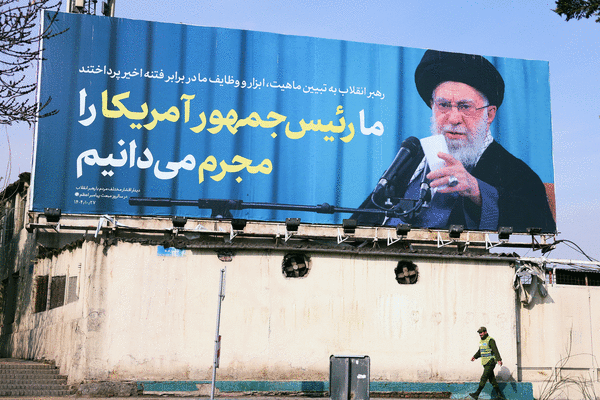
Iran and the U.S. held indirect talks on Friday to reduce tensions that have threatened to spiral into war, with Tehran saying the meetings will be the first stage of a longer diplomatic process.
“The consultations focused on creating the appropriate conditions for the resumption of diplomatic and technical negotiations,” Oman’s Foreign Ministry, which is mediating the talks in its capital Muscat, said in a statement.
Oman’s Foreign Minister Badr Albusaidi met separately with the Iranian delegation led by his counterpart Abbas Araghchi and with the U.S. team including special envoy Steve Witkoff and President Donald Trump’s son-in-law Jared Kushner.
Talks began with Iran’s Araghchi presenting a preliminary plan for “managing the current situation” and advancing negotiations with the U.S., the state-run Islamic Republic News Agency reported. Iranian state TV said a second round of consultations was underway. The U.S. hasn’t yet commented.
Ahead of the meetings, Tehran said the talks would focus on “broad topics” rather than finer details and are expected to clarify a road map for further negotiations, IRNA reported.
Iran’s main priorities include “assessing the other side’s goodwill and seriousness,” it said. “The road map for negotiations appears set to become clearer once this round concludes.”
Oil prices have soared around 12% this year, in large part because of concerns about a new war in the Middle East. Brent rose 1.1% in early trading on Friday to $68.13 a barrel.
Some supertanker operators, nervous about the rising U.S.-Iran tensions and potential risks to shipping in the Strait of Hormuz, are speeding their vessels through the chokepoint, Bloomberg has reported.
Iran seized two small oil tankers in the Persian Gulf on Thursday that were suspected of smuggling fuel, state TV reported. Iranian authorities, who frequently conduct such anti-smuggling operations, found around 6,300 barrels-worth of illicit fuel aboard, the report said, without identifying the vessels.
Trump has threatened Tehran with military strikes if it doesn’t agree to a deal, with Iran warning that any attack would trigger a regional war engulfing Israel and the U.S.
The U.S. on Friday urged any of its citizens in Iran to leave or stockpile food and water if they’re unable to do so. It’s unclear how many Americans are still in Iran, but the number is probably small.
Trump’s stated objective has morphed from assurances on the safety of Iranian protesters who staged mass anti-government demonstrations in December and January to a broader deal to constrain Tehran’s nuclear and ballistic missile programs.
Iranian officials have insisted the talks will be limited to the nuclear issue, while U.S. officials have said they have to include Iran’s missiles and Tehran’s support for regional militias. There’s widespread skepticism among analysts that the two countries can reach a deal.
“Despite some diplomatic progress, U.S. strikes on Iran remain likely,” Gregory Brew and Henning Gloystein, analysts at Eurasia Group, said in a note to clients on Thursday. “Trump’s preference for quick, decisive actions that do not turn into prolonged commitments means the expected U.S. strikes would be intensive, but not prolonged.”
“This looks closer to an end-game than a routine negotiation cycle,” Amtelon Capital Chief Investment Officer Maciej Wojtal said in a note on Friday, adding that the U.S. is likely to resist an open-ended timetable to negotiations.
“Escalation options range from targeted strikes on Revolutionary Guards missile infrastructure to maritime interdiction of Iranian oil shipments en route to China,” Wojtal said.
Much of Iran’s atomic program was damaged in June when Israel carried out airstrikes and assassinations in the country. The U.S., which was holding talks with the Islamic Republic before the fighting began, joined in later, dropping bunker-busting bombs on key sites in Iran used to produce enriched uranium.
---------
—With assistance from Golnar Motevalli, Eltaf Najafizada and Dana Khraiche.
©2026 Bloomberg L.P. Visit bloomberg.com. Distributed by Tribune Content Agency, LLC.





Comments