Michigan Supreme Court blocks legal challenges tied to Flint water prosecutions
Published in News & Features
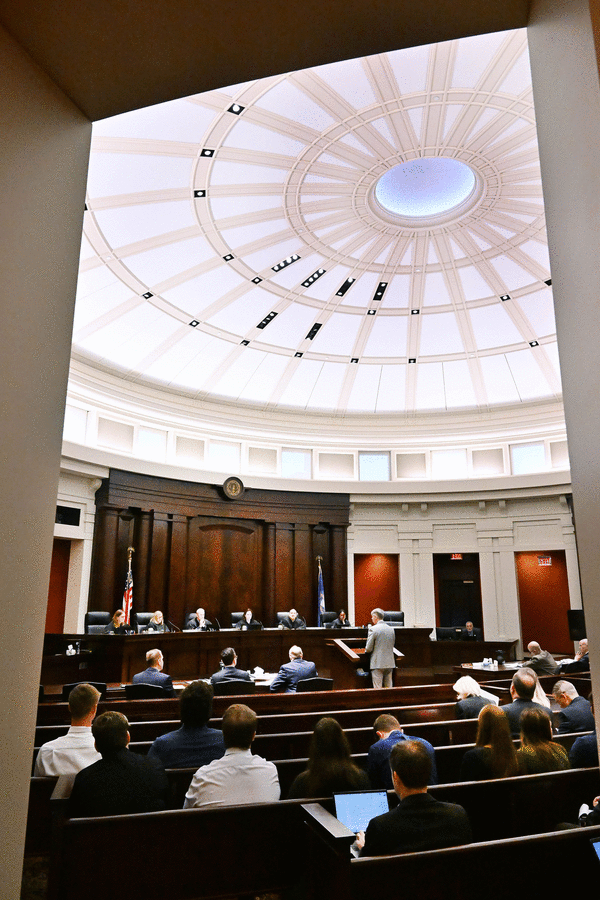
In a case with a potentially far-reaching scope, the Michigan Supreme Court has closed the door on a wave of post-conviction challenges tied to the state’s use of judges as one-person grand juries.
In the unanimous opinion issued Feb. 4 and written by Justice Elizabeth Welch, the court said that its 2022 decision restricting the use of one-man grand juries, which curtailed prosecutions in the Flint Water Crisis, does not apply retroactively to cases that are already final.
The court held that defendants convicted years ago cannot rely on its earlier ruling in People v. Peeler to reopen their cases simply because they were charged through a one-person grand jury rather than given a preliminary examination.
The case before the court involved Todd Douglas Robinson, who was convicted in 2013 of first-degree premeditated murder and felony-firearm in what was allegedly a drug deal gone bad.
Robinson was charged after a judge, acting under Michigan’s one-person grand jury statutes, authorized the case to proceed directly to trial. After the Supreme Court ruled in Peeler that judges acting as one-person grand juries may investigate crimes but may not issue criminal indictments, Robinson sought to undo his conviction through post-conviction proceedings.
The Peeler decision itself grew out of prosecutions connected to the Flint water crisis, where several former state and local officials were charged through one-person grand jury proceedings. In that context, the court ruled that while the one-man system can be used to investigate alleged crimes, defendants are still entitled to a preliminary examination before being bound over for trial. The ruling forced prosecutors to restart or abandon multiple Flint-related cases and reshaped how complex public-corruption investigations must proceed going forward.
In Robinson's case, the justices rejected that effort, concluding that Peeler announced a new procedural rule that applies only to cases that were still pending at the time of that decision. “Although Peeler established a new rule of law,” the court wrote, “it does not apply retroactively.”
The court also addressed a central argument raised by Robinson and other defendants in similar cases: that an improper charging process deprived the circuit court of its jurisdiction to hear the case, rendering the conviction void. The justices disagreed, emphasizing that jurisdiction depends on the type of case a court is authorized to hear, not on whether every procedural step was followed correctly.
“Subject-matter jurisdiction is the right of the court to exercise judicial power over a class of cases,” the opinion stated, adding that “an error in the charging procedure does not divest the circuit court of subject-matter jurisdiction over felony prosecutions.”
That conclusion carries broad consequences for other defendants who were charged under the same statutory scheme before Peeler was decided. By determining that one-person grand jury charging errors are not cause to undo the final disposition of a case, the court effectively foreclosed arguments that such defects automatically invalidate convictions.
For prosecutors, the decision preserves the finality of convictions obtained before Peeler, even if the charging process would now be considered improper. For defense attorneys, it sharply narrows a previously promising avenue for post-conviction relief and shifts the focus back to claims involving constitutional violations at trial or newly discovered evidence.
While the court made clear that judges may no longer issue indictments when acting as one-person grand juries, it also signaled that the change is forward-looking. As the opinion explained, Peeler “does not render past convictions void,” and errors in the charging mechanism alone are insufficient to reopen closed cases.
©2026 The Detroit News. Visit detroitnews.com. Distributed by Tribune Content Agency, LLC.






Comments