Haiti's ruling council leaves behind tainted legacy, as power remains in hand of gangs
Published in News & Features
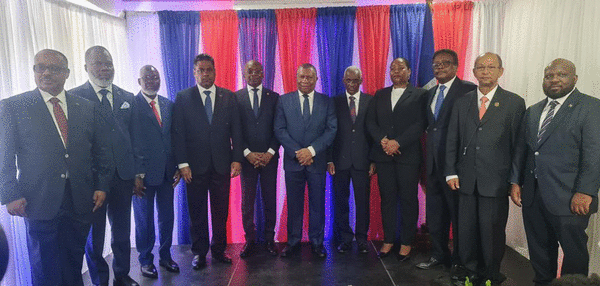
Days before Haiti’s new ruling presidential council assumed power in April 2024, one of its senior members met with a foreign diplomat and declared that the transition government, installed after the ouster of Prime Minister Ariel Henry, would reopen a gang-controlled highway within 100 days.
Nearly 22 months later, as the council prepared to step down on Saturday, the road connecting Port-au-Prince to the south remains firmly in the grasp of criminal gangs. And so do more than a dozen neighborhoods in Port-au-Prince, along with every major highway leading into and out of the Haitian capital.
Haiti’s security has deteriorated so sharply that the tentative hope many Haitians felt at the start of the ruling panel’s transition has largely evaporated. With the exception of the council members themselves, most Haitians are ready for the group to go.
“What’s happening here is total chaos,” said Port-au-Prince resident Ronald Pierre, 40, noting that more people have been killed, more have been forced to flee their homes more left hungry since the council took office in April 2024.
Made up of nine individuals representing different civic and political factions, the council was created with the help of the United States, Caribbean leaders and other foreign governments during a meeting in Jamaica as armed gangs formed a united front and threatened to take over Haiti. Henry, who had traveled to Kenya to seek support for his outgunned police forces, was stranded abroad and forced to resign under pressure from the U.S. and the Caribbean Community group CARICOM.
The council’s installation was a prerequisite for the deployment of a multinational security mission that Henry had requested in 2022. But from the outset, the council was engulfed in controversy and corruption scandals.
It now leaves office under a cloud of disappointment, its tenure marred by infighting, poor governance and paralysis, as well as persistent allegations of influence peddling, corruption, collusion with armed gangs and of diverting public resources for personal gain.
Those allegations, compounded by a plot to remove the current prime minister, Alix Didier Fils-Aimé, ahead of Saturday’s deadline, prompted the Trump administration to impose sanctions on five of the council’s seven voting members.
‘Catastrophic’ tenure
A source familiar with government spending told the Miami Herald that each of the council members has conservatively cost the government at least $56,340 a month, a figure critics say contributed to their reluctance to relinquish power. The figure includes salary and compensation like housing costs, but doesn’t include the salaries of consultants — some of the council members had as many as 20 in their offices.
“It’s a catastrophic balance sheet,” said Pierre Esperance, a human rights advocate whose organization analyzed the costs, which were even more astronomical once the salaries of advisers were added.
Considering the corruption scandals, the accusation of gang ties and the current state of the country, the experiment was a failure, Esperance said.
“These guys destroyed the country, they destroyed the public treasury, and they came to represent a source of instability for the country,” he said, accusing the group of trying to destabilize the country as they head out the door.
On Saturday, Feb. 7, Haiti enters the third phase of a political transition since the 2021 assassination of President Jovenel Moïse, and also marks — and also mark 40 years since the fall of the Duvalier dictatorship, which ruled the country for nearly three decades before its collapse in 1986.
The leadership change comes as the country remains gripped by gang violence, with armed groups controlling large swaths of Port-au-Prince. The first contingent of a U.S.-backed, United Nations-authorized Gang Suppression Force is not expected to arrive until April. Meanwhile, foreign governments are becoming increasingly impatient with the lack of progress toward long overdue elections.
As the clock wound down Friday down on the council’s troubled tenure, Haiti faced more questions than answers. There was no consensus on when the council’s mandate would actually expire — whether at the end of the day Friday or sometime Saturday — or how exactly they would relinquish power. Also unclear are the contours of the next transition, which is expected to be led solely by Fils-Aimé after political and civic leaders failed to reach an agreement on moving forward.
Around Port-au-Prince, where security forces have been making incremental gains against gangs since December, the focus turned to securing critical infrastructure amid fears of renewed violence and another coup attempt. The streets were quieter than usual, but police continued to patrol key areas, including the prime minister’s office, well into the night. A small convoy of armored vehicles that had arrived from South Korea the day before secured the perimeter of the National Palace.
Inside foreign embassies, diplomats checked their phones, uncertain how the council’s mandate would end and whether a formal transfer-of-power ceremony would take place.
An invitation finally arrived late in the afternoon for a subdued 10 a.m. ceremony at Villa d’Accueil, the former prime minister’s office serving as the council’s headquarters, on Saturday. However, its arrival was preceded by a note from one council member, Leslie Voltaire, informing foreign diplomats that three days of “inter-Haitian dialogue” had resulted in an agreement on the formation of the next government. Under his proposal, a new three-member presidential panel would include himself, a Supreme Court justice and a representative of civil society. The choice of a prime minister, he said, remained unresolved, with three candidates still under consideration.
The move was the latest in a series of political maneuvers that had already led the Trump administration to revoke U.S. visas for Voltaire and four other council members, as Washington accused them of interfering with the government’s efforts to counter gangs “for their own gain.” Council members denied the allegations and have said the U.S. sanctions are politically motivated. They also accused the U.S., which deployed a Navy warship off the coast of Port-au-Prince, of interfering in Haiti’s internal affairs.
Still, Voltaire’s last-minute attempt to remain was viewed as yet one more example of Haitian politicians’ stalled progress toward stability, and restoring democratic rule.
Lack of agreement
The Trump administration has publicly declared its support for Prime Minister Fils-Aimé, and said he should remain in office after Saturday to ensure the continuity of government. Caribbean leaders, who had spent months in 2024 mediating among Haiti’s politicians, ultimately reached the same conclusion. In the absence of an agreement, they told Haitian leaders during a Thursday meeting they were inclined to join the U.S. and Canada in endorsing Fils-Aimé’s continued leadership.
“It’s really alarming,” said Marjory Michel, a feminist leader who participated in the meeting, organized by a Caribbean Community “Eminent Persons Group,” consisting of the former prime ministers of The Bahamas, Jamaica and St. Lucia.
Michel said she was frustrated by both the lack of consensus over the path forward and the council’s troubled stewardship.
The council, made up of seasoned political figures representing all sectors of Haitian society, had failed in their efforts to form a governing bloc to address the country’s core challenges, including security and elections. “Instead we are in this endless cycle of uncertain transition,” Michel added. “Insecurity is ravaging the population, and all you see is people putting their personal interests first, along with their clans and political groups.”
Michel is among the people who spent the last four months in talks with CARICOM, representatives of the global community of French speakers and the U.N. political mission in Haiti.
“We can’t agree on anything,” she said, a day after sharply criticizing fellow leaders for failing to meet a 72-hour deadline they themselves had proposed to come up with an agreement. While disgusted, she said, she isn’t dispirited. But like many Haitians, Michel believes the transition has run its course and Haiti must move toward elections, even if the current reality of gang-blocked roads and over 1.4 million internally displaced people makes it hard to envision.
“If we can’t come together, we have just one choice — to go to elections so that the people will have the final word,” she said.
Jerry Tardieu, founder of the political party En Avant, called the council’s departure the closure of “a sad chapter” in Haiti’s history. The failure of political and civil society leaders to reach a consensus on governing the country highlights a “grim reality,” said Tardieu, whose group is part of the G10, which includes the political parties of former presidents Jean-Bertrand Aristide and Michel Martelly.
“Our society is fragmented, divided and polarized. Compromise becomes all the more difficult, but it is not impossible,” he said.
In an open letter, Tardieu invoked Haiti’s amended 1987 Constitution, which stipulates that the prime minister and his cabinet should govern in the event of a power vacuum. But he cautioned that doesn’t mean Fils-Aimé “will have a blank check to govern the country” without a road map or safeguards.
“In this regard, we urge them to invite the influential political figures of the moment as soon as possible for a properly organized” dialogue, Tardieu wrote. “Only such a dialogue can confer political legitimacy on the authorities in place for the calm and peaceful conduct of state affairs in this election year, which promises to be turbulent.”
Haiti last held elections in 2016, and creating a secure path toward the ballot box was a central job of the transitional council in order to steer the country back to democratic rule after Moïse’s killing. Though elections are tentatively scheduled for August, few experts expect them to take place this year.
Asked in a recent interview by Radio France Internationale if the council had failed, France’s ambassador to Haiti, Antoine Michon, chose to focus on one of its core tasks.
“On the security front we can say there has been no progress.”
_____
(Herald freelancer Johnny Fils-Aimé contributed to this report.)
_____
©2026 Miami Herald. Visit miamiherald.com. Distributed by Tribune Content Agency, LLC.




Comments