New front emerges in Florida GOP's higher-ed overhaul: medical school accreditors
Published in News & Features
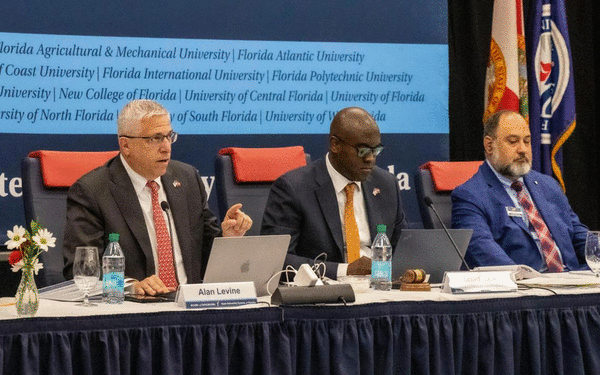
TALLAHASSEE, Fla. — Florida Republicans are opening a new front in their clash with college accreditors, this time targeting medical schools in a move that could have implications for the state’s access to billions of dollars in federal student aid.
A scathing Feb. 12 letter reviewed by the Herald/Times shows Florida university leaders pressing the accreditor of eight Florida medical schools — including University of Florida, Florida International University and University of Miami — to justify its gender-affirming care standards. It marks what could be the first salvo against medical-school accreditation in Florida’s escalating campaign against what Gov. Ron DeSantis has dubbed “woke accreditation cartels.”
The missive comes as Florida enforces a sweeping ban on gender-affirming care for minors and dismantles traditional accreditation requirements for lawyers and universities. The state recently loosened its reliance on the American Bar Association for law-school accreditation and is working with other red states to build its own alternative regional accreditor, the Commission for Public Higher Education.
In the six-page letter, the State University System’s Board of Governors Chairman Alan Levine demanded answers from the Liaison Committee on Medical Education accrediting body about whether its standards are being properly enforced at medical schools that provide gender-affirming care for minors.
Levine, who runs a Tennessee-based hospital system and previously served as the top medical official in Florida and Louisiana, wrote that his message was “not intended to argue the merits, or lack thereof,” for gender-affirming care for minors.
“While I certainly have my opinions, I do not have the requisite training to assert what the medical evidence should demonstrate,” said Levine, a three-time University of Florida graduate who earned master’s degrees in health sciences and business administration.
Undergirding Levine’s argument was a 2025 peer-reviewed study from the U.S. Department of Health and Human Services, which found “medical interventions pose unnecessary, disproportionate risks of harm,” and “healthcare providers should refuse to offer them even when they are preferred, requested or demanded by patients.”
The chairman framed the inquiry as a review of accreditation itself, questioning “the value of the current accreditation process” and why accrediting agencies did not intervene if treatments were offered without clear evidence of benefit.
A spokesperson for the Association of American Medical Colleges, an organization that sponsors the Liaison Committee on Medical Education, said in a statement that the accrediting body “does not prescribe specific curriculum.”
“Each medical school devises its own curriculum based on its mission and local community,” said the spokesperson, Stuart Heiser.
What accreditors do — and why they matter
Accreditation agencies play a little-understood but critical role in higher education: determining whether colleges and professional schools meet baseline quality standards — and gatekeeping students’ access to federal financial aid.
Under federal law, only institutions accredited by agencies recognized by the U.S. Department of Education can access federal student loans, Pell Grants and other aid. Without recognized accreditation, most universities would lose access to billions of dollars in funding and leave students unable to afford a higher education.
Accreditation also shapes professional pipelines. Medical schools must be accredited for graduates to enter residency programs, and law schools traditionally needed accreditation from the American Bar Association for graduates to sit for most state bar exams. As a result, battles over accreditation can determine not just what universities teach but whether they can function at all.
Florida’s medical-school inquiry fits into a wider campaign by DeSantis and Republican lawmakers to wean off what they view as meddling accreditors, arguing they impose ideological and diversity requirements upon public institutions. DeSantis has repeatedly branded the accreditation establishment as a “cartel” or “junta,” a term used for authoritarian governments led by a committee of high-ranking military officers who seize power, typically through a coup d’état.
Florida has already begun weaning off accreditation’s influence in other fields. In January, the Florida Supreme Court ended its decades-long reliance on the American Bar Association as the sole accreditor determining whether law school graduates can take the state bar exam, opening the door to graduates of schools accredited by other federally recognized agencies.
At the same time, Florida is committing $4 million to jumpstart an effort with several Republican-led states to create a new “ideology-free” accreditor, the Commission for Public Higher Education, intended as an alternative to traditional agencies. State leaders hope the new body will gain federal recognition before the end of Trump’s second term, allowing universities to maintain access to federal student aid while bypassing accreditors.
Set against Florida’s health-care policy
The accreditation fight is unfolding as Florida enforces one of the nation’s strictest bans on gender-affirming medical care for minors. Levine’s letter repeatedly references such treatments and questions whether medical schools offering them are complying with accreditation standards governing ethics and scientific evidence.
A Gainesville-based pediatric endocrinologist, Michael Haller, said “the idea that accrediting bodies … would penalize medical schools for teaching those fundamental principles with regards to the care of a specific minority population is dangerous and incorrect.
“Accreditation agencies do not dictate treatment decisions or promote ideology. They set educational standards,” he said. “Patient care decisions should remain between physicians, patients, and families, guided by scientific evidence and clinical judgment.” Haller said he was speaking in his personal capacity and not on behalf of his employer, UF.
Though framed as a request for information, Levine’s letter signals that Florida’s campaign against accrediting bodies — once focused on general university oversight — is expanding into medicine, one of the most tightly regulated sectors of higher education.
Because accreditation is directly tied to federal funding and professional licensing pipelines, any sustained conflict between Florida and national accreditors could carry high stakes for state universities, medical schools and students alike.
In an interview with the Herald/Times on Friday, Levine raised questions about whether “ideology” has impacted medical school admissions and curriculum development. “Are they graduating students who are capable of being physicians?” he asked. “Or are we ushering people through the system that were perhaps not appropriate to be in medical school?”
Will Florida establish its own medical-education accreditor? Maybe, Levine said, but not before the Association of American Medical Colleges answers his questions.
“I don’t want to draw conclusions yet,” he told the Herald/Times. “But I don’t think anything’s off the table.”
©2026 Miami Herald. Visit at miamiherald.com. Distributed by Tribune Content Agency, LLC.





Comments