Mamdani proposes 9.5% property tax hike for budget gap if Albany doesn't act
Published in News & Features
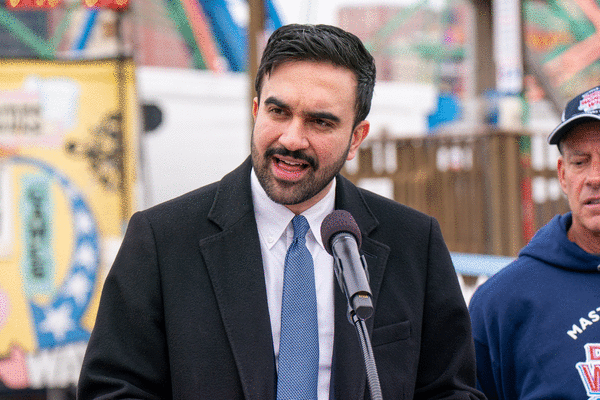
NEW YORK — Mayor Zohran Mamdani on Tuesday gave Gov. Kathy Hochul an ultimatum, saying that if the governor doesn’t raise taxes on the wealthiest New Yorkers and corporations, despite her continued resistance to the idea, he’d be forced to implement a steep property tax hike.
That proposed 9.5% hike, which Mamdani framed as the city’s nuclear option, would be the first of its kind since 2003.
“We remain firmly within a budget crisis,” the mayor said at the City Hall announcement of his preliminary budget plan, which represents the first step in the budget negotiation process.
“It is a crisis that we can and will overcome, but we cannot do so without either significant structural changes in Albany or painful decisions of last resort.”
The administration is currently projecting a $5.4 billion budget gap, which Mamdani has blamed on fiscal mismanagement and underbudgeting during the Adams administration. The mayor’s proposed budget for the upcoming fiscal year comes in at a whopping $127 billion.
Administration officials said the property hike would generate $3.7 billion in revenue in the next fiscal year. It would impact more than 3 million residential units and over 100,000 commercial buildings, the mayor said
Mamdani said he has little appetite for the property tax hike, which would hit a constituency he’s struggled to win over — homeowners in mostly Black neighborhoods — especially hard. He framed as the last possible option for his administration the possibility of making those working-class New Yorkers fork up, saying the administration has “exhausted almost every option.”
“We do not want to have to turn to such drastic measures to balance our budget,” Mamdani said. “But faced with no other choice, we will be forced to.”
Property taxes are the only taxes the mayor could raise without the state, though the City Council would have to approve the hike.
“At a time when New Yorkers are already grappling with an affordability crisis, dipping into rainy day reserves and proposing significant property tax increases should not be on the table whatsoever,” Council Speaker Julie Menin said in a statement.
Mamdani’s gamble that the threat of higher property taxes could be used to get Hochul to establish tax hikes on the rich comes as the mayor is coasting on his widespread popularity and as Hochul is facing reelection, with much of her Democratic base residing in the five boroughs.
“I’m not supportive of a property tax increase. I don’t know that that’s necessary,” Hochul said at an unrelated Hudson Yards press conference. She added that she’s brought “unprecedented levels” of state cash to the city, including the extra money announced Monday.
Just a day earlier, Gov. Hochul announced the state would give $1.5 billion to the city over the next two fiscal years — significantly decreasing the city’s budget gap projections from $7 billion to $5.4 billion.
To balance this fiscal year’s budget, the city also plans to draw down $980 million from “Rainy Day” reserves, and would plan to withdraw hundreds of millions more in the upcoming fiscal year. Mamdani then said the city would pay back funds taken from the reserves in fiscal year 2028.
Critics said Mamdani’s proposal presented a false binary.
“Mayor Mamdani’s preliminary budget proposes a false choice: either the state raises personal income and business taxes, or the city raises property taxes and saps money from reserves, including those to protect New Yorkers from a recession,” Citizens Budget Commission President Andrew Rein said in a statement. “The best choice is to eliminate spending that does not improve New Yorkers’ lives and make government more efficient and effective.”
Queens Borough President Donovan Richards said a property tax hike would “force people out of their homes.”
And City Comptroller Mark Levine called the proposed hike a “regressive” tax that will hit “communities of color much more than it hits homeowners in wealthier areas.”
“We do have a big gap to fill, and he’s put a pretty extreme option on the table, which is a combination of raising property taxes and taking money from reserves, and relying on some pretty aggressive revenue projections to boot,” Levine, who was briefed on the proposal Tuesday morning, said.
On the campaign trail, Mamdani emphasized a need to reform the city’s property tax system, which economists say favors single-family homes, luxury condos and predominantly white neighborhoods overall, and places more weight on multifamily buildings and homeowners in mostly Black neighborhoods.
Mamdani said Tuesday the city plans to introduce property tax reform legislation “in the next few weeks.”
The mayor has framed the tax increases on the rich as both a means to close the budget gap and to set the city on a stronger financial footing by giving him the cash to implement his affordability-centric agenda items.
Mamdani has not yet made good on his campaign promises to expand programs and funding for other agencies, with just 4% of the new spending in his preliminary plan allocated to new programs.
He also did not include funding for the proposed Department of Community Safety in the preliminary plan, though he promised to earmark funding for it in the executive plan, which is set to be released in April.
Mamdani has singled out the city’s rental assistance voucher program, CityFHEPS, as one particularly egregious area of overbudgeting under Adams. Mamdani last week said he’s backtracking on his campaign promise to grow the program by seeking a settlement in a lawsuit against the expansion.
_____
©2026 New York Daily News. Visit nydailynews.com. Distributed by Tribune Content Agency, LLC.


Comments