Japan's Takaichi formally elected PM, eyes swift budget passage
Published in News & Features
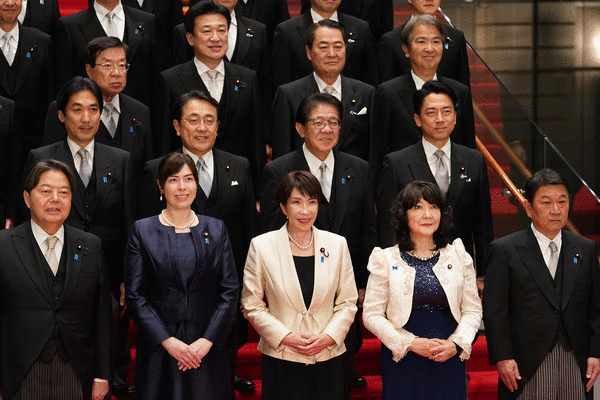
Sanae Takaichi was reappointed as Japan’s Prime Minister following her resounding electoral win, a formality that allows her to turn her attention to expediting passage of the annual budget and implementing a trade deal agreed with U.S. President Donald Trump.
The vote in parliament to affirm her as leader on Wednesday was virtually assured after her Liberal Democratic Party secured a two-thirds majority in the lower house in the Feb. 8 election. She kept her Cabinet lineup unchanged.
Takaichi’s historic victory in the lower house polls has given her a mandate to push through with a host of ambitious campaign pledges and policies, including increasing investment in areas such as the AI and semiconductor industries and beefing up defense capabilities. The premier has also vowed to accelerate talks on suspending a sales tax on food purchases for two years.
“We will accelerate discussions over the schedule, funding, and feasibility of temporarily cutting the sales tax on food items to zero, without relying on issuing deficit bonds,” she said in a news conference held Wednesday evening.
Takaichi said the tax cut would be considered in tandem with the possible introduction of a refundable tax credit mechanism. The tax cut would be a temporary measure to tide households over until the tax credit mechanism is put in place, she added.
Regarding concerns over the funding of measures, she said it was important to achieve sustainable finances by lowering the ratio of public debt to gross domestic product. She added that she was also keeping an eye on yields and currency market movements on a daily basis.
“We will continue to seek market trust by ensuring that our finances are sustainable,” Takaichi said.
Earlier Wednesday, the International Monetary Fund warned Japan against cutting its sales tax when borrowing costs on public debt are set to double.
Touching on another topic of close interest to investors, Takaichi said she hoped the Bank of Japan would continue to conduct policy toward achieving its goal of stable 2% inflation.
She declined to divulge details of her discussions with BOJ Governor Kazuo Ueda on Monday. At the time, Ueda said the premier had made no specific requests.
In the past Takaichi has criticized the idea of interest rate hikes as “stupid.” That comment still gives some BOJ watchers the lingering impression she might try to slow down the bank’s pace of rate hikes.
In a sign of progress toward implementing a trade and investment deal with the U.S. before her meeting with Trump in March, Takaichi followed the U.S. president’s lead in announcing Wednesday morning the first batch of projects under Japan’s $550 billion investment commitment.
“Both Japan and the U.S. will continue to work closely together to ensure the swift and smooth roll out of the projects,” she wrote in a social media post.
The projects include a natural gas facility expected to generate 9.2 gigawatts of power, a deepwater crude export facility, and a synthetic industrial diamond manufacturing facility.
For now Takaichi’s pledges will likely be put on the back burner as she addresses the more pressing issue of passing the budget for the 2026 fiscal year that starts April 1.
The dissolution of parliament ahead of the snap election dimmed the prospects for the 2026 budget being passed by the usual March deadline, given budget deliberations usually take over two months. Still, Takaichi told members of the LDP that she has not given up on passing the budget by the end of March, according to local media.
If the main budget is not passed by March, Takaichi would likely have to get an interim budget passed in order to tide finances over in the meantime. An interim budget covers the basic costs for government operations, so a U.S.-style shutdown is highly unlikely. Still, it could inject some level of uncertainty as the government operates on a bare-bones spending plan.
The 2026 budget will total about ¥122.3 trillion ($799 billion), marking the largest initial budget on record. It represents an increase of roughly 6.3% from the ¥115.2 trillion initially allocated for the current fiscal year.
To help finance the spending, the government plans to raise around ¥29.6 trillion through new issuance of government bonds, Takaichi has said. The budget’s reliance on debt issuance is expected to fall to 24.2% of total outlays, down from 24.9% for the current year.
“I want to pass this budget as soon as possible, even if it’s just a day earlier,” she said.
--------
—With assistance from Akemi Terukina.
©2026 Bloomberg L.P. Visit bloomberg.com. Distributed by Tribune Content Agency, LLC.






Comments