Boeing's Starliner mishap labeled as one of worst NASA disasters
Published in News & Features
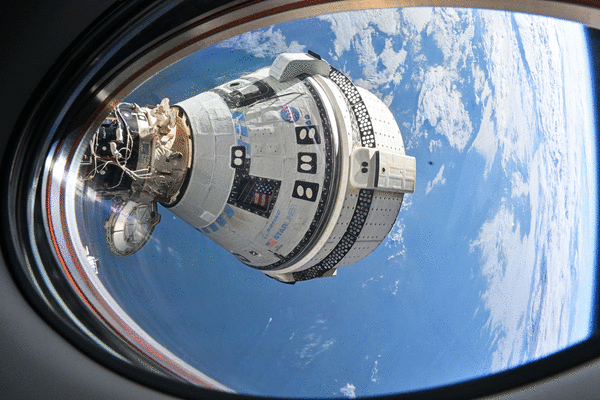
NASA is putting the botched 2024 test flight of the Starliner capsule in the same category of disaster as the Challenger and Columbia shuttle accidents, underscoring the dramatic failures that kept a pair of astronauts stuck in space for nine months.
The agency labeled the mission a “Type A” mishap in a scathing report, expected to be released as soon as Thursday, that delves into what happened during the Boeing Co. Starliner’s first crewed flight. The fates of Barry “Butch” Wilmore and Sunita “Suni” Williams captured the world’s attention as NASA frantically tried to decide how to bring them back from the International Space Station.
The 300-plus page report is fiercely critical of both NASA’s bureaucracy and Boeing, laying blame on one of the corporate pioneers of U.S. space missions, according to a copy seen by Bloomberg News. Faulty engineering, inadequate oversight and general mistrust between the parties helped turn a weeklong mission into a physical and mental ordeal for Wilmore and Williams that lasted much longer.
At the time of the incident, the U.S. manufacturer was already reeling from profound dysfunction at its civil aircraft business and constant competition in the booming market for space flights, with relative newcomer SpaceX putting its Dragon capsule into orbit numerous times before Starliner ever lifted off.
The report says NASA’s desire to maintain Boeing as a second company capable of launches to the ISS influenced decision-making and made the agency more willing to take risks.
“Advocacy exceeded reasonable bounds and placed the mission, the crew, and America’s space program at risk,” NASA Administrator Jared Isaacman will say in a letter to workers seen by Bloomberg News. “Disagreement over crew return options deteriorated into unprofessional conduct while the crew remained on-orbit.”
Investigators make 61 formal recommendations for what NASA and Boeing can do to prevent similar mistakes in the future. Congress will be briefed on the probe, which was conducted by agency employees and outside experts.
“We have to own our mistakes and ensure they never happen again,” Isaacman said about the report.
The mission “revealed critical vulnerabilities in the Starliner’s propulsion system, NASA’s oversight model, and the broader culture of commercial human spaceflight,” according to the report. Lessons from the mishap “must be institutionalized to ensure that safety is never compromised in pursuit of schedule or cost.”
The report’s timing comes as NASA prepares its Artemis II mission, which will send a crew of four astronauts around the moon for the first time in more than 50 years. Boeing is the prime contractor on the Space Launch System, or SLS, rocket that will loft the crew into orbit.
Boeing said it’s made substantial progress on corrective actions since the test flight and enacted “significant cultural changes” that align with the report.
Starliner’s test flight became an international sensation in June 2024, when it took off to the ISS for what was supposed to be a short flight to determine its viability for transporting astronauts.
But as the craft attempted to dock, it suffered failures with its thrusters — the tiny engines used to maneuver the capsule through space. The vehicle also was plagued by helium leaks and other technical issues throughout the mission.
Starliner was still able to dock successfully, but NASA decided it was too risky for the vehicle to bring Wilmore and Williams back to Earth. The space agency tapped SpaceX to bring them home instead, a decision that extended the astronauts’ stay until March 2025.
They eventually splashed down off the Florida coast with two other crew members. Starliner returned to Earth without a crew on board.
Wilmore, now 63, retired from the agency in August. Williams, now 60, retired in December.
Isaacman said in his letter the agency will continue working with Boeing because “America benefits from competition and redundancy.”
“But let me be clear: NASA will not fly another crew on Starliner until technical causes are understood and corrected,” he wrote.
Classifying this mission as a Type A mishap puts it in the same category as the shuttle disasters, the fire that killed three Apollo 1 astronauts and Apollo 13’s aborted moon landing. NASA has also declared these type of mishaps for uncrewed missions.
NASA uses this category if the mishap results in the death or permanent disability of a crew member; if the hull of a crewed vehicle comes apart; if there’s an unexpected departure from controlled flight; or if damages exceed $2 million.
Misfiring thrusters on the Starliner led to a partial loss of control and deviation from the planned flight, according to the report.
NASA’s Aerospace Safety Advisory Panel criticized the agency in December for not formally declaring the Starliner mission a mishap while it was still in progress. That fostered “an extensive — excessive, really — period of time where risk ownership and the decision-making authority were unclear,” the panel said.
The investigation also said NASA’s contract with Boeing employed a more hands-off approach, which wound up limiting the agency’s insight into Starliner’s development.
While it’s common for major aerospace programs to have some variations from their initial designs, the “engineering reality, however, is that Starliner with its qualification deficiencies is less reliable for crew survival than other crewed vehicles,” Isaacman said.
Since the failed mission, Boeing worked with NASA to do extra testing of Starliner’s thrusters in New Mexico, with the goal of still certifying the vehicle to perform regular, crewed missions to space.
NASA and Boeing aim to launch a cargo-only Starliner mission to the ISS as early as April.
©2026 Bloomberg L.P. Visit bloomberg.com. Distributed by Tribune Content Agency, LLC.






Comments