Venezuela's new amnesty law gets lambasted by freed dissident
Published in News & Features
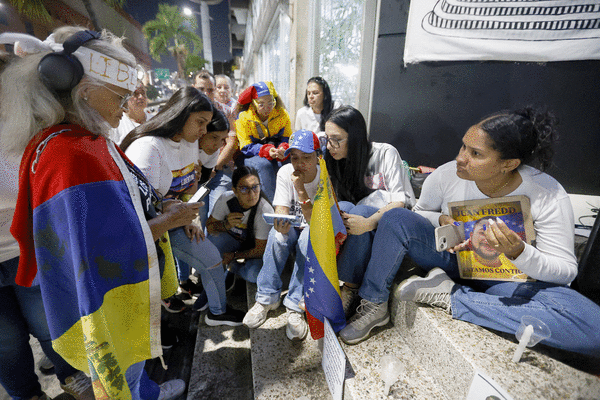
A leading Venezuelan opposition figure spoke out against a newly approved amnesty law shortly after he was released from house arrest Thursday, challenging a measure that could free hundreds of other dissidents but with carve-outs and judicial restrictions that limit its reach.
The legislation — which passed unanimously Thursday and was swiftly signed into law by acting President Delcy Rodríguez — doesn’t apply to those who promoted, supported or participated in “forceful actions” against the country and its people by foreign governments. Those are charges that the regime, over the last nearly three decades, has levied against opposition leaders to bar them from holding public office or send them to jail.
“This is a profound episode of reflection,” Rodríguez said from the presidential palace after signing the bill. It “shows Venezuela and the world what we’re capable of and of the selflessness that we’re offering as political actors with this law.”
She called on lawmakers and a “peace” committee to review cases not covered by the amnesty law and to issue appropriate recommendations aimed at “healing wounds.”
Venezuela’s National Assembly is expected to install on Friday a special committee of lawmakers, including former first lady Cilia Flores, to ensure implementation of the legislation, underscoring what critics describe as the potential for arbitrary application. U.S. forces captured Flores and her husband, former strongman Nicolás Maduro in a January raid on Caracas. Both are in U.S. custody in New York.
The law states that those seeking amnesty must obtain judicial approval, either in person or, if abroad, through a lawyer. That means that many would have to face judges who charged them or sent them to jail in the first place, in a court system that democratic observers have called corrupt under one-party rule.
Although the White House-backed interim government is lauding the measure as historic, the two provisions make the amnesty law a far cry from the type of sweeping legislation many democracy advocates had hoped for.
“When, in an amnesty law, those excluded number in the hundreds, the very purpose the law proclaims goes unfulfilled,” said Alí Daniels, director of Access to Justice, a Caracas-based nonprofit, in a post on X. “Unfortunately, that’s the case with the law that was passed.”
The opposition lawmakers, for their part, pushed back on the judicial requirement but ultimately voted in favor.
“Those who benefit from the amnesty shouldn’t have to undergo any restrictive procedures, but instead receive preferential treatment,” moderate opposition lawmaker Nora Bracho said during the debate.
Still, the opposition doesn’t hold enough seats in the assembly to have moved a vote in either direction. They ultimately threw their support behind the bill because of “commitment to the freedom of political prisoners and those who have been persecuted,” Bracho said.
Many Venezuelan remain cautious that the political changes will not endure, and that the ruling party is more focused on optics to convince the Trump administration of its cooperation.
Since the U.S. captured Maduro last month, Venezuela’s interim government has said it has freed nearly 900 people in a gesture of peace.
Independent organizations have verified about half that number and criticized the conditions of release. Many have said they remain subject to house arrest and other restrictions.
The amnesty law doesn’t automatically lift those conditions.
‘Reconciliation without truth’
A former lawmaker and close ally of Nobel Peace Prize laureate María Corina Machado, Juan Pablo Guanipa — who had been under house arrest after being re-arrested just hours following an initial release weeks ago — said overnight that he was now “truly free.” He called for the release of all political prisoners, the return of exiles, the closure of “torture centers” and the repeal of repressive laws.
What lawmakers approved “is not an amnesty,” he wrote in a lengthy post on X. “It is a half-baked document that seeks to blackmail many innocent Venezuelans and excludes several brothers and sisters who remain unjustly behind bars.”
Guanipa said he supports reconciliation, but only “with truth at the forefront.”
His high-profile case appears to be the first known outcome of the new amnesty law.
It remains unclear whether government-imposed bans on certain opposition figures like him from holding public office are still in effect, as the law does not explicitly address lifting those restrictions.
The State Department didn’t respond to a request for comment on the terms of the amnesty legislation.
In the new legislation, the opposition was able to notch some wins: The original proposal only applied to those arrested around nine political events, including the disputed presidential election in 2024. The approved version now applies to a dozen events, including a 2019 uprising spearheaded by a parallel government of opposition leader Juan Guaidó. While that incident included members of the military, they were explicitly excluded from the amnesty law.
Even when not explicit in the law, a committee of lawmakers will “correct” what Assembly President Rodríguez — brother of the interim president — acknowledged as “mistakes in the misuse of the anti-hate law,” partially meeting another demand by dissidents, their relatives and activists.
Courts must review amnesty requests within 15 days, and appeals are allowed. If approved, police and military authorities must end any criminal, civil and disciplinary actions for those covered, halt extradition requests and erase related records.
The law doesn’t apply to those charged with serious human rights violations, crimes against humanity, war crimes, intentional homicide, major drug trafficking and crimes against public assets.
Lawmakers also added a final article saying that those who benefit from the law and commit crimes after it enters into force shall be prosecuted.
©2026 Bloomberg L.P. Visit bloomberg.com. Distributed by Tribune Content Agency, LLC.





Comments