Trump boosts new tariff rate to 15% a day after announcing 10%
Published in News & Features
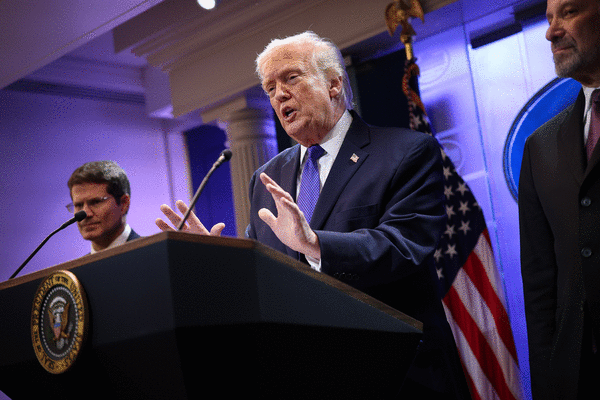
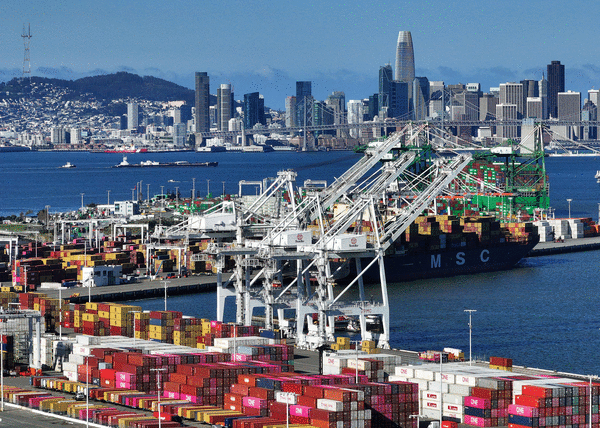

President Donald Trump said he will increase the global 10% tariff he announced one day earlier to 15%, stirring up more economic turbulence as he lashed out at the U.S. Supreme Court over its ruling that his preferred mechanism for applying tariffs was illegal.
“I, as President of the United States of America, will be, effective immediately, raising the 10% Worldwide Tariff on Countries, many of which have been ‘ripping’ the U.S. off for decades, without retribution (until I came along!), to the fully allowed, and legally tested, 15% level,” Trump said in a social-media post on Saturday.
Trump is rushing to preserve his trade agenda following the court’s ruling against his use of an emergency-powers law to impose his so-called reciprocal tariffs around the world and to use levies as a cudgel to bend foreign governments to his will. Enraged by the decision, Trump initially imposed a 10% global tariff on foreign goods on Friday, hours after the high court ruling, as he seeks to maintain the duties he insists are key to his economic and national security power.
But his post on Saturday made clear he had decided that 10% was not enough, even though he said on Friday, “Every single thing I said today is guaranteed certainty.”
The president’s efforts to restore and maintain the tariffs underscored the economic volatility ahead. The tools he is left with are less nimble than the sweeping authority he had claimed under emergency powers and will be subjected to fresh legal challenges.
Additional details were not immediately forthcoming on how soon the 15% tariff would go into effect. The initial 10% tariffs Trump announced on Friday were scheduled to go into effect on Feb. 24 at 12:01 a.m. ET, according to a White House fact sheet.
The White House and U.S. Trade Representative’s office didn’t immediately respond to requests for comment.
Trump is applying the new baseline tariff under Section 122 of the 1974 Trade Act, which allows the president to impose tariffs for 150 days without congressional approval. Securing that approval could prove challenging, as Democrats and some Republicans have opposed elements of his trade policy.
On Tuesday, Trump will face those lawmakers, as well as members of the Supreme Court, as he delivers the State of the Union address to Congress in Washington. The prime-time speech is expected to focus on his economic policies as Republicans try to land on a midterms message for an electorate that is frustrated by prices and the cost of living.
Last April, he relied on the International Emergency Economic Powers Act to levy duties ranging from 10% to 50% on dozens of U.S. trading partners. The Supreme Court ruled 6-3 Friday that Trump had acted unlawfully in using IEEPA to justify his “reciprocal” tariffs, saying his end-run around Congress was not justified in the Constitution.
Trump said Friday he would maintain a flat 10% tariff while keeping in place existing duties imposed under Sections 301 and 232, and ordered the U.S. trade representative to launch new Section 301 investigations on an accelerated timeline.
After he changed his mind on Saturday, a spokesman for the U.K. government, which had the lowest reciprocal tariff rate of 10%, said that “under any scenario, we expect our privileged trading position with the U.S. to continue and will work with the administration to understand how the ruling will affect tariffs for the U.K. and the rest of the world.”
Those probes require country-specific inquiries and findings of trade violations before tariffs can be imposed, and could eventually replace the baseline rate. He is also weighing tariffs of 15% to 30% on foreign cars, while preserving exemptions for goods and certain agricultural products under a trade agreement among the U.S., Mexico and Canada.
“We expect these investigations to cover most major trading partners and to address areas of concern such as industrial excess capacity, forced labor, pharmaceutical pricing practices, discrimination against U.S. technology companies and digital goods and services, digital services taxes, ocean pollution and practices related to the trade in seafood, rice, and other products,” U.S. Trade Representative Jamieson Greer said in a statement Friday.
The Supreme Court decision raises fresh questions about revenue that already has been collected on tariffs. More than 1,500 companies had filed tariff lawsuits in trade court in preparation for the ruling, according to a Bloomberg analysis.
The court ruling didn’t address whether importers are entitled to refunds, leaving the matter to lower courts — a potential exposure of up to $170 billion, or more than half the revenue raised by Trump’s tariffs. Trump criticized the justices for not offering guidance, but Treasury Secretary Scott Bessent said tariff revenue is expected to remain “virtually unchanged” in 2026 despite the ruling.
———
(With assistance from Ellen Milligan.)
©2026 Bloomberg L.P. Visit bloomberg.com. Distributed by Tribune Content Agency, LLC.



Comments