Feds say former North Miami mayor lived a 30-year lie, move to strip him of citizenship
Published in News & Features
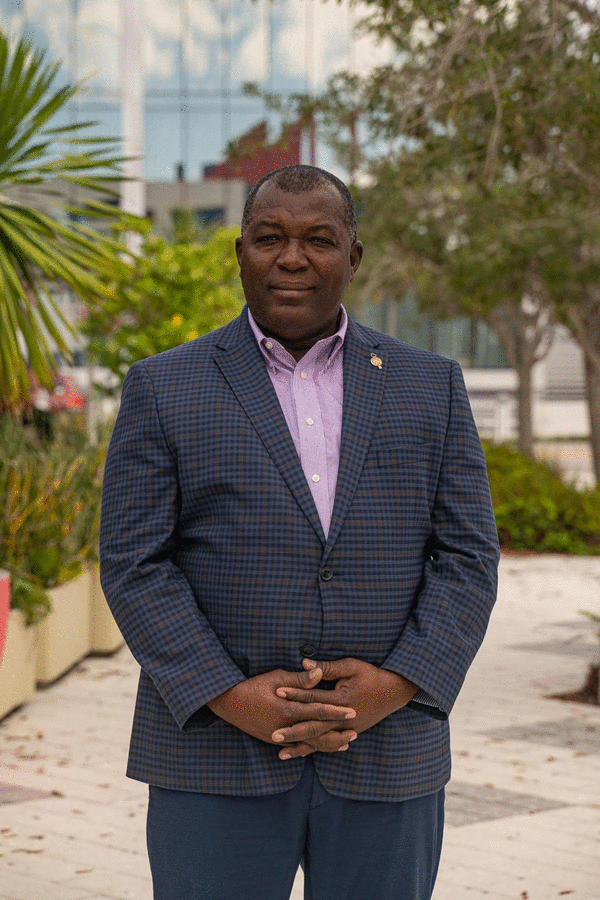
MIAMI — From the moment Philippe Bien-Aime stepped foot in the United States on July 25, 1995, immigration authorities, say the Haitian native has been living a lie.
The former mayor of North Miami arrived in the U.S. with his photo on someone else’s passport, authorities say in a federal lawsuit seeking to strip Bien-Aime of his citizenship. As part of his naturalization process, they add, Bien-Aime, 60, has lied about who and how many women he’s married and divorced and also about how many children he has had with them.
He used his original name, Jean Philippe Janvier, in a 2000 deportation case in which a U.S. immigration judge ordered his return to Haiti — though he never moved back to his country. Instead, he used a new name, Philippe Bien-Aime, on a naturalization application in 2005 after he married a U.S. citizen. He also used that name when he won the mayoral election in North Miami in 2019, after six years on the city council.
An immigration officer said in an affidavit filed in federal court in Miami this week that as part of the naturalization process, “Bien-Aime was not eligible to receive a visa as the spouse of a U.S. citizen because his marriage to the U.S. citizen … was bigamous and invalid” – pointing out that he lied about being divorced from his Haitian wife. “Bien-Aime was not legally free to marry” the U.S. citizen or allowed to attain an immigration benefit through a “bigamous marriage,” the officer said in the affidavit supporting the federal lawsuit.
Adding to the intrigue are court documents that say that, under the name Jean Philippe Janvier, he married Sarahjane Ternier, and under the name Philippe Bien-Aime, he married Beatrice Gelin — both on the same date, June 20, 1993, in Port-au-Prince.
A U.S. immigration summary of Haitian government records show that the marriage and divorce certificates for Janvier and Ternier were found to be fraudulent. Meanwhile, the Haitian divorce records for Bien-Aime and Gelin were also found to be fraudulent. The immigration summary, however, states that a marriage certificate for Bien-Aime and Gelin was found in Haiti’s National Archives but does not comment on whether it’s valid or invalid.
Court records show Bien-Aime asserted throughout his applications for a green card and for naturalization that he divorced Gelin on Dec. 30, 1999, and married Marie Rose Chauvet, a U.S. citizen, on May 30, 2001. Bien-Aime attained U.S. citizenship on Sept. 22, 2006.
The federal suit seeking his denaturalization accuses Bien-Aime of falsely telling authorities that “he has not practiced polygamy and has not given any false testimony to obtain immigration benefits.”
The decades of alleged deceptions and misrepresentations are at the heart of the federal government’s efforts to strip Bien-Aime of his American citizenship. The case is part of a larger, aggressive Trump administration campaign to catch immigrants who fraudulently obtain U.S. citizenship. The Department of Justice last year ordered its civil division to prioritize denaturalization, cases that have previously been rarely pursued.
“United States citizenship is a privilege grounded in honesty and allegiance to this country,” Jason A. Reding Quiñones, the U.S. Attorney for the Southern District of Florida, said in a statement. “The fact that he later served as an elected mayor makes the alleged deception even more serious, because public office carries a duty of candor and respect for the rule of law.”
Should U.S. authorities succeed in revoking his citizenship, Bien-Aime is facing deportation to native Haiti, a country in the throes of violence and instability.
U.S. officials were investigating the fraudulent marriage and divorce documents as early as August 2019, during President Donald Trump’s first term, according to an overseas verification report that also lists the Bien-Aime and the Janvier monikers. That was two months after Port-au-Prince-born Bien-Aime had been elected mayor of North Miami. Neither the first Trump administration nor the subsequent Biden administration pursued legal action against him.
To back up their allegations, the federal government provides a July 1965 certificate registering the birth of Jean Philippe Janvier; immigration applications where Bien-Aime does not list he had other names or mention one of his purported wives in Haiti and the children she bore him in the United States; a divorce certificate to the other woman in Haiti that they say is fraudulent; and his original deportation order from the early 2000s.
On a phone call Thursday, Bien-Aime declined to comment and referred The Miami Herald to his lawyer. His immigration attorney, Peterson St. Philippe, said he was not in a position to provide detailed comments.
“We believe it is appropriate to address the allegations through the judicial process rather than through public commentary. We trust that any reporting will reflect that the matter remains unresolved and that no findings have been made,” St. Philippe said.
Bien-Aime is no stranger to controversy. In 2018, a former North Miami city administrator filed a lawsuit against Bien-Aime and the city claiming he had sexually harassed her for months and “held her prisoner” in a car while trying “to have sex with her.” The aide said her contract with the city was terminated in retaliation for filing the federal suit against Bien-Aime, a councilman at the time.
Prosecutors say that U.S. authorities were not aware that the Jean Philippe Janvier whom an immigration judge had ordered deported was the Philippe Bien-Aime granted U.S. citizenship. On a campaign website, Bien-Aime said he was born and raised in Port-au-Prince, before immigrating to Canada in 1991 and arriving in the U.S. in 1993.
U.S. immigration authorities issued an identification number for Janvier on an unspecified date, according to court documents. They also issued an alien ID number for Bien-Aime in 1994, the documents show, which was before Janvier entered the United States in 1995 on the photo-switched passport in another person’s name.
Two years later, while Janvier was being served a notice to show up to deportation proceedings, the U.S. Embassy in Port-Au-Prince issued Bien-Aime a tourist visa, according to an affidavit from an immigration official who reviewed his records extensively. Bien-Aime entered the U.S. in June 1997 and kept traveling between the U.S. and Haiti while Janvier’s deportation proceedings were ongoing.
During three years of deportation proceedings, Janvier submitted a birth certificate with his name, testified that he was Jean Philippe Janvier and that he had used a fake passport. He welcomed a daughter with Ternier in 1999.
On July 31, 2000, an immigration judge ordered Janvier and Ternier deported. The couple challenged the decision through the Board of Immigration Appeals. But the next year, Janvier notified the court he was withdrawing his appeal and that he planned on living in Haiti. The board determined that his deportation order was final in July 2001. Janvier had another child with Ternier in 2002. The Department of Homeland Security set his departure date for June 26, 2003.
Instead of going back to Haiti, Bien-Aime married Marie Rose Chauvet, the American spouse, in 2001. Immigration authorities say that Janvier – under the name Bien-Aime – was still then married to another Haitian woman, Beatrice Gelin, who he claimed to have divorced. In 2002, he applied for a green card as Philippe Bien-Aime through his marriage with Chauvet. After he provided his fingerprints and was interviewed by immigration officers, the federal government granted Bien-Aime permanent residency.
In his green card application, he did not mention his deportation order and did not list any children. During his green card interview that same year, he mentioned one daughter he said was born in Haiti in 1999. Federal court records say he and Ternier had welcomed a daughter in the United States in August 1999.
Meanwhile, in the application to make his green card permanent he listed one son: Marc Peterson, born August 1988, and no other children, according to the federal complaint. In his subsequent application to become a U.S. citizen, he listed Marc Peterson again, but with a different birthday, June 1987.
Bien-Aime went on to have a third child with Ternier in 2004. Bien-Aime’s campaign website for an unsuccessful run for Miami-Dade county commissioner in 2022 described as “loving husband to Sara and proud father of Saphi, Philjae, and Terphil.”
He applied for naturalization in 2005, once more using his current name. During the interview process to become a naturalized citizen, Bien-Aime did not disclose other names and claimed to not be married to more than one person at a time. He was approved for citizenship on Sept. 11, 2006 and took the naturalization oath 11 days later.
Nearly 13 years after Bien-Aime became a naturalized citizen, a 2019 report out of U.S. immigration offices in Port-Au-Prince determined his marriage to Ternier and divorces to Ternier and Gelin were fraudulent. It also linked him to the Jean Philippe Janvier identity. At the time of the investigation, he was North Miami’s mayor.
Seven years later, in February 2026, the U.S. government moved to denaturalize him.
©2026 Miami Herald. Visit miamiherald.com. Distributed by Tribune Content Agency, LLC.






Comments