Savannah Guthrie offers $1 million for information about mother, says she might be 'already gone'
Published in News & Features
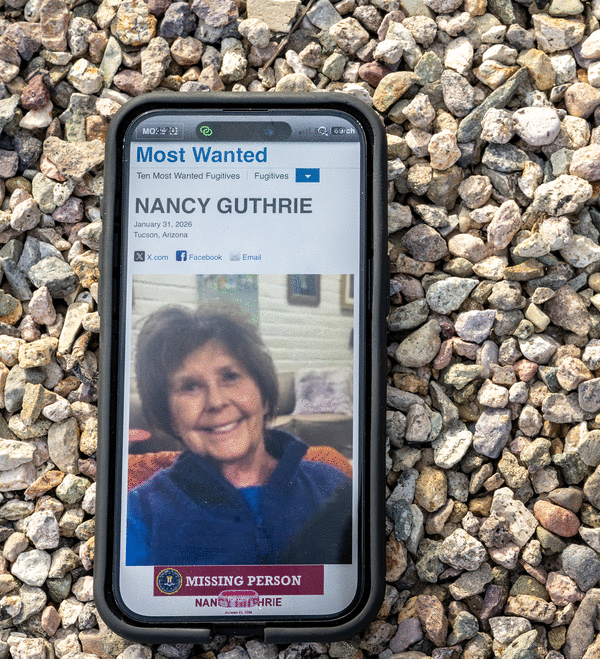
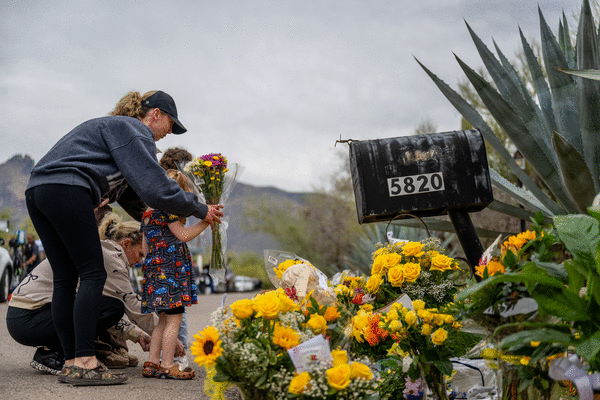


Savannah Guthrie said Tuesday her family is offering a $1 million reward for information leading to her kidnapped mother, saying it’s possible Nancy Guthrie is “already gone.”
“But we need to know where she is. We need her to come home. For that reason we are offering a family reward of up to $1 million for any information that leads us to her recovery,” the ‘Today’ host said in a video.
The video comes amid signs the investigation is growing cold.
Despite more than 20,000 tips, the investigation appears to be cooling and the paths to solving the Feb. 1 kidnapping of Nancy Guthrie could be narrowing.
Officials insist the investigation is still in full force and that they have some solid clues: Her blood drops on the doorstep. Her suspected abductor snatched the front door Nest camera, but not before it captured the ski-masked armed man with a backpack lurking on the porch and trying to cover the lens with his gloved hand. More than a dozen gloves have since been recovered in the surrounding community, including one authorities say matched that worn by the person in the video.
Guthrie, the mother of “Today” show co-anchor Savannah Guthrie, vanished from her Arizona home more than three weeks ago and there is still no person of interest, no suspect or even a description of a kidnapper’s getaway car.
But so far there have been no DNA matches with known criminals in the federal database.
Ransom notes came after the Feb. 1 kidnapping, but no proof that the Guthrie was alive followed. Locals were detained and quickly released as investigative leads dried up.
Still, experts say it’s far too early to call this a “cold case” and noted a break could come at any moment.
But the paths to finding Guthrie and her abductor are limited:
1. Forensic evidence
Investigators could get a scientific breakthrough with DNA evidence.
Sheriff’s investigators say they are still checking DNA from the gloves recovered in the area and Guthrie’s home, which was searched after the 84-year-old grandmother failed to show up on a Sunday to her church group and a missing person’s case became the nation’s biggest kidnapping drama in decades.
Nanos and his department have said there are multiple DNA strands mixed from the home — meaning two or more persons — and “there can be challenges separating DNA.”
A glove was found two miles from the scene that authorities say it appears to match the pair worn by the masked man. But the DNA found on the glove did not match any in the Combined DNA Index System, which has more than 19 million offender samples nationwide.
Investigators haven’t said how much weight they are giving to specific pieces of evidence. Still, experts say anything with Guthrie’s DNA discovered outside the home may also contain her abductor’s DNA.
“We believe that we may have some DNA that may be our suspect, but we won’t know that until that DNA is separated, sorted out, maybe admitted to CODIS, maybe through genetic genealogy,” Nanos told NBC News.
2. Familial DNA
Genetic genealogy is most famous for apprehending the Golden State Killer, Joseph James DeAngelo Jr., known for serial rapes and murders in the 1970s and 1980s in California. The technique, known as forensic investigative genetic genealogy, incorporates public genealogy websites with DNA analysis. The National District Attorneys Assn. heralded it as a “new era in crime solving.”
With FIGG, authorities can compare DNA collected from Guthrie’s home with publicly accessible databases containing the genetic profiles of millions of people who have given them over for family history research and other reasons. From there, investigators can sometimes find distant relatives to help piece together a family tree that can point to a suspect, said CeCe Moore, a genetic genealogist and co-founder of DNA Justice.
In the Golden State Killer case, investigators retrieved old DNA processed in the Ventura County crime lab connected to one of his crimes. Instead of processing it on CODIS, they used another part of the DNA to search for potential relatives of the unknown killer in ancestry databases.
If the person has a long family history in the United States, it’s a bit easier for investigators to use genetic genealogy, Moore added, because there’s more representation in the databases that law enforcement can access.
However, law enforcement does not have easy access to the roughly 50 million genetic profiles contained in Ancestry.com, 23andMe and MyHeritage databases. Those companies have barred authorities from accessing such information and said they would release it only if compelled by a court order or warrant.
Databases GEDmatch, FamilyTreeDNA and DNA Justice are open to law enforcement use but contain fewer than 2 million genetic profiles, Moore said.
“Cases with Latin American subjects are incredibly difficult,” she said. “Mexico is typically a little bit easier because we have more representation in the database from Mexico than any of the other Latin American countries. But still, because we’re limited to the smallest databases, which are less than 2 million profiles, it’s going to be quite difficult, unless they just get lucky.”
Investigators can also run familial searches on the CODIS system, where relatives of the suspect may have been placed. Such a search is legal in Arizona.
3. Evidence breakthrough
Identifying the suspected kidnapper: FBI agents have already identified the masked man’s backpack as a 25-liter Ozark Trail Hiker Pack sold at Walmart, which is now working to assist investigators. The masked assailant’s gun holster, slung between his legs, is what law enforcement terms a universal fit holster and is ill-fitted for a much larger gun. Retired LAPD Capt. Paul Vernon, who oversaw homicide probes, said the style of carry may be familiar to some at a gun range, and investigators will be pursuing the carry method as a signature part of the man’s behavior. Once law enforcement identifies the man’s specific clothing, weapon, and the carry holster, it may trigger someone’s memory and generate a vital tip, Vernon said.
On Monday, the Pima County Sheriff’s Department addressed reports that there may be video of the suspect at Guthrie’s door on a day prior to her abduction, saying it was inconclusive.
“We are aware that doorbell images released earlier in the investigation depict a suspect in different stages of attire, including with and without a backpack,” the department statement said. “There is no date or time stamp associated with these images. Therefore, any suggestion that the photographs were taken on different days is purely speculative.”
Cellphone pinging: Investigators, particularly those with FBI technical units, will use geo-fencing to scour the cell towers around Guthrie’s home for cellphone users. They will seek to separate out the phones that aren’t usually there. Even if a kidnapper carries a disposable phone with prepaid minutes, also known as a “burner,” investigators will want to identify the phone and see if they can trace its past movements. In a Los Angeles County jewelry heist, investigators last year linked a burner phone from a traffic accident to the heist location and to other crimes. Vernon said that if you identify a phone, it’s possible to see if it pings along a route, say, along the highway from Tucson toward the border.
Cameras: The investigation is also continuing to try to retrieve other data from cameras around Nancy Guthrie’s home. Detectives have asked residents of the Catalina Foothills neighborhood where Guthrie lived to submit any suspicious behavior captured on security cameras for the entire month before the abduction. Initially, they asked specifically for any videos related to Jan. 11. Authorities haven’t said whether they have evidence that the perpetrator may have surveilled the home before the kidnapping. But it is not uncommon for burglars, robbers and home invaders to be seen on surveillance of a crime in the weeks before, law enforcement experts say.
©2026 Los Angeles Times. Visit at latimes.com. Distributed by Tribune Content Agency, LLC.






Comments