Haiti prime minister overhauls cabinet as he pushes toward year-end elections
Published in News & Features
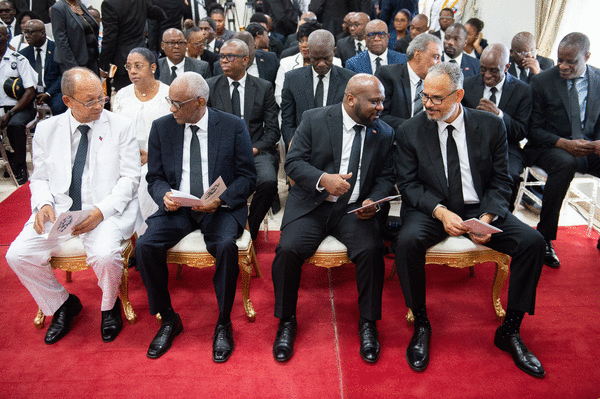
Haitian Prime Minister Alix Didier Fils-Aimé unveiled a major reshufflng of his cabinet on Tuesday, retaining just five ministers in a new government largely consisting of untested figures endorsed by political parties and groups that recently signed a sweeping national accord.
In welcoming the group during a swearing-in ceremony, Fils-Aimé made an impassioned appeal for civic engagement in Haiti and insisted on the need for his new cabinet to take resolute action.
“The time for fine speeches is over. Today is the time for action,” he said, as he urged his new ministers to “adopt sound, rigorous, and transparent management of public resources.”
Among those who managed to keep their jobs: the ministers of health, interior, trade, women’s affairs and justice and public security. But 11 new ministers and two secretaries of states are now part of the new government, including the new minister of foreign and religious affairs, Raina Forbin.
Forbin, who accompanied Fils-Aimé to the Caribbean Community’s regional summit in Saint Kitts and Nevis last week, previously served as chief of staff for Transitional Presidential Council coordinator Laurent Saint-Cyr. Saint-Cyr represented the private sector on the beleaguered entity before its term expired on Feb. 7.
One recognizable figure in the new lineup is Mario Andrésol, the country’s former police chief. A onetime captain in the Armed Forces of Haiti, Andrésol will now take on the challenge of leading the ministry of defense and its 1,000 enlistees. The institution, which recently received a financial boost from the U.S. Congress for nonlethal assistance, had been strained by internal discord and allegations of corruption.
Andrésol’s steps into the job as security forces continue to intensify their fight against armed gangs and the country prepares for the deployment of the first military contingents of the United Nations' authorized Gang Suppression Force.
The cabinet changes come on the heels of both a political pact, recently signed by parties with the prime minister, and the launching of the registration process for those seeking to run candidates in the next elections. That process was opened on Monday by the Provisional Electoral Council at its central office in Pétion-Ville, and will continue until March 12.
As the lone leader in Haiti after receiving the support of the U.S., Canada, France and the United Nations, Fils-Aimé has his work cut out for him. In a frank interview, Canada’s ambassador to Haiti, André François Giroux, made clear the international community is expecting results.
“With more powers come more responsibilities,” Giroux said in an interview on Port-au-Prince Magik 9 when asked if the prime minister had a blank check. “I know he is fully aware of that, but I can tell you from our side, the only thing … what has guided and will continue to guide Canada’s engagement and action is the well-being of the Haitian people, their security, and their constitutional right to choose their leaders.”
Elections by year’s end
Last week, as he met with Caribbean leaders, Fils-Aimé said he hopes to have the first round of elections by the end of the year. Asked whether he plans to run, he said no, citing the political pact, which he says bars him from being a candidate. Fils-Aimé called the pact “an important milestone.”
“We have over 200 political parties, civil society, private sector, that did sign with the government an accord that we will fight for security together, and we will go to the election by the end of the year,” he said of the National Pact for Stability and the Organization of Elections.
“We have found agreement between Haitians, and we have decided that we are moving forward. Elections will be held as soon as we get all the security wins necessary,” he said.
Fils-Aimé was among a small group of leaders who met with U.S. Secretary of State Marco Rubio during the CARICOM conference. During the talks, he emphasized the need for Haiti to achieve baseline security.
“This situation has been happening for over five years. We are doing our best to resolve the gang issue,” he said.
Among the key elements in the recently signed pact is the revival of the National Commission for Disarmament, Dismantling and Reintegration of gang members. The prime minister says the program, which was shelved in May 2025 by the transitional council after a controversial appointment, will be structured in three phases.
“One phase will be the police and the army and the (Gang Supression Force) that that was voted by the U.N. last year, that will fight the gangs,” he said. “The second part will go through the justice system. People will have to be arrested, people will be judged, and people will go to jail. And the third part of the security will come (from) the reinsertion of the youth that was pulled into the gangs; the youth that was used by gangs… whether they are boys, young boys or young girls, they need to be taken to centers.”
The renewed push comes as the U.N. issues a stark report detailing the exploitation of children by armed groups in Haiti. The report describes children being used to run errands, monitor security forces and collect extortion payments, as well as to participate in kidnappings, targeted killings and sexual violence.
Factors such as poverty, weak institutions and social exclusion, coupled with surging armed violence, have created an environment where children are increasingly at risk of being trafficked by gangs.
“This risk is particularly acute for children from extremely poor and marginalized families, as well as those living on the streets or in displaced persons’ sites,” Marta Hurtado, spokesperson for the Office of the U.N. High Commissioner for Human Rights, said after the report was released.
The report also found sounded the alarm on how children trafficked by gangs are often seen not as victims but as perpetrators by law enforcement. In some circumstances, some children accused of gang association have been summarily executed by police officers or killed by so-called self-defense groups, the report stressed, calling for a comprehensive, human rights-centered strategy to address the crisis.
William O’Neill, the U.N.’s independent human-rights expert who arrived in Haiti on Monday for meetings with the government and others, said the report leaves no doubt about the dangers children in Haiti face.
“Not only do children face forced recruitment by gangs, but also tens of thousand don’t have enough to eat, can’t go to school or to a doctor and have little access to clean water. And they face a bleak future of unemployment and deepening poverty,” he said.
“Haiti is one of the most dangerous places in the world to be a child.”
_____
©2026 Miami Herald. Visit miamiherald.com. Distributed by Tribune Content Agency, LLC.




Comments