Condor couple may be tending to first egg in Northern California in a century
Published in News & Features
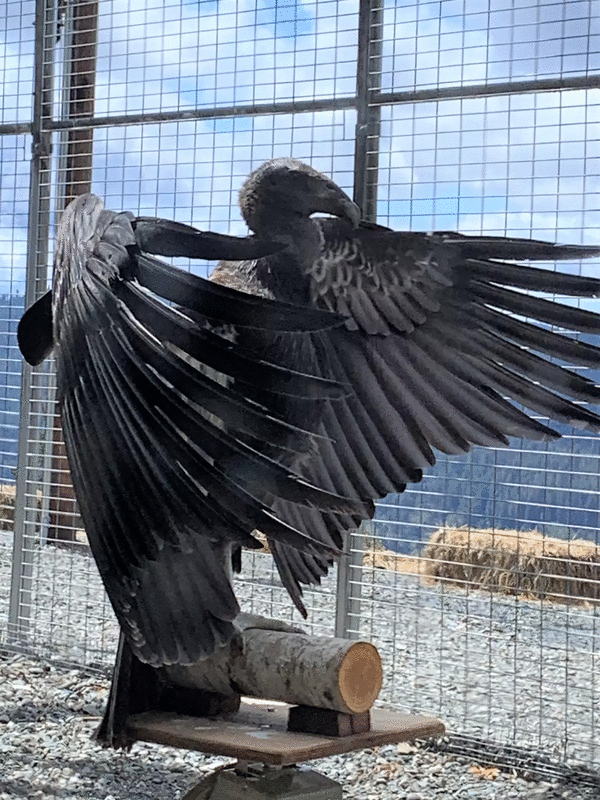
A California condor known as Ney-gem’ ‘Ne-chweenkah’ — Yurok for “She carries our prayers” — has been flying to a particular spot deep inside Redwood National Park, near Klamath.
Then she leaves and another — nicknamed ‘Hlow Hoo-let’, or “At last I (or we) fly!” — has been arriving.
Yurok wildlife officials say this behavior suggests the pair are tending to an egg in the tribe’s Northern California homeland, where they haven’t nested for more than a century.
“This is a big step, and a necessary step, to seeing recovery on the North Coast,” Yurok Wildlife Department Director Tiana Williams-Claussen said.
Condors vanished from the state’s North Coast after the arrival of European settlers, who killed other animals with lead bullets and strychnine — poisoning the raptors that feed on carrion. Others shot the bald vultures, whose wings can span 9 1/2 feet and who can live more than 50 years.
It wasn’t just a regional problem. By 1982, there were only 22 condors left in the world. Five years later, all the remaining wild condors were captured and bred in captivity to try to stave off extinction.
The pair believed to be nesting in Yurok country were captive born and released in 2022, as part of the first group reintroduced in that region.
Condors are typically released when they’re 1 1/2 to 2 1/2 years old, and generally don’t start breeding until they’re 6.
The pair, formally known as A1 and A0, are the oldest birds from their release cohort at nearly 7 years old — and the only ones old enough to reproduce.
According to wildlife officials, the couple may have laid an egg in early February, based on their activity tracked by GPS devices affixed to them.
The egg cannot be seen or confirmed because the presumed nest is too remote.
It’s tucked in an old-growth redwood tree in the backcountry of the park, in Humboldt County, where there are no roads and a creek presents an impassable barrier, Williams-Claussen said.
Condors generally nest every other year, and lay one egg at a time. Parents take turns incubating the egg, which is highly sensitive to temperature. Even a short loss of warmth can lead to death.
Early April is the soonest the light-blue, roughly 10-ounce egg could hatch.
Hopes are high but tempered; often a condor couple’s first egg doesn’t survive because they’re still figuring out the care process.
If the condors stop coming to the nest, it will suggest it failed.
Even if the egg hatches, it could be a while before scientists can confirm a chick is there. It takes six or seven months for condors to fledge, or take their first flight from the nest.
More than two decades ago, the Yurok Tribe decided they wanted to bring condors back to their ancestral territory in Humboldt and Del Norte counties, according to Williams-Claussen.
In 2008, they received funding from the U.S. Fish and Wildlife Service to develop a feasibility study, kicking off a 14-year process that unfolded before the vultures graced the skies in the region again.
“We consider ourselves to be world renewal people, or fix-the-earth people, whose primary purpose is to keep the world in balance,” Williams-Claussen said. “Post-American contact ... our world became very out of balance, ecologically and culturally.”
The condor ties to that ethic.
In Yurok creation stories, “it was Condor who provided a song that we sing” in what are known as world renewal ceremonies, she said. Condor also plays a role in carrying prayers for world renewal across the globe during the ceremonies.
News of the recently documented breeding behavior has excited condor conservationists beyond Yurok country.
Estelle Sandhaus, director of conservation and science at the Santa Barbara Zoo, called it “a signal of hope” for a population to be established in Northern California, part of their historic range.
The Yurok-managed condor release program is the newest of its kind and the birds are relatively young, she said.
Releases in Southern California, Central California, Mexico and the Southwest have led to nesting populations in the past, but this would be a first for Northern California.
“As a biologist, when you look at reintroduction of a species, you look at survival, you look at adaptation on the landscape (and) you definitely look at breeding,” she said. “That is a key milestone, and when it happens, it’s reason for celebration.”
There are now more than 200 condors flying freely in the Golden State, including roughly 100 in Southern California.
However, the vultures aren’t yet out of the woods. Lead poisoning is the top threat, and most flocks remain dependent on captive breeding.
“We must get the lead poisoning down,” Sandhaus said. “That is the path to recovery.”
©2026 Los Angeles Times. Visit at latimes.com. Distributed by Tribune Content Agency, LLC.






Comments