Witness: Colombian recruited in plot to kill Moïse was executed by Haitian police
Published in News & Features
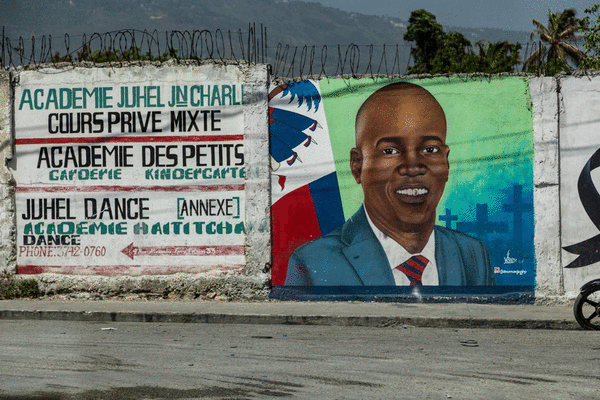
MIAMI — The smell of gunpowder hung in the air as Haitian police opened fire with .50-caliber rifles, trapping a group of Colombian commandos not far from the hillside house where President Jovenel Moïse had just been assassinated.
As Sgt. Edwin Blanquicet Rodríguez, an American-trained soldier who spent 21 years in the Colombian army, tried to find refuge, he could hear an injured fellow soldier inside a house pleading for his life.
“We could hear him begging to please not kill him,” Blanquicet said.
Then came footsteps, followed by a gunshot.
The man was Duberney Capador Giraldo, a retired Colombian army officer trained in counterterrorism whom Haitian authorities described as co-leader of the commandos. Capador was one of four suspects Haitian national police later said they killed during their manhunt for the president’s assassins.
A central figure in the plot, Capador led the team of Colombian guns-for-hire who ended up jailed and accused of killing the president on July 7, 2021. The crew of 20-plus had traveled to the country to work at a hydroelectric plant in the seaside town of Jacmel, Blanquicet said, only to be taken to a hotel upon their arrival in Port-au-Prince and told they would be providing security to a VIP in Haiti.
The VIP was Christian Emmanuel Sanon, a Haitian physician who lived part-time in Florida and styled himself as the successor of Moïse, whose presidential term was supposed to have ended in February 2021, according to Haitian government critics and constitutional experts, and who became the subject of protest and a foiled coup plot.
As the Miami federal trial over Moïse’s assassination began with jury selection on Monday, newly released testimony from Blanquicet reveals fresh details about the chaotic hours after the president’s killing as well as the apparent execution of Capador. U.S. District Judge Jacqueline Becerra questioned more than 100 potential jurors in the case, in which FBI and Homeland Security Investigations agents will testify and the role of Haitian police will come under scrutiny.
“They shot Capador in the head as the coup de grâce,” Blanquicet said in a deposition he gave to lawyers in December, accusing one of the president’s chief security officers of killing the Colombian former soldier.
Blanquicet’s account of what happened to Capador, who was accused of using a ruse to recruit Colombian former soldiers for the operation, is among several new details emerging ahead of the trial. His testimony is among nearly 1,500 filings in the government’s murder-conspiracy case in which Sanon and four others are accused of participating in a conspiracy to kill a foreign head of state.
Defense lawyers will try to show that the Colombian soldiers went to Moïse’s house in the middle of the night to arrest him and remove him from office, not to kill him. They will also try to show that by the time the Colombian crew arrived at the president’s home, he had already been killed – possibly by Haitian police officers and presidential guards.
“The intention of the police was to kill all the Colombians and not leave a shred of evidence,” Blanquicet said, describing the day he and others allegedly stormed Moïse’s residence and fatally shot him in his bedroom.
Prosecutors will present a much different version of the events. In a recent court filing, prosecutors said, “The surviving victims of the Moïse family confirm that his assassins were a group of Spanish-speaking men who stormed into their home with automatic weapons and murdered him.”
The government asserts that one of the accused, a former Colombian special-forces soldier named Victor Albeiro Pineda Cardona, known as “Pipe,” was hired by Miami defendants Arcangel Pretel Ortiz, Antonio “Tony” Intriago and Walter Veintemilla. Pineda was allegedly a member of the “Delta team” that Haitian investigators say was tasked with entering the president’s bedroom and later asked by Capador to provide a photo of Moïse’s corpse.
Federal prosecutors say Pineda traveled with James Solages, another one of the Miami defendants, to Moïse’s house “with the objective of killing the president.”
“Ballistic forensic evidence confirms these facts,” prosecutors said in the court document. “Bullets or bullet fragments from both Moïse and his wife Martine Moïse ... match an AR-15 assault rifle that belonged to the Colombian mercenaries and in particular the so-called ‘Delta’ team assigned to kill Moïse.”
‘They did not want us to surrender’
During his deposition, Blanquicet said he believes Haitian authorities never meant to take them alive.
“If we were asked, we all would have surrendered,” he said. “They did not want us to surrender.”
The former soldier also said Haitian police mentally and physically tortured the Colombian suspects after they were taken into custody.
Moise’s gruesome killing occurred around 1:30 in the morning. The Haitian national police’s manhunt, Blanquicet said, started at around 3:30 p.m., more than 12 hours later. Blanquicet said he was unarmed at the time, and tried to seek refuge as officers fired machine guns.
“They had rifles. ... There was one attack with hand grenades,” he said.
When he finally decided to surrender, Blanquicet said he was nearly killed after asking a civilian to get the police so he could turn himself in.
“The police came, but they did not offer me any kind of safety for my life,” he said. “Basically the police unleashed the population on me.”
He said he suffered dozens of machete blows, including 17 hacks on a hand that he’s now at risk of losing. He also suffered a skull fracture.
The Colombians’ treatment before and after their arrest has been the subject of human-rights complaints.
Were Colombians set up?
Blanquicet also told lawyers that he believed the group had been set up to take the blame for the real killers.
He said as the convoy approached Moïse’s home in the Pélerin 5 neighborhood of Pétion-Ville, above the capital, he heard gunfire. After arriving inside the neighborhood, he also saw four individuals running from a house.
“I found it strange because they were in combat formation,” he said, adding that there was also a drone overhead. “When I told Mr. Capador that there were some people coming out from the rear of the house that was dark, he tells me to go ahead and go inform the people that were ahead to be very careful.”
Blanquicet said that when he went to warn the other Colombians, they were all outside and had not entered the president’s home. Whether anyone eventually did, he said, he did not know because Capador ordered him to leave.
He said when he went to inform the Colombians of what he had seen, they were all outside and had not entered the president’s home.
As he headed down the mountain, the group was ambushed, he said.
“From the time we went down the mountains to the time we arrived to that place, the setup that was there really tells you that it had been organized and set up and took a long time to be set up that way,” he said.
Capador’s role
Blanquicet first publicly spoke about his role in the assassination in a June 2022 interview from the Port-au-Prince National Penitentiary, where he insisted on his innocence. He again did so in the deposition with lawyers, telling them, “If this is going to cost my life here in Haiti, then I will give my life for the truth to be known.”
In the deposition, Blanquicet said Capador recruited him with a phone call on June 3, 2021, while he was having lunch with his children. The two did not know each other even though each had spent 21 years in the Colombian military.
“I met him for the first time here in Haiti,” Blanquicet said.
Blanquicet said he was offered work with two companies, Doral-based CTU Security and Miramar-based Worldwide. He said Capador and Intriago, the owner of CTU Security, told him the companies “worked for the Department of State and the FBI.”
U.S. authorities have denied the assertion that any U.S. government agencies were involved.
The job paid $2,800 and was supposed to involve work in Central America. Capador “never mentioned Haiti,” Blanquicet said.
Blanquicet arrived in the Dominican Republic on June 4, 2021. During a video call with Capador and Germán Alejandro Rivera Garcia, a retired Colombian army officer who has pleaded guilty in the case and is expected to testify for prosecutors, Blanquicet said he “found out” he was going to Haiti.
He was informed that an officer from the Haitian embassy was asking for their passports. The passports were taken and returned later that day, he said.
In all, 20 men traveled by bus from the Dominican Republic to Haiti. Capador instructed them to say, if questions, that they were on a missionary trip.
Once in Haiti, they joined four other Colombians who had arrived by plane. On the night of the deadly assault, Blanquicet said he was among the last to arrive at a mountaintop house where the group had gathered with Haitian police who were to escort them. Because there weren’t enough guns, he said, he remained unarmed.
In the four weeks he was in Haiti, Blanquicet said he “didn’t have any weapon at any time.”
Haitian police later showed him a photo of Joseph Félix Badio, a key suspect in the assassination who was finally apprehended in October 2023 after more than two years in hiding.
While defense attorneys described Badio as a former justice ministry official, Blanquicet said he had been introduced as the “prosecutor” the night he met him and he was supposed to accompany the team to the president’s residence.
During a court proceeding in Haiti where Blanquicet and dozens of others are challenging an indictment issued by a Haitian investigative judge, Blanquicet said Badio described himself as “a government official.”
As the convoy made its way toward Moïse’s home, Blanquicet said he and others passed through several checkpoints escorted by Haitian police.
At one point, he said, something unusual caught his attention. Haitian police and the Colombians shook hands.
Asked what he made of the exchange, and noting that not one Haitian police officer was wounded or killed during the assault, Blanquicet said it seemed like the police were part of a setup.
“It seemed like everything had been planned previously,” he said. “It was like a staging, like a theater.”
_____
©2026 Miami Herald. Visit miamiherald.com. Distributed by Tribune Content Agency, LLC.




Comments