SpaceX lines up Monday night launch of a pay-TV satellite
Published in News & Features
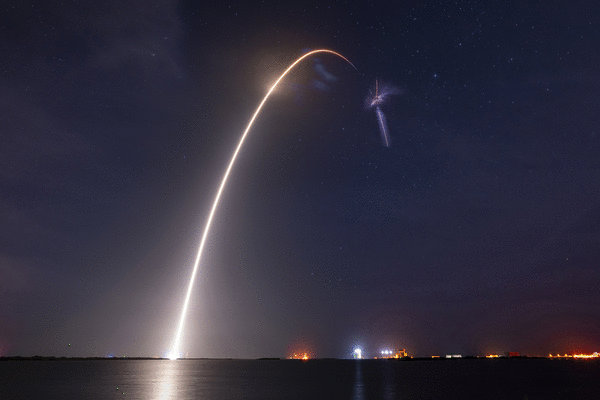
Every now and then, SpaceX has a customer other than itself including a planned launch Monday night that won’t be the company’s Starlink satellites. Instead, it’s looking to send a pay-TV satellite to space for EchoStar Corp.
A Falcon 9 rocket on the EchoStar XXV mission is aiming to send the communications company’s satellite to a geosynchronous transfer orbit after launching from Cape Canaveral Space Force Station’s Space Launch Complex 40 during a 149-minute window that opens at 11:19 p.m. Eastern time.
Space Launch Delta 45’s weather squadron forecasts a 90% chance for good conditions at the launch site, which improves to 95% in the event of a 24-hour delay.
The first-stage booster for the mission is making its 14th trip to space, and will aim for a recovery landing downrange on the droneship A Shortfall of Gravitas.
EchoStar’s business includes a variety of telecom brands including Boost Mobile, Sling TV and DISH TV.
The EchoStar XXV is the first of two new satellites constructed by Lanteris Space with the follow-on satellite, EchoStar XXVI, not set to launch until 2028. The two have driven the majority of more than $450 million in construction costs in 2025, according to its most recent quarterly report. The company earned $15 billion in the most recent quarter and has 7 million pay-TV subscribers, including 5.02 million DISH TV subscribers and 1.98 million Sling TV subscribers.
This marks the 17th launch of the year on the Space Coast, with all but one coming from SpaceX.
Of SpaceX’s 15 previous launches, all but two have been to proliferate the company’s growing Starlink constellation, which has since 2019 had than 11,400 satellites flown into orbit, according to statistics maintained by astronomer Jonathan McDowell. Of those, nearly 10,000 are still in orbit.
The other two SpaceX launches from Florida were the lone crewed mission of the year, Crew-12, in February and the national security NSSL GPS III mission in January.
United Launch Alliance flew the only non-SpaceX mission on the Space Coast this year with its Vulcan rocket, for what the company had originally hoped would be a busy launch year approaching 20 missions. A problem with one of Vulcan’s boosters though, has delayed further missions of its new rocket, although it has several of its remaining Atlas V rockets available to launch still.
Blue Origin, which launched its New Glenn rocket twice in 2025, could be headed back to the launch pad for its third mission this month.
Meanwhile, NASA’s Space Launch System rocket continues to be worked on at Kennedy Space Center’s Vehicle Assembly Building, with a flight readiness review slated for Thursday before it can be returned to Launch Pad 39-B for the crewed Artemis II mission slated for no earlier than April 1.
________
©2026 Orlando Sentinel. Visit at orlandosentinel.com. Distributed by Tribune Content Agency, LLC.






Comments