Hegseth threatens 'most intense day of strikes' as Iran war injures about 140 Americans
Published in News & Features
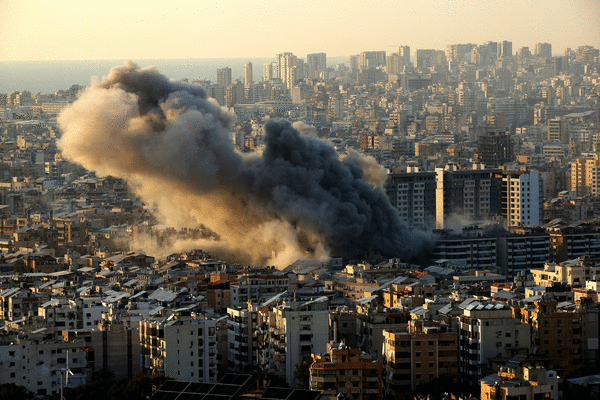
WASHINGTON — Some 140 American service members have been wounded since start of the Iran war, with eight of them "severely injured" and receiving medical care, the Pentagon said Tuesday.
"The vast majority of these injuries have been minor, and 108 service members have already returned to duty," Pentagon spokesperson Sean Parnell said in a statement.
The casualty toll adds to the seven American troops killed so far in the war, which entered its 11th day with no clear sign of slowing down as U.S. officials indicated the military campaign was likely to intensify.
Iran, too, took new actions that could escalate the conflict, reportedly laying mines in the Strait of Hormuz, a potentially devastating development for the global energy market.
Trump said that if Iran put mines in the Strait and did not remove them immediately, the U.S. military would hit Iran "at a level never seen before."
"If, on the other hand, they remove what may have been placed, it will be a giant step in the right direction!" Trump wrote on Truth Social.
The warning was yet another escalation that came after Defense Secretary Pete Hegseth said Tuesday would bring the "most intense day of strikes" inside Iran, a fighting tempo that is at odds with President Trump's own assessment that the war is "very complete" and that it could end "very soon."
At a Pentagon news conference, Hegseth said "the most fighters, the most bombers, the most strikes" would be deployed, but declined to say how much longer U.S. forces would be expected fight in the region. He instead said the president will be the one to "control the throttle."
"It's not for me to say whether this is the beginning, the middle, or the end. He will continue to communicate that," Hegseth told reporters.
That deference places the focus squarely on Trump, who a day earlier delivered mixed signals about the duration of the war, telling reporters at one point that the war is "very much complete" and a later time that it is "the beginning of building a new country."
At a briefing on Tuesday, White House Press Secretary Karoline Leavitt said the U.S. military was "way ahead of schedule" of reaching its objectives in Iran, but reiterated that the president alone will decide what victory looks like.
"President Trump will determine when Iran is in a place of unconditional surrender and when they no longer pose a credible and direct threat to the United States of America and our allies," Leavitt said.
The president's shifting positions on the war's conclusion have played out as Trump threatens to hit Iran "twenty times harder" if it attempts to halt the flow of oil in the Strait of Hormuz, a key channel for the world's oil supply — and as Democrats in Congress says they are growing concerned about the possibility of Trump sending U.S. ground troops inside Iran.
"We seem to be on a path toward deploying American troops on the ground in Iran to accomplish any of the potential objectives here," Sen. Richard Blumenthal, D-Conn., told reporters after being briefed on the Iran war.
When asked about Democrats' concerns, Leavitt said Trump "wisely ... does not rule options out as commander-in-chief."
"I would hesitate to confirm anything that a Democrat says right now about the president's thinking," she added.
U.S. says Iran's fire power is diminishing
As Washington plans out its next steps, the war has shown little signs of slowing. U.S. military officials say Iran's military capabilities are eroding under sustained strikes that have targeted "deeply buried missile launchers" and made "substantial progress toward destroying" Iran's navy.
Hegseth said "the last 24 hours have seen Iran fire the lowest amount of missiles they have fired yet."
Gen. Dan Caine, chairman of the Joint Chiefs of Staff, told reporters that Iran's ballistic missile attacks "continue to trend downward 90%" since the start of the war, and that drone attacks have decreased by 83%.
U.S. forces are also targeting Iran's "industrial base in order to prevent the regime from being able attack Americans, our interests and our partners for years to come," Caine said.
Caine said the Iranian military is adapting to the U.S. strategy, but remains confident in Washington's ability to overpower Tehran. "They are adapting, as are we, of course, we have very entrepreneurial war fighters out there," he said. "We are watching what they are doing, and we are adapting faster than they are."
Asked whether Iran had proven to be a stronger adversary than anticipated, Caine said: "They are fighting, and I respect that, but I don't think they are more formidable than what we thought."
Iran, meanwhile, has refused to bow down to Trump's demands and has issued warnings of its own.
Ali Larijani, Iran's top national security official, called Trump's threat against their targets on the Strait of Hormuz "hollow" and told him that he should instead focus on taking care of himself so that he is not "eliminated."
Iran's parliament speaker, Mohammed Bagher Qalibaf, however, said Iran was determined to keep fighting and was "definitely not looking for a ceasefire."
"We believe that the aggressor should be punched in the mouth so that he learns a lesson so that he will never think of attacking our beloved Iran again," Qalibaf said.
New attacks on neighbors
Meanwhile, Iran launched new attacks at Israel and Gulf Arab countries. In Bahrain, authorities said an Iranian attack hit a residential building in the capital, Manama, killing a 29-year-old woman and wounding eight people.
Saudi Arabia said it destroyed two drones over its oil-rich eastern region and Kuwait's National Guard said it shot down six drones. In the United Arab Emirates, firefighters battled a fire in the industrial city of Ruwais — home to petrochemical plants — after an Iranian drone strike. No injuries were reported.
In Tel Aviv, explosions could be heard as Israel's defense systems worked to intercept barrages from Iran.
Along with firing missiles and drones at Israel and at American bases in the region, Iran has also targeted energy infrastructure and traffic through the Strait of Hormuz, a vital waterway for traded oil, sending oil prices soaring. The attacks appear aimed at generating enough global economic pain to pressure the U.S. and Israel to end their strikes.
Brent crude, the international standard, spiked to nearly $120 on Monday before falling back but was still at around $90 a barrel on Tuesday, nearly 24% higher than when the war started on Feb. 28.
"The president and his energy team are closely watching the markets, speaking with industry leaders and the U.S. military is drawing up additional options, following the president's directive to continue keeping the Strait of Hormuz open," Leavitt said. "I will not broadcast what those options look like but just know the president is not afraid to use them."
So far, the president has offered to have the U.S. navy escort oil tankers.
The White House has insisted that soaring gas prices are temporary, but the shock in the energy markets has already prompted the Trump administration to lift oil-related sanctions on some countries, including Russia.
"We are going to take those sanctions off until this straightens out," Trump said Monday. "And then who knows, maybe we won't have to put them on because there will be so much peace."
The war has created an opportunity for Russia to make gains in Ukraine, as hostilities draw the global spotlight away from Kyiv and its struggle to hold back the bigger Russian army. U.S.-brokered talks between the two adversaries have been sidelined as Washington shifts focus to its war in Iran.
As Russia enjoys economic gains from the war-fueled energy crisis in the Middle east, Russian leader Vladimir Putin has been gathering forces for a renewed offensive Eastern Ukraine.
Key air defense systems have already been diverted from Ukraine to the Persian Gulf, and Ukrainian President Volodymyr Zelenskyy has dispatched drone interceptors to the region and ordered anti-drone experts to pivot from their war with Russia to help Western allies help intercept Iranian attacks.
"At the moment, the partners' priority and all attention are focused on the situation around Iran," Zelenskyy said on X. "We see that the Russians are now trying to manipulate the situation in the Middle East and the Gulf region to the benefit of their aggression."
_____
©2026 Los Angeles Times. Visit latimes.com. Distributed by Tribune Content Agency, LLC.






Comments