Cuba pulls medical brigades from Guyana and Jamaica after more than 50 years
Published in News & Features
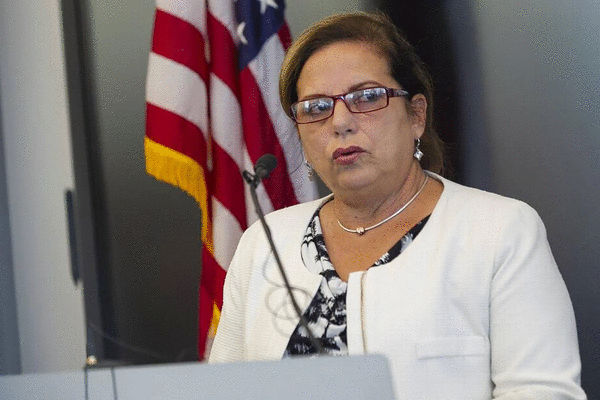
After five decades of providing medical care to nationals of Guyana and Jamaica, Cuba is withdrawing its doctors and other health specialists that have been a cornerstone of Caribbean health care.
The move comes after both Jamaica and Guyana acknowledge that they have been unable to restructure their respective long-standing agreements with Havana to provide health care workers.
The announcements, which came days apart, have been prompted by increasing pressure from the United States regarding the use of Cuban medical personnel by Caribbean governments. The Trump administration has for months been threatening sanctions against governments that employ Cuban health care workers, calling the existing contracts exploitative because workers’ wages are withheld and paid to the Cuban government, which then pays the doctors and other medical workers a fraction of the money. Also, workers do not have possession of their passports and their movements are limited.
As recently as last month, the State Department reiterated its call “for an end to exploitation and forced labor in the illegitimate Cuban regime’s overseas medical missions program..” The post on X was issued by the U.S Embassy in Bridgetown, Barbados, following statements by Saint Lucia Prime Minister Philip J. Pierre that Washington was using his country’s relationship with Cuba as leverage. The medical brigades have for years been a key source of revenue for the Cuban government.
In addition to the pressures Caribbean nations were under over their use of Cuba’s medical brigade, the U.S. asked Saint Lucia to stop sending its nationals to Cuba to study. “I have a big problem. Many of our doctors got trained in Cuba, and now the great United States has said we can’t do that any longer,” Pierre told the World Congress on Racial and Ethnic Health Disparities. “To manage a small country like St. Lucia, or like St. Vincent or Grenada is a task that many people will never understand.”
In response to Pierre’s statements about the scholarships, the embassy said: “The United States has not recently talked to Saint Lucia about international education and respects countries’ sovereign decisions regarding the education of their citizens."
Caribbean nations’ long-standing relationships with Cuba have nevertheless come under scrutiny, with Secretary of State Marco Rubio telling leaders during a meeting of regional leaders in Saint Kitts and Nevis that the U.S. is holding discussions with Cuba and that changes are coming to the island after decades of communist rule.
Still, the end of the medical partnerships has raised concerns about how Guyana and Jamaica, which have relied on Cuba’s health professionals for the past 50 years, will manage without them, particularly as governments have long relied on them to fill gaps created by the migration of their own health workers abroad.
While some Caribbean governments have quietly rewritten contracts in hopes of keeping the relationship, both Guyana and Jamaica indicated those efforts failed to materialize into an acceptable way forward. On Monday, Guyana’s health ministry said Cuba would be pulling more than 200 Cuban doctors from the South American nation that is part of the Caribbean Community bloc. The announcement followed a similar decision concerning 277 members of the Cuban medical brigade in Jamaica.
“For absolute clarity, the (Jamaican) government proposed continuation of the program with adjustments,” Jamaica’s foreign ministry said Sunday following backlash after the decision was announced.
The foreign ministry said the talks date back to July where Jamaica began engaging with Cuba to restructure the medical brigades. “It remains disappointed that despite these repeated efforts, no substantive response was ever received whether verbally or in writing from Cuba,” the ministry added.
Jamaica acknowledged the U.S. pressure In its decision.
“It is widely known that the United States government has publicly raised concerns about the operation of the medical program globally, including issues related to freedom of movement and salary payments,” Jamaica’s foreign ministry said. “The government therefore considered it necessary to review the existing arrangements to ensure compliance with domestic and international legal obligations.”
In confirming its decision “to proceed with the return of the Cuban medical brigade” in Jamaica, Havana accused the government of Prime Minister Andrew Holness of yielding to “the pressures of the government of the United States, which is not concerned about the health needs of the Caribbean brothers.”
In a statement, Havana said the results of its historic relationship with Jamaica speak for themselves. Over the last 30 years alone, more than 4,700 Cuban medical personnel have provided assistance on the island, the Cuban government said.
That work included treating more than 8.1 million patients, performing 74,302 surgeries, attending 7,170 births and saving more than 90,000 lives.
Cuba’s foreign ministry said it was informed on March 4 by Jamaica’s foreign ministry of the government’s “unilateral decision” to terminate the agreement.
“Cuba deeply regrets that in this way a history of fruitful and sustained collaboration is disregarded,” the statement said, adding that Jamaican patients would now be deprived of basic and specialized health services provided by Cuban professionals.
The government of Honduras canceled its agreement with Cuba over the medical brigades last week and more than 150 medical staffers left the Central American nation.
_____
©2026 Miami Herald. Visit miamiherald.com. Distributed by Tribune Content Agency, LLC.





Comments