Exiled Iranian women in South Florida push for change amid ongoing war
Published in News & Features
MIAMI — Sandra Madjdi remembers fleeing Tehran as a child on the last Pan Am flight out of Iran before the 1979 hostage crisis.
Her family, once living a comfortable life with nannies and chauffeurs, left in fear after her grandfather — a diplomat and congressman with ties to the Shah — was poisoned. The family moved between Turkey, Pakistan and Italy over the course of five years before eventually resettling in the United States in 1984.
“I just knew at four years old something was really wrong,” said Madjdi, 51, now a celebrity stylist and online influencer living in Coconut Grove.
Nearly five decades later, Madjdi is among a group of Iranian women living in South Florida who were displaced by the Islamic Republic of Iran that took power in 1979. They’re now watching the conflict that started two weeks ago with a mix of anxiety and hope.
Madjdi, along with activist Tara Nia, 32, and lawyer Mojdeh Khaghan Danial, 57, both Miami Beach residents, told the Miami Herald that the current turmoil could create an opening for long-awaited political change in Iran. They are hoping the moment could bring the possibility of returning to their homeland and a future where Iranian women regain rights and freedoms lost under the current regime.
Though the majority of Americans (about 53 percent) say they oppose the U.S. decision to take military action in Iran, according to a new Quinnipiac Poll, Madjdi said it’s what needs to happen in order for change to come.
“It’s just the way it is. We didn’t want it. But what else are you going to do with conflict? How are you going to face conflict? Conflict and violence has always been met with violence and conflict,” Madjdi said.
Lives of women in Iran
Women bear the brunt of oppression under the Islamic regime, and have for over four decades.
Iranian authorities enforce laws like compulsory dress codes through Draconian forms of punishment — harassment, arrests, imprisonment, and violence. The Islamic Republic restricts women’s rights in all areas of life — marriage, divorce, inheritance, child custody, work, the courts, political office, travel, lifestyle, and clothing, according to the Center for Human Rights in Iran.
After fleeing as a child, Madjdi returned to Iran when she was 18 in hopes to reconnect with her Iranian roots. She attended a cosmetology school in Iran to try and fulfill her dream of working in fashion and beauty industry. But, the experience was complicated, she said, as someone who had spent years assimilating to Western culture.
“I got caught with my hair outside of my hijab, and they cut it,” she said. “It was awful. It was hard, so hard.”
Madjdi said she was punished and arrested several times for violating the regime’s rules, though felt she was doing things that were normal for teenagers in the United States, like smoking or wearing nail polish and bright fashions. In Iran, women are legally required to adhere to a dress code, and must wear a hijab, or headscarf, regardless of their nationality or religion.
“I was wild to them, but to an American I was normal,” she said.
Nia, 32, is an Iran native who was raised Muslim, but left the faith completely after she came to the U.S. at 16.
“We run away from the religion like there’s no tomorrow. We lost our faith,” said Nia, who is now a business owner living in Miami Beach.
Nia said almost every woman she knows has gotten in trouble, or arrested, for violating the moral codes in Iran.
She remembers walking to class with her cousin at 15 years old and being stopped by Iranian authorities. The unknown men forced the young women into a van and took them to a police station because their hair was not wrapped in a headscarf.
“You try and talk to an Iranian woman who hasn’t been arrested because of her hijab, I bet you won’t find one,” she said.
In most Muslim societies, wearing a headscarf is encouraged, but not mandated.
Iran’s legal system is based on one interpretation of what Islam teaches about gender roles and modesty for women, and is used to control women, said Iqbal Akhtar, professor of politics and international relations and religious studies at Florida International University.
“It’s control over the body as a way of controlling the politics of society,” Akhtar said.
“They use religion as a way of justifying what they’re doing,” he said, pointing out that many don’t believe the regime is truly following the religion of Islam.
Seeing family suffer
For the Iranian women who rebuilt their lives in South Florida, exile has meant living with both freedom and heartbreak. Even after decades abroad, Madjdi, Nia and Danial say the hardest part has been watching from afar as parents, siblings and friends remain in a country where people still face deep restrictions on their rights and daily lives.
After she saw the anti-government protests in Iran unfolding in January, when Iranian authorities killed tens of thousands of people and cut off the country’s access to the internet, Nia decided to get involved by speaking out, calling representatives and advocating for a regime change.
Nia, who speaks every day to family and friends still in Iran, said though she decided to stay in the U.S., she feels torn over her inability to help her country and her people. She lost at least one friend during the protests, which started over economic grievances and were the largest since the Iranian Revolution of 1979, according to BBC.
“I wish I could go and fight there, but I’m here. Unfortunately, we feel bad for being here, bad for being alive,” she said.
Nia said she wishes she could have been in Iran during the night her friend was shot in the street for protesting. The guilt is something that fuels her, and many Iranians living outside of Iran, to try to make change from afar, she said.
Advocating for change
Even before the conflict in Iran, Nia and Madjdi — along with hundreds of others — had been advocating for former Iranian Crown Prince Reza Pahlavi to step in and lead the country to a democracy.
“We’re trying our best to lead this road to what we want, which is the leader, Reza Pahlavi, to basically become the transition leader,” Nia said. “Slowly and surely, he can change things.”
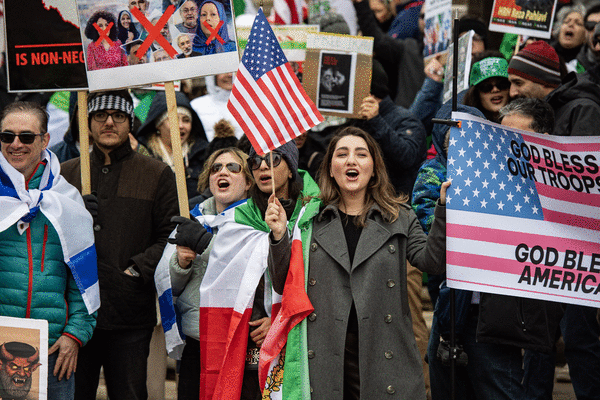
The women recently organized a rally in downtown Fort Lauderdale where about 150 demonstrators showed up, chanting Pahlavi’s name and waving flags from Iran, Israel and the United States. They stress that they are not taking to the streets to celebrate war, but are instead rallying for the liberation of Iranian people.
But the chances of Pahlavi taking power seem unlikely for now. Just over a week after the Iran war began, Mojtaba Khamenei, a son of Ayatollah Ali Khamenei, was named his father’s successor to become Iran’s third supreme leader. The selection suggests that little may soon change, according to experts.
The majority of Iranians, about 70%, oppose the Islamic Republic, while about 20% of Iranians support the regime, according to a 2024 survey by The Group for Analyzing and Measuring Attitudes in Iran (GAMANN). About 40% supported a total regime change compared to about 10% who support gradual reform within the Islamic Republic.
Though the majority of Iranians want a secular democracy, overthrowing the current regime could also come with consequences, according to professor Akhtar.
“If you topple this government, everything can completely fall apart,” said Akhtar. “Is it same government, but in different form, or is it anarchy and chaos, like what happened in Iraq, and people just start killing each other.”
Longing to return
Danial, who left Iran when she was 11, is among the thousands of Iranian Jews who fled the country during the 1979 Iranian Revolution. The chaotic conditions and fears of antisemitism in the Islamic regime led her family to leave.
Iran is a diverse country, both culturally and ethnically. Persians make up the majority, but there are a number of other minority and religious groups.
“It’s a beautiful country with an incredibly rich heritage and great leaders who have not been given the opportunity to step up,” Danial said.
Her father put his wife and three children on a plane to the U.S. for what he thought was going to be a temporary visit — just until conditions settled in Iran. Soon after they left, the airport shut down and the hostage crisis began in Tehran. Her father, a Persian carpet trader, was stuck in Iran for three years before the family was reunited in New York.
Danial, who is the general campaign chair for the Greater Miami Jewish Federation, remembers her childhood before the Iranian Revolution as a happy, more peaceful time. Her family had good relationships with non-Jewish neighbors, though there was a general feeling of being “an outsider” in a majority Muslim nation.
After 48 years of living in the U.S., Danial said she’s yearning to return to her roots, hoping that maybe someday she’ll be able to take her own children.
“There’s so much about my nation that I don’t know,” she said.
_____
©2026 Miami Herald. Visit miamiherald.com. Distributed by Tribune Content Agency, LLC.






Comments