DACA delays lead to lost jobs, less stability and anxiety over potential deportation under Donald Trump
Published in News & Features
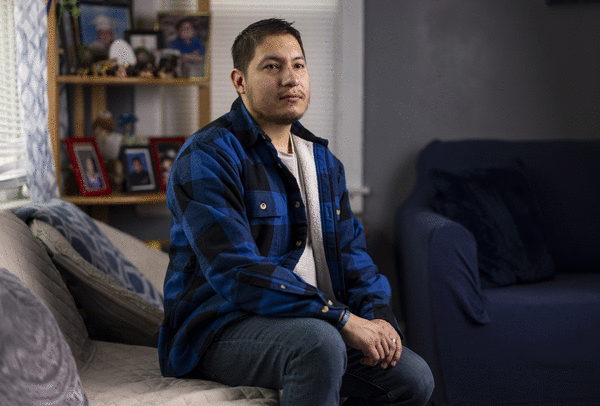
CHICAGO — Victor Jardon-Reyes worked for companies that provide airplane repair supplies, commuting to O’Hare and Midway airports from his home in Belmont Cragin to put in half-day shifts consulting with mechanics and giving them the needed parts to keep the skies safe.
But on Feb. 18, the 33-year-old lost his job. Through no fault of his own, he had lost the right to work.
Jardon-Reyes is a recipient of Deferred Action for Childhood Arrivals, a federal program instituted under President Barack Obama that gives some legal protection and a work permit to children who were brought to the U.S. by immigrant parents without legal authorization.
DACA lasts for two years and then must be renewed. Jardon-Reyes applied to renew his in November. The government confirmed receipt later that month. He received an appointment for fingerprinting in January but the expected renewal did not come through before his DACA expired.
Without it, he lost his permission to work legally in the country and with that, protection from deportation.
“You feel like a dog on the corner waiting for somebody to feed them,” Jardon-Reyes said.
His situation is one faced by scores of immigrants across the country. Advocates say delays in paperwork renewal by U.S. Citizenship and Immigration Services have increased, with some delays stretching up to six months. Without the renewal, DACA recipients are in danger of being placed in deportation proceedings.
In a statement, USCIS spokesman Matthew Tragesser acknowledged the delays and possibility of potential deportation.
“Under the leadership of President Trump, USCIS is safeguarding the American people by more thoroughly screening and vetting all aliens, which can lengthen processing times,” Tragesser said. “DACA does not confer any form of legal status in this country. Illegal aliens claiming to be recipients of DACA are not automatically protected from deportation. Any illegal alien who is a DACA recipient may be subject to arrest and deportation for a number of reasons — including if they committed a crime.”
Erendira Rendon, vice president of immigrant justice at The Resurrection Project and a DACA recipient of more than 14 years herself, said she’s “anxious and nervous” as she seeks renewal. She applied just last month, 150 days before her DACA is set to expire, which is the time recommended by USCIS.
In her role, Rendon has spent more than a decade helping others navigate the system. The department centers on advocacy and providing access to legal representation and resources for immigrants, including DACA recipients.
But as new delays slow the renewal process, the uncertainty she helps others manage is something she is now facing.
“Before, even if it lapsed, it was a little bit of an OK feeling because you just needed to wait and it would be OK,” Rendon said. “But this time, if it lapses, you run the risk of just getting detained because you have no protection.”
Donald Trump and his administration have long argued that DACA is unlawful and an overreach of executive power. Trump has repeatedly called the program “illegal amnesty” that bypasses Congress. During his first term, his administration moved to terminate DACA in 2017, but the effort was blocked by the U.S. Supreme Court in 2020 after justices ruled the administration failed to provide adequate legal justification. Legal challenges to the program have continued, and in January 2025 the U.S. Court of Appeals for the 5th Circuit again found major parts of DACA unlawful.
As the legal case continues, the program is suspended. New, first-time applications are not being processed due to federal court orders while pending initial applications are frozen.
Meanwhile, advocates and attorneys across the country told the Tribune that, anecdotally, they have seen an increase in delays. Yet how prevalent those delays are can be hard to quantify. In one small example, a paralegal from The Resurrection Project submitted 37 renewal applications late last year. As of this month, 14 of them are delayed, the applicants’ work permits now expired, as the cases wind their way through the system.
“Right now what we’re seeing, it could take up to six months,” said Emma Melton, the attorney handling DACA cases at The Resurrection Project. That timeline exceeds the processing window many applicants are told to expect of one to two months.
There are an estimated half a million DACA recipients in the country who are potentially affected by the problem.
Gaby Pacheco, president and CEO of TheDream.US, said the delays are a widespread concern. She worries the Trump administration is “slowly dismantling the program” through a “death by a thousand cuts strategy.”
DACA recipients are “super vetted,” she said, as individual applicants undergo regular background checks. Those who have had it from the program’s beginning more than a decade ago have paid more than $3,000 to renew.
Tom Wong, political science professor at the University of California at San Diego and founding director of the U.S. Immigration Policy Center, said the delays are consistent with other problems with USCIS under the Trump administration.
“The administration isn’t hiding what it is trying to do. Since Trump won, there has been a very clear, ‘let’s throw wrenches into the process so that we can slow things down as much as possible,’” Wong said.
“That leads to people not being able to enter the United States, not just DACA recipients but also asylees not being able to work. That means people are not able to adjust (status). In some cases that also means denaturalization,” he added.
Jaclyn Kelley-Widmer, faculty director at Path2Papers, a Cornell Law School project aimed at helping DACA holders, said the renewal process already contains uncertainties. For instance, deciding when to apply for renewal is a challenge.
Citizenship and Immigration Services might grant their renewal but apply it to the date of their application instead of the end of the previous work authorization, effectively giving them less time. Uncertainty around DACA strains businesses too, by complicating personnel decisions
“It’s very challenging to keep projects moving and have a predictable and stable workforce when we have these kinds of needless delays,” Kelley-Widmer said.
Trump’s expanded, aggressive immigration actions have also raised political questions about how people with DACA are being treated.
Earlier this month, Rep. Delia Ramirez of Illinois and Rep. Sylvia Garcia of Texas pressed the Department of Homeland Security and USCIS over conflicting information about the arrest and deportation of people enrolled in DACA.
In September, 95 members of Congress requested a full accounting from the DHS of how many active DACA recipients had been detained or deported since January 2025, including where and when those arrests occurred.
DHS responded that 270 DACA recipients had been arrested and 174 DACA applicants had been removed from the United States between Jan. 1 and Sept. 28, 2025.
But in a separate response to Sen. Dick Durbin, DHS reported that U.S. Immigration and Customs Enforcement had arrested 261 DACA recipients and removed 86 from the country between Jan. 1 and Nov. 19, 2025, a longer time frame that showed fewer arrests and removals.
“It is clear that DACA recipients are at great risk; we must have transparency,” Ramirez said.
Lawmakers say the situation underscores the need for permanent protections through legislation such as the American Dream and Promise Act, a bipartisan bill led by Garcia and co-led by Ramirez that would provide Dreamers with permanent deportation protections and a pathway to citizenship.
As Durbin prepares to leave the Senate, he is making one final push to secure permanent protections for undocumented immigrants brought to the United States as children.
In December, the Illinois Democrat teamed up with Lisa Murkowski, a Republican from Alaska, to introduce the Development, Relief, and Education for Alien Minors Act of 2025, the latest version of the long-debated DREAM Act.
The bipartisan legislation, first introduced in 2001, would allow Dreamers to pursue citizenship if they meet certain requirements, including military service, higher education or steady employment.
The bill has been introduced multiple times over the past two decades but has never passed Congress.
Vanessa Esparza-López, associate director of legal services at the National Immigrant Justice Center, said the lack of a permanent solution means people “are having to plan their lives in two-year increments.”
“It is a lot of stress to think about, ‘if I can’t renew my DACA the next time around, what am I going to do in terms of supporting myself? My family?’” she said. “DACA, when it first came out, the narrative was about a high school student. Now DACA recipients are in their early 40s, they’re homeowners. It’s really pulling the rug out from underneath them if they can no longer access work permits.”
Jardon-Reyes lives with that uncertainty.
He was born in Guerrero, Mexico. His sister was born in Juarez. His parents brought him to the United States when he was a child, barely old enough to attend school.
Now he owns his home in Belmont Cragin and has a $2,608 mortgage payment to make and is currently enrolled in college seeking a degree in Biblical studies.
Over the years, Jardon-Reyes has worked for a cleaning company, as a lab operator at a chemical company and on an assembly line at a fiber barrel factory.
He left that job because he would get sick from the dust. He first took a job at Midway in February 2024 and then took a job at O’Hare in September 2024. He worked full time at O’Hare and part-time at Midway.
When his DACA expired, the O’Hare company put him on leave but he was let go from the Midway job, he said.
As his DACA renewal works its way through the system, Jardon-Reyes is scared of going out and being detained by ICE.
“My mom told me not to lose hope in God,” he said.
_____
©2026 Chicago Tribune. Visit chicagotribune.com. Distributed by Tribune Content Agency, LLC.






Comments