Drone strikes, US deportations, kidnapped journalists worry UN expert on Haiti
Published in News & Features
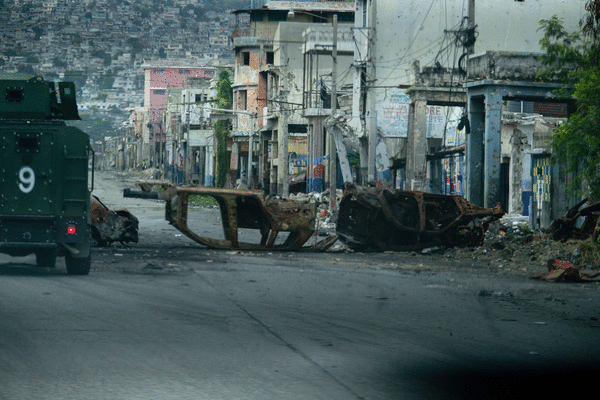
The United Nations’ leading Haiti human rights observer says he remains alarmed by the daily reality Haitians face even as a recent visit to the volatile country revealed some “glimmers of hope” in its gang-ridden capital.
During his recent 10-day trip, William O’Neill said he saw signs of territory being “liberated” from gang control and a more motivated, visible police force.
“There are slight areas where the gangs have been chased away, but they’re very small,” he said. “It’s not clear the police can hold those areas.”
The U.N.’s independent expert on human rights, O’Neill said Haitians still struggle every day to survive, especially the youth, and individuals living in soiled encampments after being forced to flee their homes and neighborhoods by armed gangs.
“Sexual violence is rife in these sites,” he said. “Meanwhile, thousands remain trapped in areas controlled by gangs or along shifting front lines. Young people in these communities live under constant threat. They are also frequently stigmatized or suspected simply because of where they live, sometimes by security forces, sometimes by others in the population. This places them in an impossible situation, caught between violence and suspicion.”
O’Neill’s recent visit come as Haitians both at home and in the United States continue to face mounting challenges. Shortly after O’Neill’s press conference on Monday, the U.S. Supreme Court announced it will hear oral arguments next month on the Trump administration’s request to end temporary legal protections against deportations for hundreds of thousands of Haitians.
The decision would affect more than 300,000 Haitians and could lift a stay granted last month by U.S. District Judge Ana Reyes, after she ruled that a group of five Haitian nationals challenging the termination were likely to succeed on the merits of their case. The Haitians sued to block the administration from ending the program, citing its hostility toward “nonwhite immigrants,” including disparaging comments made by President Donald Trump and others about Haitians and Haiti.
Haiti’s human rights situation
Violence and instability has now displaced more than 1.45 million people from their homes, according to the latest numbers from the U.N.’s International Organization for Migration. The figure is quickly approaching the scale of the devastating 2010 earthquake, when 1.5 million people were forced to abandon their homes.
O’Neill fears that any mass deportations of Haitians from the U.S. would further strain an already “dire” and “catastrophic” situation.
“There’s no guarantee that there could be a safe and dignified and durable return, given the situation in Haiti,” he said, noting that he, along with the High Commissioner of Human Rights and the High Commissioner for Refugees, have repeatedly called for a halt to deportations.
The human rights situation, he added, is significantly worse today than when the Obama administration designated Haiti for Temporary Protected Status after the 2010 quake.
“My question is, where would people who have been out of the country for many years and maybe don’t have family anymore, or they’re from gang neighborhoods that are very dangerous … where would they go? How would they live each day?’ ” he said.
“I’ve seen how the internally displaced barely survive. I just don’t see how you could take in another 200,000 to 300,000 from anywhere to Haiti and see that they could have a dignified, even a remotely dignified, survivable, living condition. It’s so I very much urge no deportations to Haiti now, because it’s just not viable in any sense.”
Missing journalists in Haiti
The dangers Haitian continue to face were also reinforced on Monday as the family of two missing journalists and a local media associate pleaded for their release by their captors.
Junior Célestin of Radio Television Megastar and Osnel Espérance of Radio Uni FM were kidnapped on Friday while reporting near the presidential palace, and their whereabouts and conditions are unknown.
“Now Haiti is one of the most dangerous places in the world to be a journalist,” O’Neill said. “Human rights defenders are also at risk. A number of my colleagues that I’ve known for many years now regularly get death threats.”
Since 2022, at least nine journalists have been killed in Haiti. The area where the two journalists went missing is largely controlled by the powerful Viv Ansanm gang coalition, which the U.S. has designated a foreign terrorist organization.
Haitian police on Monday reported that several gang members were killed Monday and their weapons seized as police continued to make inroads in reclaiming parts of downtown Port-au-Prince.
The progress, which allowed police to gain entry into areas for the first time since 2022, is among the “glimmers of hope” O’Neill said he saw. Haitians, he added, are exasperated by the violence and “just want to live well and safely.”
Prison conditions
During his visit, O’Neill toured the prison in Cap-Haïtien, the country’s second-largest city, and a jail facility in the capital originally intended for children but now housing adult women and men as well.
“The conditions I observed were inhuman and degrading,” he said, adding the facilities are overcrowded and unsanitary.
“Such treatment is unacceptable and reflects deeper structural failures within the justice and detention systems,” he said. “Strengthening the accountability will be essential.”
In addition to improved prison conditions, O’Neill, whose history with Haiti dates back decades, called for greater transparency on the soon-to be deployed U.N. authorized Gang Suppression Force. While there are high expectations for the force, few people understand its role, its mandate or the composition of the 5,500 mostly military personnel, he said.
“Greater transparency will be needed to build public trust,” O’Neill said, adding that security measures are not enough.
“Haiti must also invest urgently in violence reduction and prevention, particularly for young people,” he said.
Drone strikes
O’Neill also raised concerns about the increased use of explosive drones by a government-backed security task force supported by Vectus Global, a firm owned by Erik Prince, the founder of the private military company Blackwater.
“I heard serious concerns about police operations and the reported use of drones that have resulted in deaths and injuries,” he said. “Efforts to restore security are essential and desired by most, but they must fully respect international human rights law.”
Last week, Human Rights Watch reported that at least 1,243 people were killed in drone strikes between March 2025 and Jan. 21, 2026d. The attacks, carried out with quadcopter drones armed with explosives in densely populated areas, in some cases killed or injured dozens of people, including children and civilians not linked to criminal groups.
Among those killed in 141 operations were at least 43 adults not believed to be gang members and 17 children.
The deliberate use of lethal force is permissible only when strictly unavoidable to protect life, the organization said, and any use of force must be necessary and proportionate. The organization said the strikes “appear to be deliberate extrajudicial killings” and warned that Haitian authorities could be violating international law.
“The number of armed drone attacks in Port-au-Prince has significantly increased in recent months, with 57 reported between November and January 21, nearly double the 29 from August through October,” the group said in a statement. “Over 40% of reported killings took place between December 1 and January 21. The average number of people killed per operation is 8.8, with the most lethal operation killing 57 people.”
Human Rights Watch said Haitian authorities should transparently investigate all allegations of unlawful killings, prosecute those responsible and provide reparations to affected families. The government should also clarify the command structure behind the drone operations and the role of private military contractors.
“Haitian authorities should urgently rein in the security forces and private contractors working for them before more children die,” said Juanita Goebertus, the group’s Americas director.
“Restoring security in Haiti is essential,” she added. “But unlawful attacks with armed drones are adding a new layer of abuses to the violence that has devastated communities for years.”
A person associated with the drone operations previously told the Miami Herald that precautions are taken before operations are launched, and police announce to the population the zones that will be targeted. Nevertheless, human rights groups in Haiti have reported on a number of civilian casualties, which Human Rights Watch used.
That analysis coincides with a recent report by Port-au-Prince based Fondasyon Je Klere/Eyes Wide Open slamming the government of interim Prime Minister Alix Didier Fils-Aimé for the signing of the $53 million drone contract and two other “onerous” inked with private and international firms.
One of the contracts is for the construction of a prison; the third is a 10-year border-security contract with a consortium of firms. Under the border agreement, the firms involved can earn more than $1 billion over a decade, the human rights group said, accusing the government of undermining national sovereignty by privatizing state responsibilities.
----------
—Miami Herald staff writer Churchill Ndonwie contributed to this report.
©2026 Miami Herald. Visit at miamiherald.com. Distributed by Tribune Content Agency, LLC.






Comments