Minnesota Gov. Tim Walz pitches child care tax credit, new social media tax in his final budget
Published in News & Features
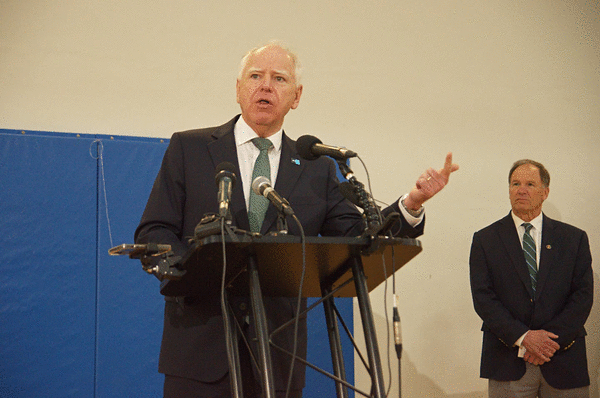
MINNEAPOLIS — Gov. Tim Walz is proposing to trim the statewide sales tax rate, expand a child care tax credit for families and boost programs meant to help Minnesotans recover from the federal government’s immigration crackdown in the state.
The proposals are part of an amended budget plan that would make several other significant changes, including a new tax on social media companies that would fund workforce and economic development programs meant to prepare for artificial intelligence.
The changes are aimed at lowering costs for middle class families and equipping the state for potentially huge changes ushered in by changing technology, Walz said Tuesday, March 17, at the St. Paul Eastside YMCA.
“If we don’t prepare our children for the future, both making sure they’re healthy, they have access to housing, access to food, access to safety ... and prepare us for this AI transition, our economy won’t work,” Walz said. “This is a smart budget. I think it’s one that we should see support across the political spectrum.”
The budget proposal will be Walz’s last before he leaves office early next year and builds on proposals he’s pushed for families in the state since his first term. The proposed plan would augment a much larger $66 billion two-year budget the closely divided Legislature passed last June. That budget took weeks of negotiations, and Walz’s new proposal could face opposition given Republicans’ resistance to any new taxes.
The state’s overall budget picture improved last month when a forecast predicted a $3.7 billion surplus in its current 2026-2027 two-year budget cycle and a small $377 million surplus in 2028-2029, though officials warned that outside factors — like the federal government’s shifting priorities and threats to withhold hundreds of millions of dollars — could change those figures significantly.
Walz said his new proposal would slow the growth of programs that have driven spending increases for years and would leave a projected balance of $1.8 billion in the 2028-2029 budget cycle.
“This is a responsible budget,” Walz said.
The governor’s proposal to expand the Dependent Care Tax Credit for families would nearly triple it, increasing maximum allowable expenses to $3,000 for one child and $6,000 for two children, said Paul Marquart, commissioner of the Minnesota Department of Revenue. That would make it the largest of its kind in the nation and would affect more than 100,000 Minnesota families, he said.
“It is going to save middle class families thousands of dollars every year,” Marquart said.
The statewide sales tax rate would be cut by 0.075% but would also be expanded to cover things like professional services. His proposal would also set aside about $100 million for housing, including $34 million for first-time homebuyer down payment assistance, $33 million for supportive housing and $33 million for emergency rental assistance.
The Senate recently approved $40 million in rental assistance for people affected by the immigration crackdown, but House Republicans have blocked efforts there. The governor also wants to offer partially forgivable loans to small businesses affected by the immigration crackdown.
Senate Minority Leader Mark Johnson, R-East Grand Forks, said those loans would mostly go to businesses in St. Paul and Minneapolis and would amount to a “slap in the face” to residents across the state. The state should instead look at lifting onerous taxes and regulations, he said.
“This is pretty tone deaf to what’s happening in Minnesota,” Johnson said of Walz’s proposal.
The social media tax would collect about $100 million a year by taxing the data companies collect from Minnesota users, Marquart said. A similar proposal pushed by DFLers stalled in the Legislature last year.
©2026 The Minnesota Star Tribune. Visit at startribune.com. Distributed by Tribune Content Agency, LLC.






Comments