Ready to roll again, NASA's workhorse crawler has been hauling rockets since Apollo
Published in News & Features
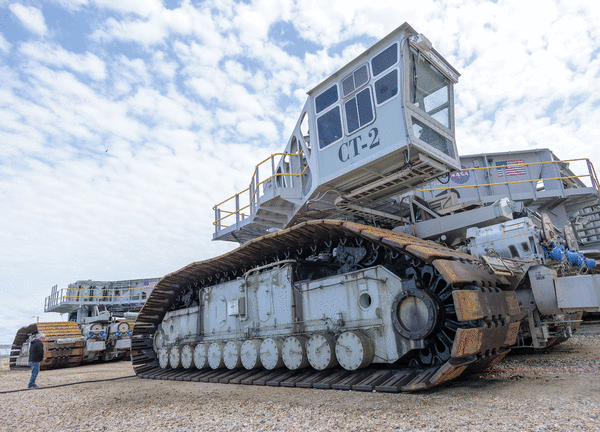
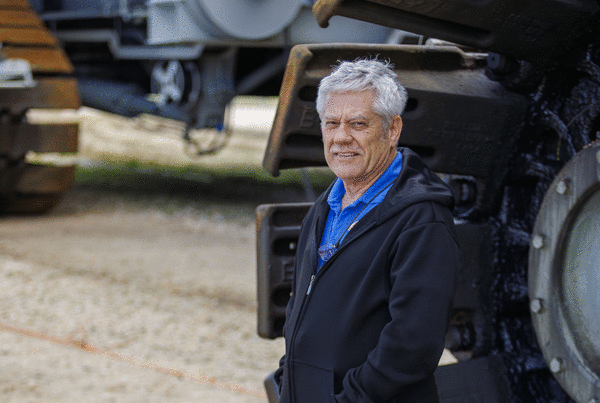
CAPE CANAVERAL, Fla. — When he’s not at work, Sam Dove drives a Chevy Silverado 1500. But on the job, he gets behind the wheel of a 16-million-pound behemoth that’s been transporting NASA’s rockets for more than 60 years.
Dove gets to drive the crawler-transporter 2 (CT-2), which was one of two tracked vehicles originally designed to haul the Saturn V rockets of the Apollo program to KSC’s launch pads. It continued its piggyback service during the Space Shuttle Program and has most recently been tasked to support NASA’s Artemis program.
On a cold, windy Tuesday afternoon in the shadow the Vehicle Assembly Building, Dove shows off the nuts, bolts and grease for the moving platform the size of a baseball diamond as he awaits the go from NASA for its next trip, expected Thursday evening. It’s tasked to haul the moon-bound Artemis II rocket on an hours-long, 4.2-mile slog to KSC’s Launch Pad 39-B at a top speed of under 1 mph.
“It’s the enormity of what you’re carrying, right? ... Basically, you’re carrying $4 billion of hardware, so you don’t want to really mess up or run into anything,” he said about the most rewarding aspect of the job. “It’s the responsibility to do that and get everything out, and get it there safely in one piece.”
Artemis II will be the first crewed launch of Orion and SLS, targeting liftoff as early as April 1. It’s slated to bring NASA astronauts Reid Wiseman, Victor Glover and Christina Koch, as well as Canadian Space Agency astronaut Jeremy Hansen, on a 10-day lunar fly-by mission to ensure Orion can safely fly humans. It will also set up future missions, including what aims to be the first return of humans to the moon’s surface since Apollo 17 in 1972.
CT-2, which was revamped to handle the heavier loads of the Artemis program compared to the shuttles and Saturn V rockets, can handle up to 18 million pounds. Without fuel, the Space Launch System rocket, Orion spacecraft and Mobile Launcher 1 come in at around 15 million pounds.
“It’s all mojo, man. This thing’s powerful. There’s no magic dust. It’s all powerful,” he said.
Guinness World Records agrees, designating it the record holder for “the heaviest self-powered vehicle.”
It was operational by 1964 as America pushed toward its goal of landing the first man on the moon. NASA has been able to keep it going now for more than 60 years.
“You can rebuild this thing until it literally just falls apart. That that’s the great thing about the crawler,” he said. “They built this thing so well that we’re able to take an early-1960s technology ... and keep going with it.”
With 5,000 gallons of diesel on two tanks, CT-2 can gun it up to about 2 mph without a load. The trip to the pad will try and stay at around 0.82 mph, Dove said.
“That way we don’t force any bad vibrations or any functions onto the mobile launcher and the vehicle,” he said.
It’s already taken the Artemis II hardware once to the pad, having rolled back in January before NASA identified issues that needed fixing back at the VAB.
The trip can take between 8-12 hours with built-in stops along the way, but also some unexpected delays.
“We’ve had alligators cross in front of us, rabbits, hogs, foxes ... But you’re not going to run over them,” he said. “There’s some gopher tortoises, they dig a hole right beside the crawler, and they come out, but you’re not going to hit them.”
Dove is one of three certified crawler test conductors for the vehicle, although he expects a fourth will soon earn the right to run the show.
“You’re the crawler commander, and you’re responsible for everything that goes on the crawler, everything around it, making sure that everybody’s doing what they’re supposed to be doing,” he said.
Some of the names of past crawler support personnel who have passed away are enshrined on the side of the crawler as a memorial. But when he started, some of the crews active in the Apollo era were still around to help.
“Most of the old guys are gone now, but we, some of us, had the good fortune to have them come in and teach us a lot of stuff,” he said. “That was some serious good training, because they had a different view of everything than you have now. So it’s hard. So we try to take that and and impart that wit and wisdom to the new guys we go to train.”
They will be among more than 30 personnel on hand running the transit. Although there is a seat in the cab, sticking off the front of the vehicle like the cockpit of the Millennium Falcon, Dove says drivers pretty much remain standing as they stay in constant headset communication with teams monitoring temperatures and pressures from a control center embedded in the heart of the vehicle.
The steering wheel is no bigger than a child’s playset, and has a maximum turn of 6 degrees either direction. The vehicle features four pairs of tracks called belts at each corner, with 57 six-foot-long steel shoes that will crunch their way over a pathway filled with river rock.
Hundreds of the rocks, which act like ball bearings to reduce friction of such a massive load, are stuck in crevices in the tracks from its most recent trip, after which its odometer hit 2,537.76 miles.
For Artemis I in 2022, the crawler made seven trips to and from the pad, including one to get the rocket out of the path of a hurricane.
Dove said he hopes the next time will be the last before launch.
“As long as I’m moving a rocket and moving the crawler, we’re fine,” he said. “But I’d rather go to the pad, because that’s what we’re really here for.”
_____
©2026 Orlando Sentinel. Visit at orlandosentinel.com. Distributed by Tribune Content Agency, LLC.






Comments