Iran defies Trump with energy strikes as war costs rise
Published in News & Features
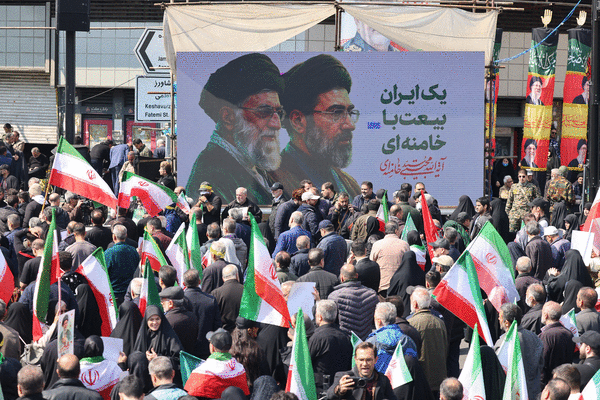
Iran stepped up its assault on key oil and gas infrastructure across the Middle East, defying U.S. President Donald Trump’s calls for restraint and triggering a fresh surge in energy prices that have highlighted the cost of the ever-widening conflict.
The Islamic Republic targeted sites in countries including Saudi Arabia, Qatar and the United Arab Emirates with a wave of drone and missile attacks on Thursday, a retaliation for Israel’s assault on Iran’s giant South Pars gas field the previous day.
The sharp escalation, with the bombing of more energy facilities from both sides, threatened to draw in both Gulf and European powers and exposed tensions between the U.S. and Israel.
For Washington, the costs of the conflict it launched against Tehran alongside Israel were becoming clearer as the war neared the end of its third week. On Thursday, Iran said its air defense “seriously damaged” a U.S. F-35 stealth fighter, with U.S. Central Command saying one of the jets made an emergency landing and the pilot was in stable condition.
The Pentagon also asked Congress for an additional $200 billion to pay for the war against Iran, a person familiar with the matter said. The enormous funding request suggested the U.S. was girding for a protracted conflict, though Defense Secretary Pete Hegseth downplayed concerns and said the U.S. was “on plan” with its war aims.
“It takes money to kill bad guys,” Hegseth said in a combative news conference where he denied “that we’re somehow spinning toward an endless abyss or a forever war or quagmire.”
But with no end in sight, oil and gas prices soared once again, and bonds tumbled amid widening fears the war will stoke inflation and hurt economic growth. Equities in Asia and Europe extended losses, though U.S. stocks staged a sharp recovery late in the session as Israeli Prime Minister Benjamin Netanyahu said the country would help the U.S. open the Strait of Hormuz.
Yet the vital waterway remained effectively shut, even as Iran assault on regional energy facilities continued. Iranian Foreign Minister Abbas Araghchi vowed in a post on X to show “ZERO restraint” if the country’s energy infrastructure was hit again.
As part of the barrage, Saudi Arabia said a drone hit its Samref refinery on the Red Sea, a vital exit route for the world’s biggest oil exporter, while the kingdom said it also shot down ballistic missiles fired toward the capital, Riyadh.
Qatar reported “extensive damage” at the world’s largest liquefied natural gas export plant and the UAE shut a major gas facility due to falling debris from missiles. Two oil refineries in Kuwait were struck by drones that caused fires, according to Kuwait Petroleum Corp. Iraq also reported a loss of power generation after Iran halted gas supplies from South Pars in the wake of the Israeli attack.
The latest attacks increased the potential for other countries to join the conflict. Saudi Foreign Minister Faisal bin Farhan Al Saud warned overnight that the kingdom’s restraint isn’t “unlimited,” and warned it could take military action.
“It could be a day, two days, or a week,” he told reporters in Riyadh, adding the relationship between the kingdom and Tehran has “completely shattered.”
The energy strikes also frayed close ties between the U.S. and Israel, with Trump saying in a social media post late Wednesday that “NO MORE ATTACKS WILL BE MADE BY ISRAEL” on South Pars. While he threatened the U.S. “will massively blow up the entirety of the South Pars Gas Field” if Iran continued hitting Qatar, Trump also hit out at Netanyahu.
“I told him, ‘don’t do that.’ And he won’t do that,” Trump said Thursday at the White House, referring to Netanyahu.
On Thursday morning, Trump’s spy chief Tulsi Gabbard acknowledged the U.S. and Israel had different goals in the Iran war. The U.S. was focused more on degrading Tehran’s military, while Israel was focusing on eliminating the country’s leadership. In a briefing in Israel, Netanyahu said Israel would help U.S. forces reopen Hormuz and acted alone in hitting Iran’s gas assets.
Still, Brent crude prices soared as high as $119 a barrel on Thursday before easing to end the session near $108 a barrel. Prices are now at the highest level since July 2022.
Now in its 20th day, the war has claimed more than 4,100 lives across the region, with about three quarters of them in Iran. Dozens have been killed across the Middle East, while the U.S. has lost 13 military personnel and numerous aircraft.
Israel has also stepped up a parallel offensive in Lebanon, where it’s fighting Tehran-backed Hezbollah. Israeli strikes in the country have killed 968 people, according to the Lebanese government.
The risk of lasting damage to energy infrastructure and supply is increasing. Efforts to reopen the Strait of Hormuz — a chokepoint for about a fifth of global oil and LNG flows — have so far been unsuccessful, pushing energy prices higher. The fallout is spreading globally, with fuel, shipping and household costs already rising.
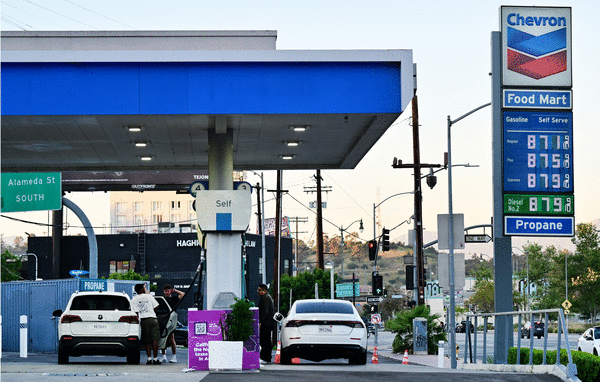
U.S. gasoline prices have soared in recent weeks, rising to around $3.88 a gallon on Thursday, according to the American Automobile Association. That’s the highest level in more than three years and is piling pressure on the Trump administration before the November midterm elections.
“Gas prices are up and we know they’re up, and we know that people are hurting because of it and we’re doing everything that we can to ensure that they stay lower,” Vice President JD Vance said on Wednesday, calling the spike “a temporary blip.”
Trump temporarily waived a century-old shipping mandate to lower the cost of transporting energy goods around the U.S. in a bid to curb price rises. Vance and other top administration officials plan to meet with oil executives Thursday, according to people familiar with the matter.
The war began with the joint U.S.-Israeli bombing of Iran on Feb. 28.
Trump has since said that he started the operation to disarm a potent nuclear threat, claiming Tehran was just two weeks away from acquiring a weapon. Iran has denied pursuing atomic weapons, and nuclear experts mostly disagree it could have built weapons that quickly.
Earlier this week, a senior U.S. counter-terrorism official, Joe Kent, who had previously been supported by Trump in failed bids for Congress, resigned publicly over the war, saying Iran “posed no imminent threat to our nation.”
_____
(With assistance from Omar Tamo, Mike Cohen and Derek Wallbank.)
_____
©2026 Bloomberg L.P. Visit bloomberg.com. Distributed by Tribune Content Agency, LLC.





Comments