He was brought to jail instead of the hospital, and died within hours. A judge just OK'd his mother's lawsuit
Published in News & Features
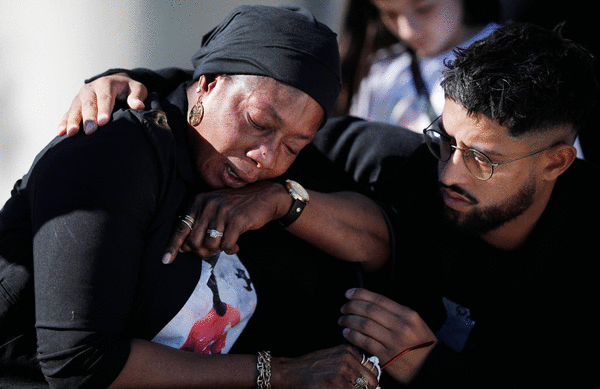
SAN DIEGO — A federal judge this week declined a request by county attorneys to dismiss a lawsuit filed by the mother of 29-year-old Abdul Kamara, who died March 4, 2024, hours after being placed in a restraint device at the Vista jail.
U.S. District Judge Roger Benitez ruled that the lawsuit, filed last year by Fredrika Nabbie, provides enough evidence to allege that failures by San Diego County sheriff’s deputies led to Kamara’s death.
According to the lawsuit, on March 3, 2024, Carlsbad paramedics responded just after 9 p.m. to a call about a medical emergency at a Carl’s Jr. and found Kamara wandering around a nearby parking lot. His blood pressure was dangerously high — 181/116 — and he asked to be taken to the hospital.
At Scripps Memorial Hospital Encinitas, Kamara exhibited behavior that an ER doctor described as “paranoid and delusional” and in need of further evaluation.
But before that evaluation could take place, Kamara ran out of the ER barefoot and without a shirt. Hospital staff called 911, reporting that he needed “mental help” and was “unable to care for himself.”
Deputies were dispatched to locate him and to return him to the hospital.
About 30 minutes later, at a gas station about a mile away, deputies found Kamara on the ground behaving erratically. According to the lawsuit, he was handcuffed without resistance.
Deputies told dispatch they were taking him back to the hospital, but roughly 20 minutes later said they would be transporting him to the Vista Detention Facility instead.
While in the back of the patrol vehicle, the lawsuit says, Kamara became increasingly agitated.
“He bounced around in the back seat of the patrol car and hit his head on the plexiglass separating the back seat from the front seat,” it says. “Abdul suffered a cut on his head that began to bleed.”
At the jail, deputies removed him from the vehicle and placed him on a bench, but minutes later he began acting erratically again. During efforts to control him, he struck his head on the ground.
Deputies placed Kamara in a WRAP full-body restraint device and called paramedics. The lawsuit alleges that six deputies spent seven minutes securing the device while placing their weight on Kamara, who was 5’ 6” and 136 pounds.
The lawsuit says Kamara was kept face-down, despite protocol requiring that a person who is restrained be placed upright to allow them to breathe properly.
None of the deputies asked jail medical staff to assess Kamara while he was restrained, the lawsuit says.
“Although Abdul should have been seated upright or placed in a standing position, and closely monitored for signs of distress, officers left him laying prone on the ground,” it says.
Paramedics arrived roughly 15 minutes later. They noted Kamara’s blood pressure was only 79/51, suggesting he wasn’t getting enough oxygen.
Within minutes, he became unresponsive and went into cardiac arrest.
Kamara was taken to Tri-City Medical Center, where doctors were briefly able to restore his pulse. But his condition deteriorated rapidly, and he was pronounced dead at 4:03 a.m.
The medical examiner concluded that Kamara most likely died from a combination of methamphetamine use and complications from sickle cell disease. Physical exertion and agitation may have triggered a sickle cell crisis that restricted blood flow, the report says. The manner of death was ruled an accident.
The lawsuit argues that at the time of Kamara’s death, there was a pattern and practice of San Diego County sheriff’s deputies taking people in crisis to jail instead of a hospital.
The lawsuit cites more than 20 previous deaths involving people experiencing medical or drug-related crises while in custody. According to the complaint, the county was on notice of these previous deaths but failed to act.
“(H)ospital staff, including the ER physician, expressly instructed the deputies to return Abdul to the hospital for a medical hold after locating him,” the lawsuit says.
A Sheriff’s Office spokesperson declined comment, citing pending litigation.
In their motion to dismiss the lawsuit, county attorneys argued deputies weren’t liable because they eventually called paramedics. The judge rejected this argument.
“Plaintiffs do not allege defendants never provide arrestees and detainees medical care,” he wrote. “Rather, the allegation is that defendants have a policy and practice of arresting and jailing individuals in need of medical attention instead of addressing their medical needs first.”
Born in Sierra Leone during that country’s brutal civil war, Kamara legally immigrated with his family to the United States when he was 15.
He later worked as a certified nursing assistant in Long Beach before moving to Oceanside in early 2024 to attend the Gemological Institute of America.
His mother told The San Diego Union-Tribune that he had no known history of drug use or mental illness. She described him as quiet, compassionate and committed to helping others.
The autopsy notes that Kamara had previously been arrested on Feb. 11, 2024, after wandering into an Oceanside hotel and insisting he had a room. He reportedly became combative, and police used a Taser to subdue him.
He was taken to Tri-City Medical Center and initially released to jail, but returned to the hospital after tests showed rhabdomyolysis, a potentially fatal syndrome caused by rapid muscle breakdown. He spent six days in the hospital and was discharged in stable condition on Feb. 18, 2024.
By then, Kamara had missed too many classes. He had planned to return home to Virginia on March 5, spend time with his family and reenroll in school later that year.
©2026 The San Diego Union-Tribune. Visit sandiegouniontribune.com. Distributed by Tribune Content Agency, LLC.





Comments