'It's the people who are suffering.' How Cuba is struggling under US oil blockade
Published in News & Features
Reggaeton boomed in a neighborhood bar in Old Havana on a recent night, when, suddenly, the music stopped and everything went dark.
The customers groaned. Another blackout.
A U.S. blockade on oil shipments to Cuba has plunged the island into its worst energy crisis in modern history. The country's already cratering economy now teeters on the verge of collapse, with vehicles idled by a lack of gas, hospitals forced to cancel surgeries and millions living without a steady supply of electricity and water.
It is the result of a calculated pressure campaign by President Trump, whose administration is negotiating with Cuba's leaders over the future of the communist-ruled Caribbean island.
People fed up with rolling blackouts have staged sporadic protests in recent days, banging pots and shouting slogans against the government, rare demonstrations in a country known for repressing dissent.
Some power outages hit isolated areas, but in recent weeks Cuba has experienced three island-wide blackouts. The most recent one struck Saturday night and continued into Sunday.
As Havana and Washington hash out a possible deal — which is likely to include some form of economic opening, and perhaps limited changes to Cuba's leadership — many people here say they feel like pawns in a geopolitical game beyond their control.
Some, like those at the bar, who kept drinking in the dark after the power vanished, say they have little choice but to adjust to a life where flushing a toilet, cooking a pot of rice or riding a bus to work is now considered a luxury.
"The U.S. is trying to punish the Cuban government," said one customer, named Rolando. "But it's the people who are suffering."
Cuba's struggles long predate the oil embargo. For years, Cubans have complained of food shortages, crumbling public services and political repression. Demographers say Cuba is undergoing one of the world's fastest population declines — a 25% drop in just four years — as birth rates fall and emigration soars.
Cuban President Miguel Díaz-Canel blames "genocidal" economic, financial and trade restrictions imposed by the United States in the decades since Fidel Castro's army toppled the U.S.-backed dictator Fulgencio Batista in 1959.
But many Cubans blame their own leaders for mismanaging the economy — and straying from the ideals of Castro's revolution. They were raised to believe in an implicit social contract, which maintained that while Cubans might not have luxuries or be allowed all civil liberties, they would always have free education and health care, a place to sleep and enough to eat.
"The pact has failed," said Juan Carlos Albizu-Campos Espiñeira, an economist at the Christian Center for Reflection and Dialogue in Havana.
He faults the government for soaring inflation and a misguided investment strategy that pumped money into the tourism industry while neglecting fundamental sectors like industry and health care.
"This is the worst moment in Cuba's history," he said. "But things were really bad before this."
Life has long been challenging for Pablo Barrueto, 63, who works mornings at a construction site and now spends afternoons filling plastic jugs from a tap on the street and hauling them up narrow stairwells to neighbors who have been without water for weeks.
His two jobs barely enough cover food for him and his partner, Maribel Estrada, 55, who earns $5 monthly as a security guard at a state-run museum.
The pair, who live in a cramped studio apartment in a crumbling colonial-era building, can't afford butter or mayonnaise, so breakfast is a piece of plain bread. Barrueto said he often goes to bed hungry. It has been years since he has tasted pork or beef.
"I work so hard," said Barrueto, who on a recent afternoon was cooking beans in a pair of tattered jeans. "But I don't see the fruits of my labor."
Estrada has developed ulcers on her legs, but the doctor who prescribed her antibiotics said she wouldn't be able to find them on the empty shelves of state-run pharmacies. On the black market, the medication was being sold for more than what Estrada makes in a month.
"If I lived in another country, my legs wouldn't look like this," she said, rolling up her pants to show the chronic sores on her calves.
Estrada said she was reaching a point where she would accept anything that would improve her life, even U.S. intervention.
"If things don't get better, they should just hand over the country to Trump," she said.
The U.S. has long played a major role in Cuban history, from its involvement in the island's war of independence from Spain to the heavy hand of American companies in Cuba's sugar industry. Washington repeatedly backed unpopular leaders who protected U.S. interests, including Batista, whose corrupt and repressive regime sparked support for the Cuban Revolution.
For decades, the island was celebrated by U.S. critics worldwide as a scrappy symbol of anti-imperialism and a utopic experiment in socialism. But in recent years, amid a government crackdown on dissent, some of that support has faded.
The Trump administration's bellicose new push to dominate Latin America with tariffs and military intervention has scared allies who in the past might have come to Cuba's rescue.
Mexico, Brazil and Colombia, all led by leftists, have declined to provide emergency fuel shipments in recent months out of fear of angering Trump.
The current crisis was set in motion on Jan. 3, when the U.S. launched a surprise attack on Venezuela, killing 32 Cuban security guards stationed there — in addition to scores of Venezuelan troops and civilians — and capturing President Nicolás Maduro.
As the U.S. seized control of Venezuela's oil industry, the impacts immediately rocked Cuba, which had long relied on subsidized oil shipments from Maduro's regime.
Cuba's leaders say the country has not received a single fuel shipment in three months, debilitating an economy that depends on oil to generate the electricity.
There is little relief in sight.
A state-owned Russian oil tanker loaded with 750,000 barrels of crude is currently crossing the Atlantic. It's unclear whether the U.S. will try to stop the ship from reaching Cuba, where the oil, once refined, could provide Havana with energy for several weeks.
At the same time, the "Nuestra América" humanitarian convoy is in the process of delivering more than 20 tons of critical supplies to Cuba, some of which will arrive by boat in the coming days.
David Adler, a general coordinator of Progressive International, a global leftist group that helped organize the flotilla, said he hoped the delivery of medicine, food, baby formula and solar panels would highlight the severity of Trump's restrictions on Cuba.
"We're beginning to come to grips with the fact that there will be mothers and children and elderly and sick people who will die simply as a result of this senseless and cruel and criminal policy," Adler said. "Why are we inflicting such cruel punishment on a country that does not represent any threat to the United States?"
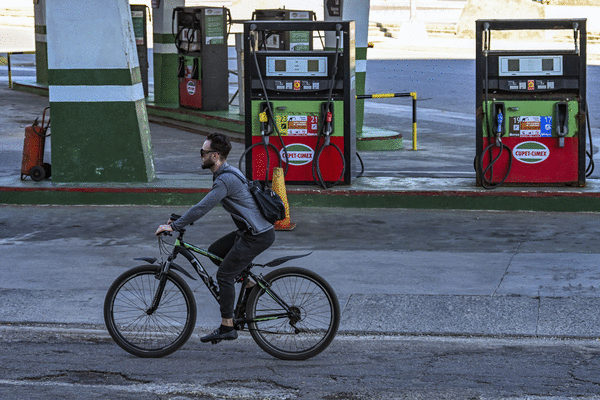
In Cuba, where many fear the prospect of no electricity come summer, with its muggy heat and swarms of disease-carrying mosquitoes, people are getting creative. With virtually no public transport and few drivers able to find — or afford — gas that costs more than $5 a gallon, many people have resumed riding bicycles. Others have fashioned electric-powered scooters into slow-moving taxis.
One man in the small town of Aguacate made headlines after he modified his 1980 Fiat Polski to run on charcoal, the same fuel many people here are now cooking with.
Camila Hernández, who works at Havana's airport, had hoped to celebrate her 21st birthday at home with friends, eating and dancing. "It would have been wonderful," she said.
But it had been weeks without regular electricity in the home she shares with her parents and boyfriend. His family's home had power — but lacked water.
To avoid yet another night sitting in the darkness, she marked her birthday by strolling to the Paseo del Prado, an iconic boulevard not far from the waterfront cooled by a light sea breeze.
Her boyfriend's mother, Yusmary Salas, 47, said poor living conditions were testing her patience. "I can't even go to the bathroom without planning how I will flush the toilet," she said. She said she is hungry for change, but has no idea what shape it will take.
Trump insists he "can do whatever I want" in Cuba, and recently said he expects to have the "honor" of "taking Cuba in some form."
Such talk rattles many here who grew up in a country where government buildings still bear the revolutionary motto: "Homeland or death, we will prevail."
Salas said she hopes that whatever comes next is peaceful, and that Cubans, long a proud people, have their dignity restored. And their power restored, too.
At the darkened bar in Old Havana, workers scrambled to light candles and serve beer that, without refrigeration, would soon go warm. Someone with a battery-powered speaker hit "play" on a song, the 2004 Daddy Yankee hit "Gasolina."
"Dáme más gasolina!" they sang together. "Give me more gasoline!"
_____
©2026 Los Angeles Times. Visit latimes.com. Distributed by Tribune Content Agency, LLC.





Comments