Idaho political races will get more expensive with proposed campaign law changes
Published in News & Features


BOISE, Idaho — Candidates for Idaho state and district and local offices could collect bigger campaign contributions — but would face tougher disclosure rules — under a bill advancing through the Idaho Legislature.
Senate Bill 1422 would boost the total that a candidate for statewide office — such as governor, attorney general and superintendent of public instruction — could receive from individual donors to $6,000 per election, up from $5,000. The limit for candidates for the Legislature and local offices, and in judicial elections, would be raised to $1,500 from $1,000.
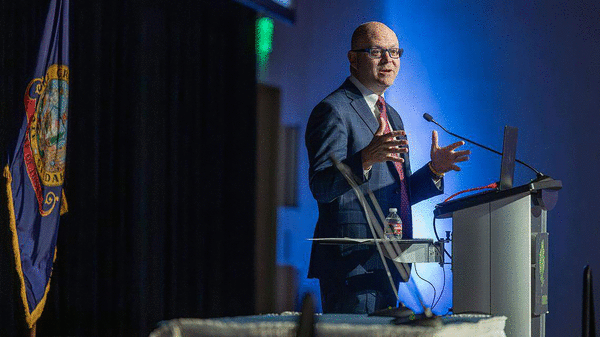
Secretary of State Phil McGrane called the adjustment in the late-session bill “a modest increase” on Wednesday in a Senate committee.
Under current rules, candidates can accept campaign donations for primaries as well as general elections. The new rules would allow contributions only for the active campaign — one or the other.
“You can’t collect money for the general election until you win the primary election,’” McGrane said. “You have to be able to actively spend the money for that election, in theory, at least.
Sponsored by Senate Assistant Majority Leader Mark Harris, R-Soda Springs, the proposed changes to contribution limits have gone through six iterations over the 2025 and 2026 legislative sessions, McGrane said. Reporting requirements largely remain unchanged under the bill, he told lawmakers, but with added teeth through better-defined disclosure requirements and more-uniform fines for violations, he said.
The Secretary of State’s Office is tasked with enforcement of Idaho’s campaign laws.
“I will honestly say I have too much discretion when it comes to fines right now,” McGrane said. “And this kind of clears that up, and it makes it a little bit more formulaic.”
McGrane, a former elected county clerk of Ada County, himself has filed for reelection. He faces no Republican challenger in the May primary, but — in a rematch from 2022 — will be on the ballot against Democratic candidate Shawn Keenan in the November general election.
The campaign finance bill sets a minimum fine for improper reporting of contributions and expenditures of $50, plus 5% of the monetary amount associated with the violation. Different levels of fines should apply for different levels of spending, McGrane said.
A campaign ad on social media boosted at a cost of $10, but without sufficient disclosure, is not the same as a $100,000 expenditure for campaign ads on billboards, he told the Senate State Affairs Committee.
“So this is kind of adding the weight of whatever the message is — the political speech that’s being spent in— and what that fine would be,” McGrane said.
Under Idaho law, political campaign contributions and expenditures of $1,000 or more must be reported within 48 hours. That would go unchanged if the bill is approved and signed into law. In the 16 days leading up to an election, the requirement moves to a 24-hour reporting requirement.
Under the bill, late filing fees would also be set at $50, plus $10 for each day a report misses the deadline. The bill’s provisions would take effect in July, too late for the May primary but in time for November’s general election.
The committee passed the bill with no opposition. It now faces a Senate vote. If passed, it would go to the House.
©2026 Idaho Statesman. Visit at idahostatesman.com. Distributed by Tribune Content Agency, LLC.






Comments