Israel, Iran keep up strikes with warring sides at odds on talks
Published in News & Features
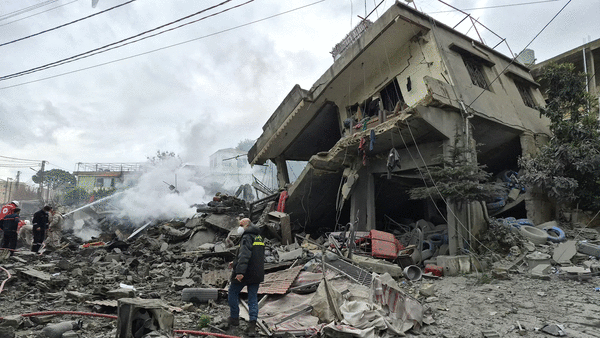
Israel and Iran exchanged missile strikes as the status of potential peace talks remains uncertain, extending a war that’s wreaked havoc across the Middle East and global markets.
U.S. President Donald Trump claimed Iran is desperate to make a deal to end the nearly month-long conflict, while Iran publicly rejected Washington’s push for discussions. Tehran is seeking its own guarantees, including that the U.S. and Israel won’t resume their attacks, reparations for war damages and recognition of its authority over the Strait of Hormuz, state-owned Press TV said.
Stocks and bonds edged lower and oil climbed as the conflicting signals eroded optimism that a resolution to the war is imminent.
Brent crude rose more than 2% to $105 a barrel. Equity-index futures for the U.S. and Europe pointed to further losses, while the MSCI All Country World Index headed for its first decline this week.
As the war heads toward the end of its fourth week, each side has kept up attacks, with Tehran showing little sign of backing down despite daily bombardment by the U.S. and Israel.
The Israel Defense Forces completed a wave of strikes in the central Iranian city of Isfahan. Iran’s state TV said early Thursday it had begun another wave of missile strikes against Israel.
The United Arab Emirates said its air defenses were responding to Iranian missile and drone threats, and two people were killed after debris from an intercepted missile fell in Abu Dhabi. Bahrain said an Iranian attack caused a fire at a facility in Muharraq.
Iran is also looking to formalize a transit fee for the Strait of Hormuz, with lawmakers working on a draft bill to impose a toll in exchange for providing security to ships passing via the key waterway, according to the Fars news agency. Since the war started on Feb. 28, Iran has effectively shuttered the conduit for about a fifth of the world’s oil and liquefied natural gas, triggering a global supply shock.
Tehran has already begun charging a limited number of commercial vessels for transit, with payments of as much as $2 million per voyage, according to people familiar with the matter.
Trump had set a deadline for Iran to negotiate an agreement to end the war by the end of the week, though there are lingering questions over the status of negotiations and the likelihood for a deal.
The U.S. compiled a 15-point peace proposal that Pakistan delivered to the Islamic Republic, according to people familiar with the matter, highlighting the urgency within Trump’s administration to resolve the conflict. White House Press Secretary Karoline Leavitt on Wednesday said there were “elements of truth” to the reported U.S. proposal.
Vice President JD Vance may travel to Pakistan for Iran talks this weekend, CNN reported.
The conflict has led to surging fuel and fertilizer prices, with commercial tankers avoiding crossing the Strait of Hormuz and Iranian attacks damaging energy infrastructure. It has also sparked fears of an inflation crisis and worldwide food shortages.
The risks of further escalation are still substantial. The White House has asserted that Trump is keeping all options open for expanded military action and has ordered more troops to the region, with some set to arrive before week’s end.
Leavitt on Wednesday announced that a summit between Trump and Chinese President Xi Jinping that was slated for later this month would instead take place in May. Trump had postponed the meeting after launching the war, which brought fresh strains to U.S.-China ties. Iran is a major trading partner for China, the world’s largest crude importer.
Trump has publicly signaled any peace agreement would have to include a prohibition on Iran ever obtaining a nuclear weapon or enriching radioactive material for civilian purposes.
The U.S. plan stipulates that the Islamic Republic dismantle its main nuclear facilities and use a reduced missile arsenal in self-defense only, according to people familiar with the matter. Iran would receive certain concessions in return, including sanctions relief.
It’s still unclear who the U.S. is negotiating with since several top Iranian government and military officials have been killed, including Supreme Leader Ali Khamenei on the conflict’s first day. On Monday, Axios identified Mohammad-Bagher Ghalibaf, Iran’s speaker of parliament, as the likely front man for talks, though he denied negotiations have taken place.
There’s also little clarity over whether Iran would immediately allow all commercial ships to safely transit the Strait of Hormuz without paying, as well as how Israel would respond to any deal. Israeli officials have said they’ll continue striking Iran for now.
“At this stage we are still at war, and when it might end, no one knows,” Israeli Energy Minister Eli Cohen told radio station Galey Israel. The Israeli military and “defense establishment have the stamina and determination to see this historic campaign, in whose midst we find ourselves, to its conclusion.”
Gulf states such as Saudi Arabia and the UAE are considering joining the war against Tehran, several people with knowledge of the situation said this week. They would only do so if the Islamic Republic attacks vital power and water infrastructure — a high threshold, the people said.
“We can’t let Iran hold the U.S., the United Arab Emirates and the global economy hostage,” UAE Amabassador to the U.S. Yousef Al Otaiba wrote in a Wall Street Journal op-ed. “A simple cease-fire isn’t enough. We need a conclusive outcome that addresses Iran’s full range of threats.”
Turkey, meanwhile, is conducting intense diplomacy to try and prevent Gulf Arab countries from becoming involved, according to people familiar with the matter.
More than 4,500 people have been killed in the conflict, according to governments and non-government agencies. Around three-quarters of the fatalities have been in Iran, while almost 1,100 people have died in Lebanon, where Israel is fighting a parallel war against Iran-backed Hezbollah militants and has displaced more than a million people. Dozens have been killed in Israel and Arab Gulf states.
--------
—With assistance from Dana Khraiche, Dan Williams and Julius Domoney.
©2026 Bloomberg L.P. Visit bloomberg.com. Distributed by Tribune Content Agency, LLC.






Comments