After third year of calm, is Miami Beach spring break a thing of the past?
Published in News & Features
MIAMI — For three straight years, spring break in South Beach has come and gone without major incident.
Crowds were relatively small last month, especially compared to March weekends in the years after the COVID pandemic, when thousands of young people packed Ocean Drive and the party was sullied by shootings, stampedes and curfews.
This year, people still came to town for spring break. But it seemed that even more were there for other reasons, including fitness and wellness programming that Miami Beach officials had promoted.
Spring break was more raucous elsewhere: Fort Lauderdale, Daytona Beach, even Houston.
Now, two years after Miami Beach released a viral marketing video that declared the city was “breaking up with spring break” — prompting many people to stay away — there may be no turning back.
“You can see and feel the difference,” Mayor Steven Meiner said in a March 31 email to residents. “We didn’t simply outgrow the problems of the past — we confronted them and broke the cycle.”
Compared to last year, arrests were down 14% citywide over an analogous 30-day spring break period, according to Miami Beach police. In the South Beach entertainment district, arrests were down 24%.
Multiple South Beach business owners told the Miami Herald they were financially successful in March, something that had become a concern in recent years after the city imposed draconian measures like $100 parking rates, garage closures, beach closures and the removal of sidewalk café seating.
There were still strict rules in place this year, but they were scaled back. Parking in some South Beach garages was $40, but garages and street parking remained open. Traffic was rerouted in some areas, but barricades didn’t line all of Ocean Drive and sidewalk seating returned.
Jonathan Plutzik, who owns The Betsy hotel and is the chair of the Ocean Drive Association, said that for The Betsy, it was “as good a March as we’ve ever had.” Fitness events and others like the Futureproof finance conference made a difference, he said, as did the increased “freedom of movement” for residents and visitors.
“We’re back on the right path,” Plutzik said.
Mitch Novick, who owns the Sherbrooke Hotel on Collins Avenue near Ninth Street, said this was the best March his business has had in more than a decade.
“It was a world of difference from last year, from five years ago, from 10 years ago,” Novick said. “It should be what we strive for.”
The Greater Miami Convention and Visitors Bureau reported an 85.5% hotel occupancy rate in Miami Beach over the first 28 days of March, a slight increase from last year.
Business owners still had some gripes. David Wallack, who owns Mango’s Tropical Cafe, noted that cars were routed onto Ocean Drive through a single entry point and only afforded a single exit point, limiting access for rideshares and valets.
“We’ve got to get past all of that,” Wallack said.
Wallack has previously proposed that the city host a major music festival in March. This year’s fitness events were “wonderful,” he said, but still “nowhere close to being enough to have the businesses flourish.”
“What’s missing is real, excellent, international-level entertainment to attract a whole new demographic of people to fill the hotel rooms — to make Miami Beach cool again,” Wallack said.
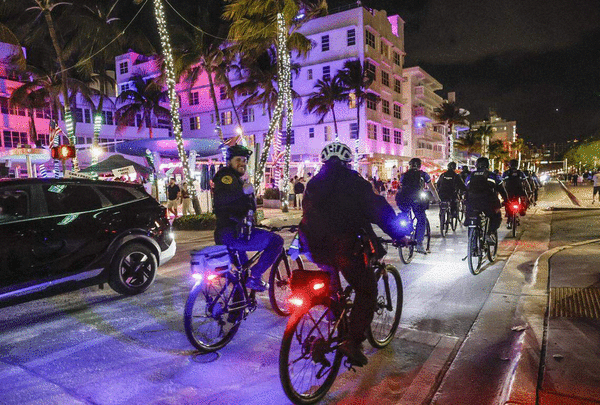
As before, there was still a massive police presence in South Beach. Officers operated a DUI checkpoint and license-plate reader detail that slowed traffic going into Miami Beach on the MacArthur and Julia Tuttle causeways during two mid-March weekends.
But there were no high-profile incidents of police clashes with spring breakers or aggressive shows of force — like in 2021, when police deployed SWAT teams, pepper-spray balls and a military-style vehicle to try to enforce an 8 p.m. curfew. Those tactics led to backlash from local Black leaders, who said police went too far in dealing with crowds of mostly Black young people.
Glendon Hall, who leads the Miami Beach Black Affairs Advisory Committee, criticized the police at the time. Since then, he has urged officers not to take a “zero tolerance” approach during spring break.
Hall praised the department’s efforts this year under the leadership of Wayne Jones, who became the city’s first Black police chief in 2023.
“We’ve got this tremendous progress without a zero-tolerance policing policy,” Hall said. “They deescalate, rather than escalate.”
Miami Beach police said they were focused, in part, on getting guns off the street. In a press release, the department said it made 28 “firearm-related arrests” and impounded 37 guns during spring break.
“While this year’s spring break was smooth and largely uneventful, our operational tempo did not decrease,” Jones said in a statement.
Joseph Magazine, a Miami Beach city commissioner, said he believes this March set the tone not only for future spring breaks but also for the overall direction of the city.
Miami Beach officials have been trying for years to change the reputation of South Beach as a hard-partying destination. The city should keep embracing alternatives, Magazine said, like the health and wellness events and business conferences that took place last month.
“This turned into an absolutely iconic month,” Magazine said, “that is really going to lay the groundwork and framework not just for March going forward, but year-round going forward.”
©2026 Miami Herald. Visit at miamiherald.com. Distributed by Tribune Content Agency, LLC.






Comments