Jim Whittaker, mountaineer who was first American to summit Mount Everest, dies at 97
Published in News & Features
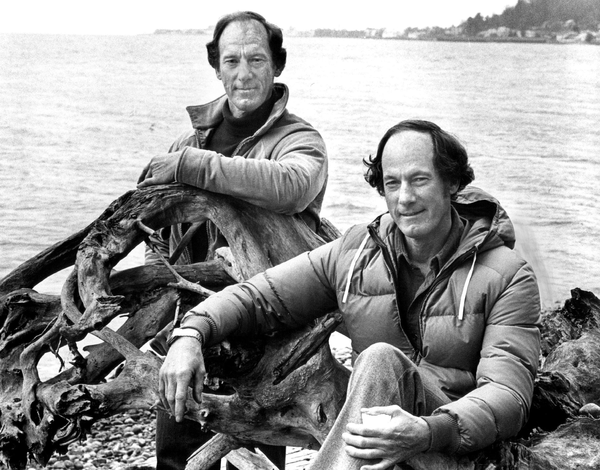
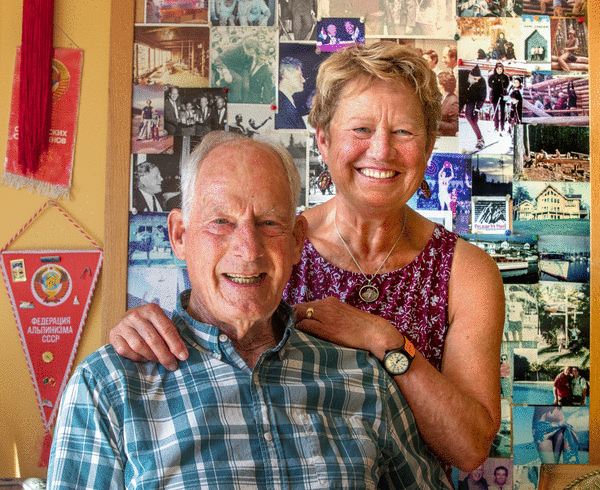
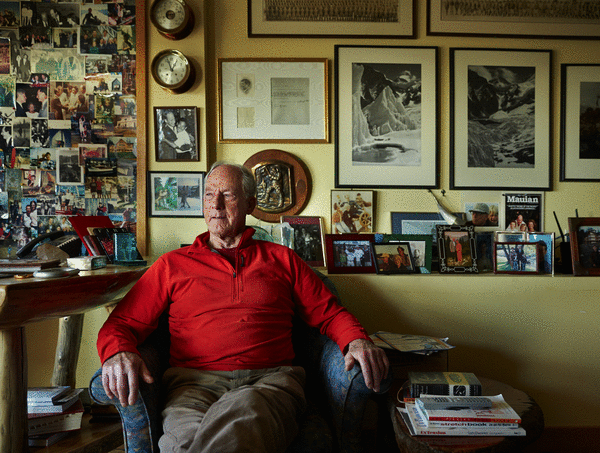

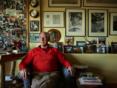
SEATTLE — Jim Whittaker, a Seattle-born and -raised mountaineer who achieved legendary status when he became the first American to summit the world’s tallest peak in 1963, died Tuesday in Port Townsend at the age of 97.
Cascadia Daily News reported Whittaker’s death in an obituary published Wednesday morning.
Whittaker reached the top of Mount Everest on May 1, 1963, alongside Sherpa Nawang Gombu, drawing on years of formative climbing experience forged in the Cascades. His historic ascent, a decade after Edmund Hillary and Tenzing Norgay, earned him and his American Everest Expedition teammates the National Geographic Society’s Hubbard Medal.
Even beyond his exploits on mountains across the globe, Whittaker’s life is the subject of outdoors folklore.
He was the first full-time employee at REI and eventually became its CEO. And together with his twin brother, Lou, an accomplished climber who died in 2024, Jim founded Rainier Mountaineering, Inc. The Ashford-based outfitter, today run by the second generation of Whittakers, remains the biggest outfitter that guides clients up Washington’s tallest peak.
Seattle’s mountaineer
Whittaker and Lou were born Feb. 10, 1929, and raised in West Seattle’s Arbor Heights neighborhood. The siblings began climbing in the early 1940s as part of the Boy Scouts, the Explorers climbing group and The Mountaineers. Jim enrolled in The Mountaineers Basic Climbing course in 1945, the beginning of an 82-year membership in the Seattle-based outing club.
“I’m forever grateful to those brave volunteer instructors who were willing to welcome a stumbling teenager into their course and teach me about gravity,” Whittaker said, as quoted in a tribute published Wednesday afternoon by The Mountaineers.
Whittaker credited The Mountaineers for introducing him to mentorship figures from Washington’s climbing community like REI founder Lloyd Anderson, mountaineer and environmentalist Wolf Bauer, and climbing ranger turned artist and author Dee Molenaar.
Jim and Lou were quick studies; they began guiding climbers on Mount Rainier, taking over management of the national park’s guide service in 1949, according to The Mountaineers. When he wasn’t guiding, Jim studied at Seattle University and sold ski equipment. Both brothers were drafted by the U.S. military during the Korean War, when they leaned on their Rainier experience and taught high-altitude and winter survival skills to 10th Mountain Division soldiers at the Army’s Mountain and Cold Weather command in Camp Hale, Colorado.
After an honorable discharge in 1954, the siblings came back to Seattle and Jim returned to his job selling ski gear. The next year, Anderson hired him as the first full-time employee of REI, then still a fledgling cooperative opening its debut store.
Despite the requirements of managing a retail outpost, Jim found time to steal away and guide clients — including a 1961 expedition with his brother at Mount McKinley, also known as Denali, that went awry, stranding the team above 17,000 feet for four days.
Jim and Lou emerged unscathed, and their grace under pressure in part earned them invitations to the 1963 American Everest Expedition. According to HistoryLink, Lou trained alongside Jim but ultimately declined a spot on the team because he was opening a sporting goods store in Tacoma. “I felt betrayed,” Jim wrote in his autobiography, “A Life on the Edge,” published by Mountaineers Books in 1999. “It was a stunning blow.”
Becoming the first
Jim ended up proving instrumental, as his REI experience enabled him to organize and ship loads of gear for the four-month attempt. While even a modern Everest climb is not a walk in the park, Whittaker’s era entailed a true expedition undertaken at a time before the infrastructure of mass climbing tourism like intricate fixed rope systems installed by sherpa teams.
After weeks of hauling gear and establishing base camps, Whittaker found himself pinned down at 27,300 feet in Camp 6 alongside expedition leader Norman Dyhrenfurth and two Nepalese guides. With supplies and oxygen running low, the American climbers decided it was “a sort of now-or-never situation,” Whittaker told The Seattle Times in 1983.
Their summit bid began at 6 a.m. in strong winds, blinding snow and temperatures of negative 35 degrees Fahrenheit. Dyhrenfurth couldn’t match Whittaker’s pace and turned back after an hour, leaving the final push to Whittaker and Gombu. The cold seeped through Whittaker’s mask and frostbite nipped at his cheek. An eye swelled shut. But the weather broke long enough to see the ridgeline to the main summit. That omen propelled them forward “because you feel you have to get it, you don’t even think about turning around,” Whittaker said.
Seven hours into their trek, the duo reached the summit. With their oxygen dwindling, they spent only 20 minutes on the roof of the world — long enough to plant an American flag and take the requisite photos. An enduring image shows Whittaker in all his glory: red parka, blue insulated pants, the Stars and Stripes wrapped around his ice axe.
Whittaker’s son, Leif, himself an accomplished guide and high-altitude climber, appreciated the magnitude of his father’s accomplishment on one of his own Everest climbs in 2012.
“I was sitting at the South Summit at about 300 vertical feet from the top and looking at the Hillary Step, I had this vision of my dad and Nawang Gombu Sherpa climbing up there,” he told Cascadia Daily News.
“It’s 50 years earlier and I imagined what that was like without the fixed ropes, without the crowds. Just those two with a single rope connecting them and ascending this incredibly challenging terrain through a storm no less.”
From anonymous climber to national hero
The team’s successful summit bid — four climbers in addition to Whittaker and Gombu made it to the top on May 22 — made rock stars out of the mountaineers in an era of national rivalries like the Space Race.
“Back then, everyone paid attention to these climbs,” high-altitude climber Ed Viesturs told REI’s Uncommon Path. “It was a very nationalistic thing. ... The president took notice.”
President John F. Kennedy made a short speech the next day, though at the time Whittaker’s name had not been made public as the successful summit climber. While the expedition consisted of 19 Americans and six Sherpas, in a culture that celebrates firsts — from John Glenn to Neil Armstrong — Whittaker’s feat made him the face of the climb.
According to HistoryLink, Whittaker‘s photo was on the covers of Life and National Geographic magazines. The Seattle Times named him state newsmaker of the year.
He returned to Seattle, where the local boy made good was feted with a downtown parade on June 24. The next month, Kennedy presented Whittaker and his teammates with their Hubbard Medals.
The White House ceremony introduced Whittaker to the Kennedy clan and he forged a close bond with Robert. When the Canadian government named unclimbed 14,000-foot Mount Kennedy in the slain president’s honor, the pair of friends decided to climb it as a tribute.
_____
©2026 The Seattle Times. Visit seattletimes.com. Distributed by Tribune Content Agency, LLC.






Comments