Opposition says Machado to return to Venezuela, coordinating with US
Published in News & Features
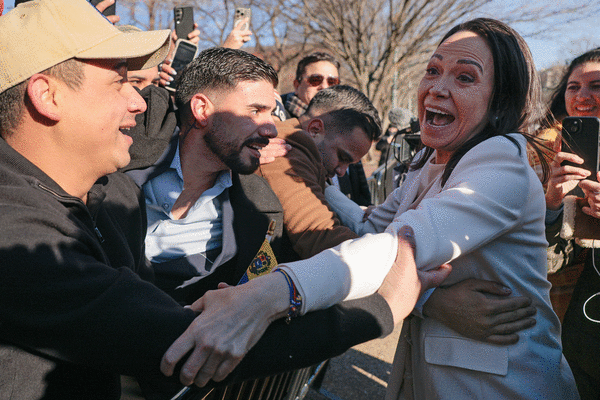
Venezuelan opposition leaders said this week that María Corina Machado is preparing to return to Venezuela soon and will do so without necessarily seeking permission from the United States, describing the move as a decisive step in efforts to accelerate the country’s political transition after Nicolás Maduro’s capture by U.S. forces in January.
Speaking at a forum in Miami hosted this week by the Interamerican Institute for Democracy, opposition leader Omar González said Machado’s return is a “definitive decision” that does not depend on authorization from Washington, though coordination with the international community, including the Trump administration, is under way to ensure an orderly process.
The comments came amid growing speculation that Machado may have delayed her return following recommendations from officials in the Trump administration urging caution due to security risks and the fragile political balance in Caracas.
The uncertainty has fueled debate within opposition circles over timing, particularly after Machado announced on March 2 that she would return to Venezuela “very soon,” raising expectations among supporters that her re-entry was imminent.
Instead, Machado began a tour of cities abroad with large Venezuelan communities, holding meetings with exiles and political allies while building international backing for electoral pressure.
The trip, which included stops in Europe and the United States, was widely interpreted by analysts as an effort to consolidate support and assess conditions before making a final decision on her return. Opposition figures at the Miami forum framed their remarks as a signal that, despite the delay, plans for Machado’s return remain active and tied to a broader push for street mobilization inside Venezuela.
In his comments, González described Machado’s plans to return as a large-scale political re-entry involving thousands of supporters and exiles entering Venezuela from multiple points.
González likened the operation to a “Normandy landing,” saying Machado and her allies would return through various borders — including Colombia via Cúcuta, Brazil through Roraima, Caribbean routes through Falcón — as well as major airports such as Maiquetía, Maracaibo and Barcelona. He said the objective is to spark nationwide mobilization and push for new elections.
The remarks come as Venezuela remains under the interim leadership of Delcy Rodríguez, who assumed control of the government after Maduro was captured alongside his wife, Cilia Flores, earlier this year. The arrangement, backed by segments of the ruling movement and tolerated by Washington as part of a stabilization strategy, has drawn sharp criticism from opposition leaders who argue that it prolongs the regime’s rule without democratic legitimacy.
González said the opposition must push for elections based on constitutional provisions governing presidential absence, arguing that the current interim setup ignores both the will of Venezuelan voters and legal timelines requiring a vote. He also described the country’s economic situation as catastrophic, with soaring inflation, collapsing public services and deepening social unrest.
The opposition leader, who fled Venezuela in May 2025 after spending 412 days trapped inside the Argentine embassy in Caracas, said the conditions are ripe for mass mobilization once Machado returns. He argued that Venezuelans inside and outside the country are prepared to act simultaneously, creating a wave of political pressure difficult for authorities to contain.
He also stressed that Machado’s return is intended to trigger nationwide rallies and a campaign across the country demanding elections, describing it as the start of a new phase of internal mobilization.
At the same forum, opposition leader Juan Pablo Guanipa echoed that view, saying Machado’s return is central to the opposition’s strategy to accelerate democratic change. Guanipa spoke via video link from Venezuela after being released earlier this year from detention, where he had been held as a political prisoner.
Guanipa said Machado’s presence inside Venezuela would help unify opposition forces and channel growing public pressure into a coordinated push for electoral guarantees. He emphasized that her leadership — legitimized in the opposition primaries — remains a key factor in building momentum toward elections.
He added that the return is being discussed under security conditions designed to allow Machado to reconnect directly with the population while minimizing risks. Guanipa said the move should be coordinated with other nations to ensure safe conditions for her return and maximize political impact.
Both leaders framed the moment as a turning point following Maduro’s capture, which reshaped Venezuela’s political landscape but did not immediately produce elections. Instead, the country is now governed by Rodríguez, a longtime figure in the ruling movement who previously served as vice president and foreign minister.
Opposition figures argue that while Maduro’s removal created an opening, the continuation of Chavista leadership has prolonged uncertainty and delayed a democratic transition. They say Machado’s return could shift the balance by energizing public mobilization inside Venezuela.
González described the country as a “pressure cooker,” saying economic hardship and political frustration are fueling growing demands for change. He said workers, students and civil society groups are prepared to demonstrate once Machado re-enters the country.
Guanipa pointed to worsening conditions, including blackouts, failing services and extremely low wages, as factors driving popular discontent. He said Venezuelans increasingly believe change is possible and are more willing to mobilize than in previous months.
The opposition leaders also outlined key demands for credible elections, including the release of all political prisoners, restructuring the National Electoral Council and auditing the electoral registry to allow millions of Venezuelans abroad to vote.
Machado’s return, they said, would help consolidate those demands into a unified political campaign.
Carlos Sánchez Berzaín, executive director of the Interamerican Institute for Democracy, urged Venezuelans to take to the streets to accelerate the transition, arguing that sustained mobilization could shorten the path toward democratic restoration. He said the protests discussed at the forum would create pressure difficult for authorities to suppress.
“And there is a statement that I want to make clear. The mobilization of the people that has been announced here — and hopefully it happens with great pressure and repeated intensity, as our friend Omar González mentioned — has the advantage that the dictatorship cannot repress it,” Sánchez Berzaín said.
He argued that a crackdown on mass protests would undermine the interim leadership and weaken the grip on power by Rodriguez and her brother, Jorge Rodriguez, who leads the national assembly.
“Can you imagine the dictatorship repressing in Venezuela? How long would Delcy Rodríguez last, or how long would the ‘Rodrigato’ (the Rodriguez regime) last?” he said. “It wouldn’t last at all, because the supervision of the United States is precisely in that direction.”
_____
©2026 Miami Herald. Visit miamiherald.com. Distributed by Tribune Content Agency, LLC.





Comments