Trump says US to sever Iran lifeline with blockade of strait
Published in News & Features
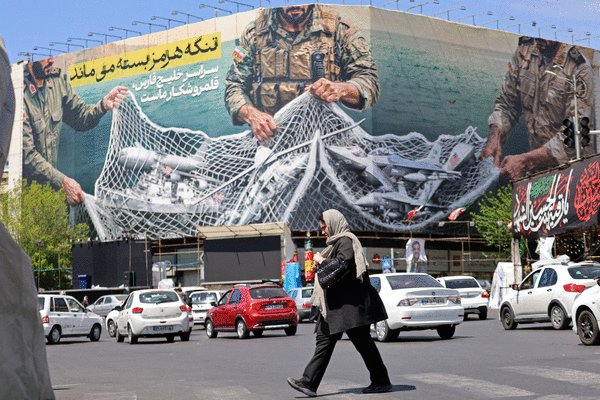
President Donald Trump said the U.S. will blockade the Strait of Hormuz following the failure of peace talks with Iran in Islamabad this weekend, a move that will likely exacerbate oil and fuel shortages globally.
“Effective immediately, the United States Navy, the Finest in the World, will begin the process of BLOCKADING any and all Ships trying to enter, or leave, the Strait of Hormuz,” Trump said in a social media post. The blockade would effectively sever Iran’s primary means of exporting oil.
Vice President JD Vance and envoys Steve Witkoff and Jared Kushner left the region Sunday after 21 hours of negotiations with top Iranian officials, mediated by Pakistan in an effort to end the six-week-old war. The failed talks left the ceasefire clinched last week in limbo, and Trump’s post signals more peril for the deal.
Hormuz is the world’s most important energy chokepoint, accounting for about a fifth of the world’s oil and liquefied natural gas. A full blockade of the strait would further pressure global oil markets by choking off the remaining trickle of shipments that have continued to move through the waterway.
A blockade would also sever a key financial lifeline for Iran, which has continued to export at levels similar to before the war, while benefiting from surging prices for its crude. Oil futures ended last week 30% above where they were before the war, while traders are paying record amounts north of $140 a barrel for some real-world cargoes as they scour the globe for supplies.
Trump later said the blockade would eventually lead to the free-flowing traffic that existed before the U.S. and Israel started the war.
“It’s called all in and all out,” Trump said in a live telephone interview on Fox News’ Sunday Morning Futures. “There’ll be a time when we’ll have them all come in and all come out, but it won’t be a percentage. It won’t be a friend of yours, like a country that’s your ally, or a country that your friend. It is all or nothing.”
Trump noted that the UK would be sending minesweepers and suggested allies would help with the blockade.
Britain won’t be taking part in the blockade, people familiar with the government’s position said. The UK has autonomous mine-hunting drones in the region but will only deploy them to the strait if a viable plan emerges in conjunction with other allies to reopen it, they said. That would be a separate action to Trump’s plan to blockade Hormuz.
Iran’s semi-official media cited “excessive” U.S. demands for the failed talks. But the country’s foreign ministry said it was natural that differences wouldn’t be resolved in a single round of negotiations, leaving the door open for more discussions.
The Trump administration used a similar approach against Venezuela earlier this year — effectively enforcing a blockade against its sanctioned crude on the open seas before its January capture of Nicolas Maduro.
Roughly a dozen warships were summoned for that effort. While the operation concentrated on the Caribbean, seizures sometimes happened far from Venezuela, including in the Indian Ocean.
Trump didn’t say Sunday where the U.S. would enforce its blockade against Iran. But his declaration comes after weeks of encouragement from some energy experts, who cast the approach as a way to deprive Iran of revenue tied to oil and strengthen U.S. leverage against Tehran as it seeks a full opening of the Strait of Hormuz.
If Trump orders the Navy to blockade the strait itself, he puts U.S. assets in danger of Iranian missiles. But the U.S. could more easily enforce a blockade out of reach of most of Tehran’s weaponry, in the Arabian Sea and other waters.
A blockade of the Hormuz strait is a less risky alternative to a military operation to seize Kharg Island, Iran’s critical oil export hub, said Dennis Ross, a former U.S. diplomat and Middle East envoy.
“Kharg Island for them is what they need to be able to hold. We can seize it, but then our forces would be quite vulnerable,” Ross said Sunday on Fox News. “This is a much smarter move than seizing Kharg Island.”
Seized oil cargoes could be sold by commodity trading firms on the world market, ensuring Tehran doesn’t benefit, said Clayton Seigle, a senior fellow at the Center for Strategic and International Studies.
The U.S. last month issued a sanctions waiver authorizing the sale of some Iranian crude — a move seen to help address concerns about oil supplies, particularly in Asia. Since U.S. curbs came into effect, China has historically been the biggest buyer of Iranian oil.
Even before that waiver expires on April 19, the blockade threatens to shrink supply.
“Countries around the world are now facing genuine energy emergencies and Washington’s economic response has been entirely disjointed,” said Brett Erickson, managing principal of Obsidian Risk Advisors. Administration officials “have backed themselves into a corner where the only remaining path is either hurting our allies in Asia, or letting Iran plunder the global energy markets.”
Since the war began, Iran has been the one Gulf country that has been able to export oil at a rate akin to pre-war levels. In contrast, production from its neighbors collapsed as the Hormuz strait was effectively closed off and Tehran began striking critical energy infrastructure in the region, sparking a hunt for crude oil across the world.
Iran exported about 1.7 million barrels a day of crude oil and condensate in March, according to preliminary tanker tracking data compiled by Bloomberg. That’s more than neighboring Iraq, which before the war was shipping at a rate far in excess of Iran.
Trump also said Iran’s possible mining of the key waterway and its demands for tolls to ensure safe passage is “WORLD EXTORTION, and Leaders of Countries, especially the United States of America, will never be extorted.”
The president also widened his threat to international waters, saying the U.S. Navy would interdict any vessel that had paid Iran’s toll. “No one who pays an illegal toll will have safe passage on the high seas,” he said.
While the U.S. president has demanded the strait be free and open for passage, some shippers have negotiated with Iran for safe travel through the corridor and Trump previously praised as a “present” the regime allowing 10 vessels to cross.
____
—With assistance from Tony Czuczka, Liezel Hill, Catherine Lucey and Ellen Milligan.
©2026 Bloomberg L.P. Visit bloomberg.com. Distributed by Tribune Content Agency, LLC.



Comments