UK and EU agree to tighten relationship as global order shifts
Published in News & Features
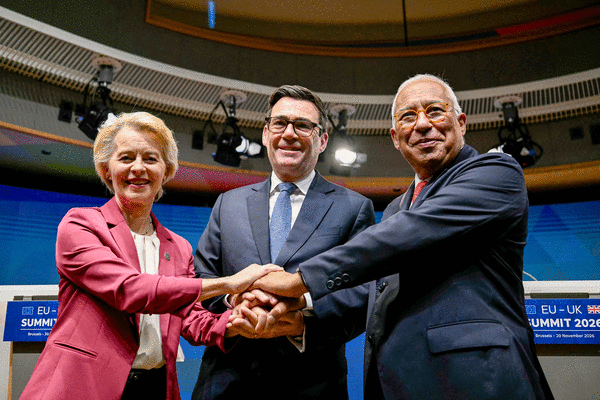
The U.K. and European Union have reached a set of deals to deepen their post-Brexit relationship, seeking to build collective strength against Russia, China and the U.S.
The deals will help ease food trade, link carbon markets and enable young people to live, work and study in each other’s countries, according to U.K. and E.U. officials. The timing for when these agreements will come into force will be included in an upcoming joint statement, a U.K. official added.
U.K. officials said the two will also make a political commitment regarding the E.U.’s Made in Europe trade and procurement policy, which seeks to prioritize E.U. companies.
Settling on a post-Brexit accord was the key goal of a Friday summit in Brussels between U.K. Prime Minister Andy Burnham and E.U. officials. Both partners say tighter bonds are needed given the shifting global order, with the U.S. questioning long-standing security commitments to Europe, Russia waging war in Ukraine and China tightening exports of key resources.
Burnham said the pact would be “good for working people, good for Britain and good for Europe,” arguing: “In a more dangerous world, we are stronger together.” The British prime minister has said the deals could add as much as 0.4% to Britain’s economic output.
An official with the European Commission, the E.U.’s executive arm, described the deal as a good package, adding that, as always, some details still need to be hashed out.
The core elements being signed off at the summit in Brussels have been widely previewed over months of talks that were delayed after the resignation of Burnham’s predecessor, Keir Starmer:
•The U.K. and E.U. will harmonize their so-called sanitary and phytosanitary standards. That would allow most foods to be traded without the current requirement for certification. In exchange, the U.K. would align its rules with those of the bloc.
•Both sides will link their emissions trading systems, which impose pollution caps on companies and allow those that reduce emissions faster to sell unneeded credits to others. The two will now work to link their systems and allow for mutual recognition of each other’s pollution permits.
•They will set up a Youth Experience Scheme giving young Europeans the freedom to travel, work and study in both regions. Bloomberg previously reported that the agreement would include 100,000 people, a win for the E.U. after British envoys sought a lower number.
There are some outstanding disagreements, however, as the two are still wrangling over whether E.U. students get to pay U.K. rates when studying in Britain. The two will commit to resolving the matter in the next six months.
Lower tuition fees has long been a key demand of E.U. countries during post-Brexit talks, given E.U. nationals are currently subject to much higher international tuition costs. But the impact of such a move could have a sizeable impact on the British economy. The Russell Group of leading U.K. research universities calculated that home-fee status for E.U. students would cost the university sector about £570 million ($750 million) a year.
U.K. officials said the three agreements would proceed even if the U.K. and E.U. can’t agree on tuition fees in the next six months, saying the deal had been done.
They added that both the U.K. and E.U. would immediately begin the process of legislating to implement the deals. The U.K. will introduce a bill next week to giving the government power to implement both the carbon market and food standards agreements, while the E.U. will also begin its legal ratification process, the people said.
Full implementation is unlikely to be completed within six months, however, the U.K. officials added.
They said the joint statement will also contain a commitment for the U.K. and E.U. to work together on Made in Europe policies to give Britain a foot in the door of the procurement policy — potentially a significant boost for U.K. industry.
Details of how the future partnership could work will emerge as talks progress. But, for the U.K., the commitment to entering negotiations on this is a significant political and economic win.
The U.K. and E.U. have been on a fitful path to reconciliation since the center-left Labour Party returned to power in 2024, taking over from the Conservatives who had pushed for Brexit. While Starmer said he wanted to warm ties with the continent, those attempts haven’t always gone smoothly.
The two sides fell out, for instance, over negotiations for the U.K. to join the E.U.’s flagship €150 billion ($165 billion) defense fund, making it harder for British firms to bid for certain contracts. Later, a planned summit between the two was pushed back after Starmer resigned.
But Burnham has breathed new life into the effort, catching attention when he floated a possible E.U. return for Britain. Since then, the two sides have sought agreements they could peg to Friday’s summit — the one initially planned for earlier this year.
—With assistance from Max Ramsay.
©2026 Bloomberg L.P. Visit bloomberg.com. Distributed by Tribune Content Agency, LLC.




Comments