Chicago Mayor Brandon Johnson proposing vacant lot tax to help fill $75 million budget gap, but sticking with head tax
Published in News & Features
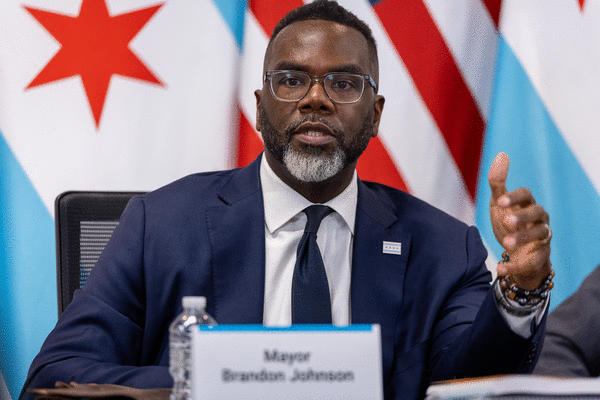
CHICAGO — Mayor Brandon Johnson is proposing a new tax on vacant lots as part of his plan to close a $75 million budget gap, while holding on to a corporate head tax that most aldermen have rebuffed.
The budget amendment package Johnson shared with aldermen Tuesday also counts on rosier tax revenue projections and stepped-up debt collection. But because the mayor is sticking with the corporate head tax, which a City Council majority has repeatedly rejected in letters, his new proposals appear unlikely to end City Hall’s budget stalemate.
The new gap opened earlier this month, when the City Council voted 44-6 to spend a $75 million windfall on an additional advance pension payment. Aldermen secured the money in September during negotiations over the city’s parking meter deal. Johnson had proposed folding the cash into the city’s $364 million advance pension payment, but aldermen insisted they had earmarked it for a separate payment on top of that.
To make up the difference, Johnson wants to impose a $1,000 annual tax on privately owned vacant lots, starting in July. His administration wrote in a memo to aldermen that the tax would raise $12 million and push owners to put land to productive use.
The tax would exempt side lots and areas that “serve a neighborhood purpose,” as well as lots whose owners are awaiting permits or financing, his team said. Johnson also wants to raise $1.2 million by increasing fees on vacant buildings.
The largest piece of the plan comes from a revised revenue estimate. Johnson is counting on $25 million more from state tax revenue distributed to Chicago than his budget projected in late October. When his team first made the estimate in June, revenue from the state’s Personal Property Replacement Tax had been running 2% below expectations. It is now running 20% above projections, according to Johnson’s administration.
The mayor’s new plan also counts on $13.3 million generated by modernizing procurement through competitive pricing and reverse auctions. Another $12 million would come from reviewing overdue invoices, primarily ones tied to corporations and other governments, and hiring more debt collectors tasked with going after “parties with the greatest amounts of outstanding debt,” the memo said.
Johnson wants another $11.5 million to come from the city’s Catalyst Fund, a fund tasked with loaning money to businesses in underserved neighborhoods that has gone untouched since 2020.
The mayor’s team planned to brief aldermen on the proposal Tuesday, according to Ald. Byron Sigcho-Lopez, 25th, who shared a memo outlining the plan with the Tribune. Last week, Johnson canceled similar briefings scheduled for Friday and told aldermen he would instead send them an “amendments package” that day, according to emails his administration sent to aldermen. The emails suggested the package would address more than the $75 million gap.
“I think some of these are backed by a referendum already,” said Sigcho-Lopez, a close Johnson ally. “These seem to be feasible, but I’m going to listen into the briefings to see what else people are saying.”
But for many aldermen, only one thing will stick out in Johnson’s new package: his decision to keep a head tax.
Johnson’s $17.6 billion spending plan for 2027, which he calls the “Fair Share” budget, would revitalize his corporate head tax proposal from last year with a twist. The tax of $25 per worker per month on companies with more than 125 employees would offer a full rebate for jobs in designated areas, mostly on the South, Southwest and West sides.
But as with his proposal last year, most aldermen are staunchly against it.
Opponents on the council signed a letter shooting down a head tax before the mayor introduced his budget and reiterated that red line afterward. Gov. JB Pritzker also publicly criticized the levy again. But Johnson and his progressive allies have rallied around making big businesses pay more, especially as the Trump administration cuts corporate taxes. They have also dared opponents to offer a better plan, after an opposition bloc crafted its own final revenue package last year.
“Do they have the ability to pass their own budget or not?” Johnson said at a news conference last Tuesday in which he described his predicament of aldermen demanding he go back to the drawing board as “ironic” after last year’s historic revolt against him.
Sigcho-Lopez defended the mayor’s decision to stick with the head tax, arguing the aldermen who oppose it bear the burden of finding a replacement.
“I think the mayor is listening directly to the people,” he said. “To me, it’s important that the City Council offer alternatives. …They need to offer solutions.”
Johnson’s decision to hold firm comes after aldermen passed a veto-proof ordinance to independently investigate the city’s finances after his third chief financial officer resigned this year. Ashlee Gabrysch left after just three months on the job, saying she couldn’t fulfill her obligation to provide “complete and accurate” statements about the city’s finances.
Holding onto the head tax does nothing to cool tensions at City Hall. But it keeps scrutiny off other parts of his budget, including his plan to raise $234 million by hiking personal property lease transaction taxes from 15% to 20%.
And he keeps the debate focused on a question he is sure to want voters to focus on when they head to the ballot box in February: Should Chicago tax the rich more?
____
©2026 Chicago Tribune. Visit at chicagotribune.com. Distributed by Tribune Content Agency, LLC.


Comments