Movie review: Storytelling less than magical in fantastical '100 Nights of Hero'
Published in Entertainment News
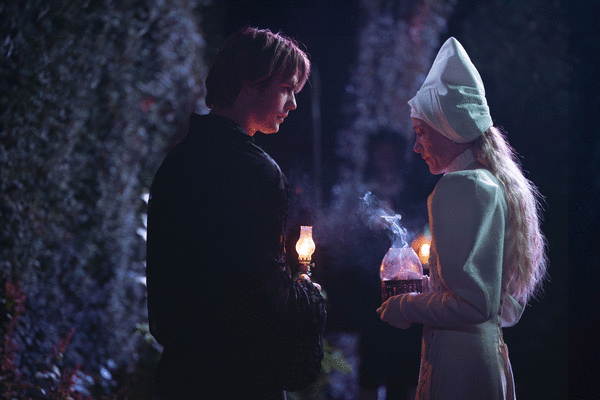
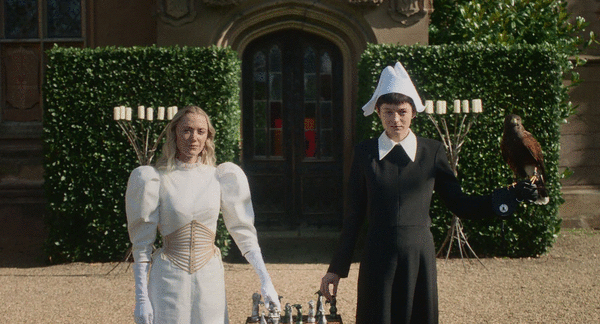


“Are you ready? Then we shall begin.” This narration, over an image of three moons hanging in the sky, begins Julia Jackman’s “100 Nights of Hero,” which she adapted from Isabel Greenberg’s 2016 graphic novel, and directed. It signifies that we’re in for a level of heightened, self-reflective fantasy storytelling, and in fact, the revolutionary power of storytelling itself is the beating heart of this film.
Jackman takes her own stylistic approach to “100 Nights of Hero” without replicating Greenberg’s aesthetic. You can almost immediately tell this fantastical film has a feminine touch in its colorful, highly stylized, modernist look and sound; there’s a certain girlish wit in the vibrant pink hues and the centering of women’s narratives within the mannered compositions. The setting is an ancient (vaguely medieval England), secluded, cult-like community that reveres their god, Birdman (Richard E. Grant, in essentially a cameo), and fashions their patriarchal society around the usual tenets: controlling women, producing heirs.
Young bride Cherry (Maika Monroe) is married to Jerome (Amir El-Masry), and though he claims they are trying to have a baby, he is not. Too bad she’s the one who will suffer the consequences of failing to get pregnant.
Soon, Jerome’s hunky man friend Manfred (Nicholas Galitzine) turns up and the two men engage in a cruel bet. Manfred has 100 nights alone in the castle to seduce Cherry while Jerome is away on business. If he fails, he has to find a baby for Jerome, who is uninterested in sex with women. If Manfred succeeds, he gets the castle. But if Cherry strays, she hangs. It’s a lose-lose situation for the wife, as expected.
Cherry has one person on her side, Hero (Emma Corrin), her cunning maid, who distracts Manfred from his goal by telling the story of three sisters, who engage in the “sinful, wicked and absolutely forbidden” (for women) pleasure of reading and writing. One of the sisters, Rosa (Charli XCX), is married off to a merchant who soon discovers her “witchcraft.”
Every night, Hero, tacks on a new chapter of the three sisters, their story interwoven with Cherry and Manfred’s, while we discover that Hero is a part of the League of Secret Storytellers, women who collect stories and weave them into tapestries, their women’s work hiding their true intention while the stories spread from ear to ear.
The issues here are basic and elemental: the trials and tribulations of sex, marriage, fidelity and procreation. Though brides are trapped in castles and men in bird masks want to burn the witches, this story is not so out of our time or place. The pressure to “produce an heir” lives on in current pro-natalist arguments and “trad wife” discourse, and the control of women’s bodies — and minds — is required to fulfill the goal of producing more and more babies. This tale doesn’t seem so ancient or fantastical at all.
However, there’s little nuance to the storytelling of “100 Nights of Hero” itself. It feels a bit like “feminism for tweens,” a young-adult approach to explaining how the liberation of minds is necessary for the liberation of women’s bodies — it is blunt and obvious, which is to the film’s detriment. There are few gaps to fill, or threads we pull together on our own, and its quirky, opulent aesthetic can only sustain the exercise for so long.
As our interest wanes over the course of this 90-minute modernist fable, Manfred starts to slip away — natural for a folktale that seeks to decenter men. Unfortunately, Galitzine’s screen presence is just too powerful to ignore, and we notice his absence. Perhaps it’s that Manfred is so swaggeringly confident, Galitzine’s embodiment of fluid sensuality standing in stark contrast to Monroe’s stiff, anxious, breathy performance as Cherry.
The most powerful image of the film, which is made up of interesting images, is of Galitzine covered in blood as he hauls a freshly killed stag home for lunch. If the film is about women discovering their own pleasure and sensuality outside of men, they shouldn’t have made Manfred the most appealing and earthy character on screen.
While “100 Nights of Hero” sports compelling actors and beautiful visuals (often best seen in montage, animated by editing), its storytelling about the power of storytelling is unfortunately less than riveting. The urgency of the message remains, but the delivery leaves something to be desired.
———
'100 NIGHTS OF HERO'
2.5 stars (out of 4)
MPA rating: PG-13 (for sexual material, some bloody images and language)
Running time: 1:30
How to watch: In theaters Dec. 5
———
©2025 Tribune Content Agency, LLC












Comments