Review: In 'Marjorie Prime' on Broadway, the disquieting robot future is here
Published in Entertainment News
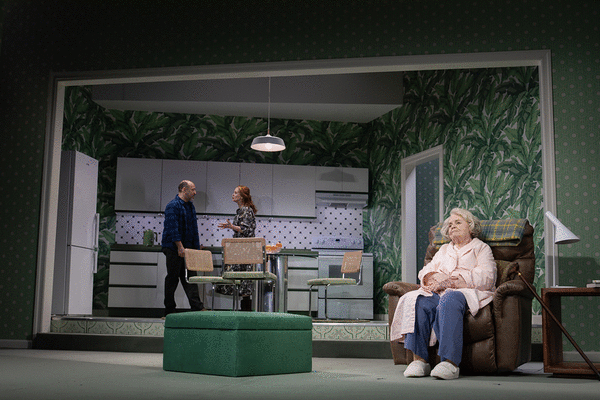
NEW YORK — The central premise of “Marjorie Prime,” now on Broadway with Cynthia Nixon, June Squibb, Danny Burstein and Christopher Lowell, is that technology might allow the creation of bespoke robots allowing, say, a grieving widow with dementia to talk to something that looks and talks exactly like her late husband. Not only would he be restored to her in three dimensions, he could be ordered up looking tanned, handsome and hot, as he did in his prime. The play begins with an elderly woman, played by Squibb, having just such a conversation with just such a strong-jawed dude (Lowell).
I first saw this Jordan Harrison play in 2015 at Writers Theatre in Glencoe, Illinois. The premise certainly was intriguing but it felt futuristic and, well, safely remote. My reaction at the time was mostly of curiosity, including the quip “Beats interacting with strangers in a nursing home, wouldn’t you say?”
Now? The play is far more disquieting as a consequence of the passage of time. In fact, I can’t ever remember ever seeing a play whose impact felt so utterly different a decade later.
These things are almost here now, thanks to the advances in artificial intelligence and other forms of human mapping that use our history and our actions to such an extent that they could replicate us after death. Once you have those guts, the rest is just sculpted plastic.
Harrison’s 80-minute play, directed with an eye on what matters most by Anne Kauffman, has a new urgency that sends your head spiraling in all kinds of directions. As you watch, you likely will first think about how dementia care — heck, how all kinds of senior care — could be immeasurably improved by these robots that can work 24-hour shifts. But after a while, since Harrison leads you by the hand that way, your head will go to the problems: Who would win the fight to program these things?
Imagine, for example, two warring siblings with different views of their father. His “Prime” version could reflect just one of their dubious take on his identity, leading his widow down the kind of garden path that strikes me as dangerous for the entire human race. Taking that a step further, the play explores the likelihood that we won’t even be able to control representations of ourselves after we are dead. For some, that’s already the case, god help us.
Harrison explores this issues with a simple, four-character play that begins with the aforementioned conversation but then focuses on Marjorie’s daughter and son-in-law, played by Nixon and Burstein, nice people in their late 50s who are trying to figure out how they feel about this technology and, just as importantly, what it might mean for them in their own future. (I won’t give that away, but the play, like the world, only spins forward.)
Kauffman is one of America’s most humanistic stage directors and both Nixon and Burstein forge likable characters, focused on the vulnerability those of us close to 60 years old feel when it comes to the demise and loss of our parents. I should note that I walked into 2nd Stage’s Hayes Theatre having just spent extended time with my 102-year-old mother, so that certainly was in my head, although she was not talking to any robots. Yet. She does talk to carers though and they have only limited, quickly crammed knowledge of her rich life. A robot of my dad perhaps could write a book.
You see where this play takes you?
Nixon’s Tess is vulnerable enough for you to sense the fear in her eyes, but this is an actress with a steely core and, indeed, Nixon turns on a dime when her character realizes, as I think many of us have or will, that this brave new world of now is short on both guardrails and moral principles.
“Am I supposed not to notice she is being nicer to that thing than me?” Tess snaps at one point, bringing up another salient AI issue.
Squibb, 96, whose Broadway career stretches back to her role as Electra in the original 1960 production of “Gypsy,” is excellent. For the record, she is the oldest actress ever to open a Broadway show. With Mike Nussbaum gone, she is singular.
Comparisons surely will be made with another Broadway show about robots, “Maybe Happy Ending,” a quite lovely musical that also uses them as proxies for a study of mortality. The singing robots have degraded batteries, though; the ones in “Marjorie Prime” appear to go on forever. It’s the humans who die first.
———
At the Hayes Theater, 240 W. 44th St., New York; 2st.com.
———
©2025 Chicago Tribune. Visit chicagotribune.com. Distributed by Tribune Content Agency, LLC.









Comments