Review: 'Mel Brooks: The 99 Year Old Man!' chronicles the comedic genius of a living legend
Published in Entertainment News
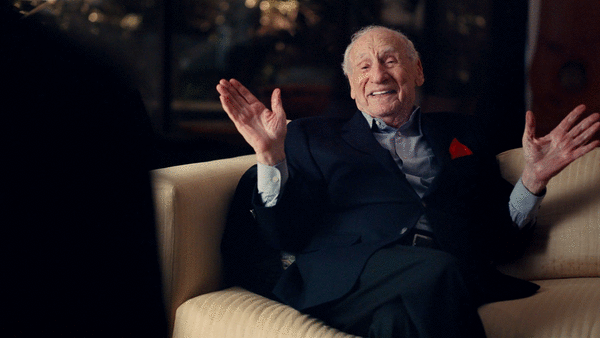
Judd Apatow and Michael Bonfiglio have made a two-part, four-hour documentary about a comedy idol, "Mel Brooks: The 99 Year Old Man!," premiering Thursday on HBO and HBO Max. It follows Apatow's "The Zen Diaries of Garry Shandling" and "George Carlin's American Dream," also directed with Bonfiglio, in a growing library of comic biographies; a film on Norm Macdonald is in the works.
It's a basically chronological telling of the life and work of a man who helped shape the comedy of the 1950s, '60s and '70s, and as an influence, of the '80s and '90s and beyond — there is perhaps no "Airplane!," no "Austin Powers," without the trail blazed by "Blazing Saddles" and "Young Frankenstein." When I told my friend Jack, 33, that a "Spaceballs" sequel is coming, co-starring and co-written by Brooks, he could not have been more excited.
It's also as a love story, or stories: that of Brooks and second wife Anne Bancroft; of Brooks and best friend and double-act partner Carl Reiner; of the love of the audience for the work, and the love between characters in the work, which might not always be obvious but is clear to Brooks. ("He's a loving man. It's about love with him," says Richard Pryor, one of the writers on "Blazing Saddles.") There's a subtle sweetness to the documentary that can be quite moving, especially if the work means something to you, as well. I grew up on the New York Jewish sound of Brooks as the 2000 Year Old Man and the soundtrack album to "The Producers," which included large sections of dialogue; I know its inflections like one might internalize every element of a popular song. It's music to me.
I also laughed a lot, even at clips from movies I might not have laughed at before, which makes a course of rewatching feel inevitable.
After Brooks apprenticed as a teen entertaining in the Catskills and served in World War II, Sid Caesar hired the young comedian on his own dime to write for "Your Show of Shows." He joined a murderers' row of Jewish comedy geniuses there, led by Mel Tolkin (born in a shtetl near Odessa, Ukraine) and including Neil Simon, Norman Lear, Larry Gelbart, Lucille Kallen and Selma Diamond, with contributions from co-star Reiner. Woody Allen came on board for "The Sid Caesar Show" and "Caesar's Hour."
When Brooks failed to convince Caesar to quit TV and make movies with him, which he saw as the more durable medium, he struck out himself, reducing his income from $5,000 to $85 a week. Even when he'd been doing well, his ambitions were inextricable from anxiety, and it wasn't until "Get Smart!," the 1965 sitcom he created with Buck Henry, that his fortunes turned around. "The Producers" followed, which was not initially a great financial or critical success; negative reviews are displayed here. (In "History of the World, Part I," he had a caveman critic urinating on cave art.) But it earned Brooks an Oscar for writing and started something.
"Blazing Saddles," a Western about racism, with farting, followed "The Twelve Chairs," an underappreciated, serious sort of comedy and a tonal anomaly in his canon. An enormous success ("We went to that movie like it was a concert," recalls "Dumb and Dumber" director Peter Farrelly), "Blazing Saddles" codified the Brooksian style, mixing smart humor, low humor, surreal humor, metahumor, satire, sight gags, slapstick and an insouciant impudence that smelled like freedom. "Young Frankenstein," another huge success, came next, with other genre parodies — "Silent Movie," "High Anxiety," "History of the World," with its huge production number based on the Spanish Inquisition, "Spaceballs," "Robin Hood: Men in Tights," "Dracula: Dead and Loving It" — lined up behind. And then, after a spell, came the Broadway musical adaptations of "The Producers" (which won a record 12 Tonys and became a movie in turn) and "Young Frankenstein," their scores written by Brooks.
One of the advantages of taking Brooks as a subject is that he likes to talk, and is smart and funny when he does. (Interviewer: "You lost your father at an early age." Brooks: "No, no. My father died.") "Your Show of Shows" producer Max Liebman called him "a human interruption," and Gelbart observes, "Mel thought when he got slapped in the ass by the doctor who delivered him that was applause, and he has not stopped performing since."
"The 99 Year Old Man!" supports Apatow's new at-home interviews with decades of talk show and panel appearances, which the directors might cut between to construct a patchwork version of a single anecdote — the oft-told "Cary Grant" never gets old — and providing a picture of Brooks through the ages. Time, inevitably, is a subject of such a film, and though mortality isn't specifically on the agenda, many people seen here are no longer alive — not just Brooks' peers, who are all gone, and Bancroft, who died in 2005, but David Lynch, whom Brooks hired to direct "The Elephant Man," and Rob Reiner, who has a funny story about meeting him as a child.
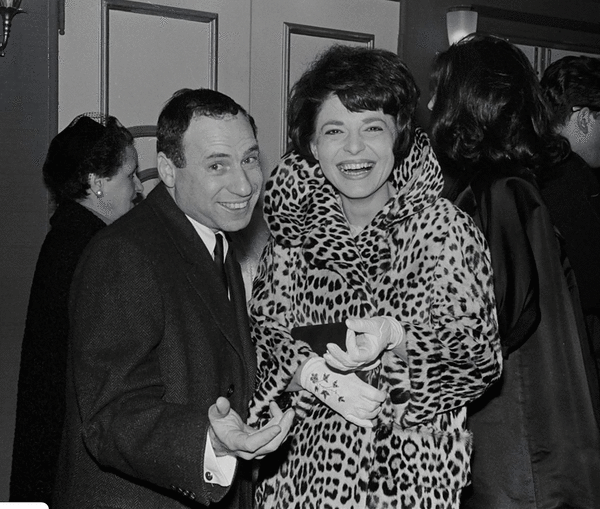
Brooks is forthcoming about the low points in his life and career. When he met his future second wife in 1961 — or rather, shouted "Anne Bancroft! I'm Mel Brooks!" from out in the theater where he first saw her rehearsing for a TV broadcast, then proceeded to follow her around for days — he was completely broke. (She would pay for dinner when they went out, but slip him the money to preserve his ego.) "I was in love with him instantly," Bancroft said, "because he looked like my father, and he acted like my mother."
As pictured here, their relationship is a delight, not the least because they seem so delighted with each other. Though Brooks calls himself funny-looking where Bancroft was a great beauty all her life, they made a handsome couple; the photographs are wonderful. On some tandem television appearances they harmonize, ad lib, on "For Me and My Gal," and sing "Sweet Georgia Brown" in Polish (as in their co-starring remake of "To Be or Not To Be.") They are wonderful in a meta episode of "Curb Your Enthusiasm," echoing the plot of "The Producers," in which Larry David is cast as a replacement Max Bialystock, in order to close the show.
Newly interviewed subjects include Adam Sandler, Ben Stiller, Jerry Seinfeld, Sarah Silverman, Amy Schumer, Nick Kroll, Patton Oswalt, Dave Chappelle (who was 19 when Brooks cast him in "Robin Hood"), Cary Elwes (doing a wicked Brooks imitation), Conan O'Brien, Josh Gad, Robert Townsend, Jerry and David Zucker, Barry Levinson, Matthew Broderick, Nathan Lane, Brooks' four children and granddaughter Samantha.
There is discussion of Jewishness ("There isn't anybody our age or up that didn't have the pride of Mel being Jewish," Sandler tells Apatow), of the appropriateness of Hitler jokes ("Comedy destroys the dignity of the enemy") and of the uses of humor: "I maintain seriously there is nothing that is not the subject for comedy," says Brooks, "because comedy is a sensational and sometimes spectacular political weapon."
"I feel I'm doing a great service to mankind by bringing important ideas in the form of great art to the public," he says of his studio, Brooksfilms (which, besides "The Elephant Man," produced David Cronenberg's "The Fly," the Frances Farmer biopic "Frances" and the Caesar-inspired "My Favorite Year"). "And in return all I want is a lot of money." But he also lives for "the moment an audience will abandon its dignity and its self-respect" and laugh.
"You give them a little sweetness," he says, "you get it back."
———
'MEL BROOKS: THE 99 YEAR OLD MAN'
Rating: TV-MA
How to watch: HBO and HBO Max
———
©2026 Los Angeles Times. Visit latimes.com. Distributed by Tribune Content Agency, LLC.







Comments