Q&A: 'Shelter' director Ric Roman Waugh reflects on the growing Texas film industry
Published in Entertainment News
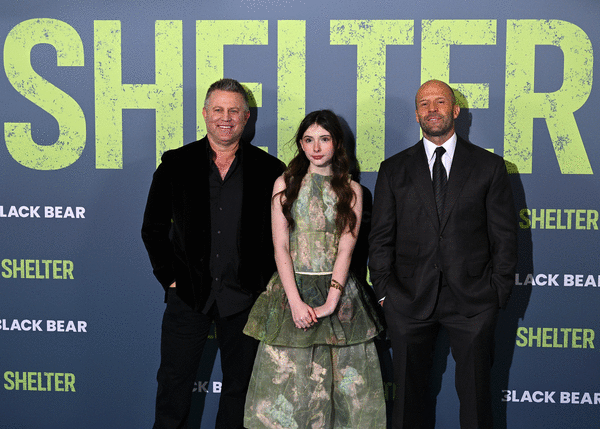
FORT WORTH, Texas — Ric Roman Waugh is having a busy January.
The 57-year-old California native has not one, but two feature films out this month in the Gerard Butler-starring “Greenland 2: Migration” and the Jason Staham-led “Shelter.” The former released on Jan. 9, while the latter hits theaters on Friday, Jan. 30.
It’s “Shelter” that finds Waugh speaking virtually with Star-Telegram on a cold January day.
The action film follows a recluse (Statham) who rescues a girl from the sea while living on a remote Scottish island. This action unleashes “a perilous sequence of events that culminate in an attack on his home, compelling him to face his turbulent history.”
Waugh, who lived in Austin for more than a decade, said the film hits right in his wheelhouse of action and heart.
“If it doesn’t hit me in the gut, and I’m not feeling it, I’m just not in,” he said.
Ahead of the film’s release, Waugh spoke with the Star-Telegram about the changing Texas film industry, what it’s like working with Statham and making a film in the (cold and windy) elements.
[This interview has been edited for clarity and length.]
Star-Telegram: Are you still based in Austin?
Ric Roman Waugh: The irony is, I just had moved to Savannah, Georgia. My boys are going to go to film school here. [My wife] Tanya and I, we’re a very tight-knit family, and we said, “Well, I guess we’re following you.” We miss Texas. We had a great, great run in Austin for many, many years, and will always be close to my heart.
S-T: The filmmaking landscape in Texas has changed so much over the years. Chief among that is the $1.5 billion film incentive bill that passed in the State Legislature last year. I know you’re not here anymore, but I’m curious for your thoughts on this as someone who did live in Texas for over a decade. What do you think this investment means for the industry in Texas?
RRW: I’m hoping that it means good things, because right now we’re dealing with an economy, and I’m talking about the film economy, where we’re not being as competitive as we can be or should be. Just keep pictures here, keep productions in the U.S. I just moved to Savannah, and obviously Atlanta is one of the places that a tremendous amount of filming was happening, and it’s not as much now.
I think everybody’s feeling it. I’m doing everything I possibly can to start to help that process of getting stuff back here. But it’s going to take all of us to figure out the economics of it, to make it a viable path for studios and financiers that are going to look at the bottom dollar as they should.
S-T: “Shelter” continues a trend for you in that it has plenty of action and heart. I know those two elements are crucial to you, so I’m curious when you’re developing something or choosing a project, how do you know when you’re hitting both of those things?
RRW: It’s got to hit me in the gut. If it doesn’t hit me in the gut, and I’m not feeling it, I’m just not in. I probably have passed on things I shouldn’t of. But it really has to have an emotional hook to me.
I come from the stunt world, I come from the action world. I can build action, but building heart, that has to be an organic thing that’s in the DNA of the story that you’re going to tell. And also, what is the controversial subject matter, or what is the relatable subject matter that makes it feel real to us, that we understand what this character is going through?
This one came from Jason Statham himself. He had called me, which was such a great call to get about this passion project that meant a lot to him. The minute I read it, I knew it was going to give audiences, especially his fan base, something brand new. You’re going to get your cake and eat it too. You’re going to get a big action ride and love the action star that we love and admire. But you’re going to see a tour de force performance and a character that is reminiscent of the great anti-heroes of “Shane” from the 1950s to Creasy in “Man on Fire,” Jean Reno in “Léon: The Professional.” These people that have dealt with a dark shadow in their past and have dealt with trauma and different issues and put themselves into a form of exile, which I loved about this movie, what it had to say. How we can all do that to ourselves and put ourselves into any form of our own exile.
He saves this young girl who’s going through the same kind of similar experience of isolation, only to realize down the road that maybe she’s there to save him. It becomes this great gauntlet run and love story. These two people that find family in one another, but [has] that great moral question and conflict of, “Do I keep her in my life because I finally found family? Or, do I go and seek shelter for her and get her away from the dark cloud that’s following me and will never stop following me?” I love that. I love that question and that complication for a hero. Watching Jason Statham play somebody vulnerable and very different than a lot of the things you’ve seen from him.
S-T: I don’t have children myself, but it made me think of how having a child can completely change your life. You’re a different person before and after they arrive. As a filmmaker, do you feel like you’ve changed since becoming a father?
RRW: Yeah. I think that whenever I’ve tried to mentor younger filmmakers or writers and so forth, even people that are brand new to the business. I always talk about your life experiences are your war chest. The most darkest of times, the triumphs, everything in between. When you become a parent and you start being responsible for others, it gives your life perspective in a very different way that you just can’t fake. That’s what is lovely about the collaboration with Jason Statham, because Jason is the most authentic person I’ve met in a very long time. He lives or breathes his life with the same code, the same level of respect, the same sense of family. How important his kids and his wife are to him. His parents came to set all the time. That authenticity comes across into the characters he plays, especially this guy Michael Mason.
That sensitivity that you see in him with this young girl and protecting her, and that familial way where she finally finds somebody that is 100% there for her and she doesn’t want to lose it. His responsibility that he has about trying to make sure that her safety comes first. It’s a great kind of emotional thrust that hopefully doesn’t pull any punches along the way. I’m a bit of a softie, and you hopefully get that great smile at the end of what will be next for them, but at the same time, really trying to be true and authentic.
That’s kind of what I love about where filming action is going, which is great. It’s really getting back to doing grounded action again, that is real. That’s the fun part of everything in “Shelter.” I mean, we did it live. It’s all real.
S-T: It sounds like you and Jason have known each other for some time. Have you guys wanted to work together before? Or, was this the first time you guys talked about doing a project?
RRW: We had talked about things and so forth, but this was the first one, and I heard it in his voice when he called about what it meant to him. When you get somebody calling you at his level that you already admire, and you hear that passion. Then you read it, and you see it, hook, line and sinker, this is different. That’s everything I’m trying to do with movies that I take on as a director. I’m trying to give you your cake and eat it too. I’ll use that same terminology. Where I’m trying to give you a big action ride, put you in a big, visceral world, but do it slightly off center in a way that feels fresh and unique and different and also relatable. Like, how is it the inside out version of the thrill ride? Where you live and you’re immersed with the characters that you’re following, versus watching them. You feel like you’re a part of the journey with them.
S-T: When it comes to the action, it couldn’t have been a pleasant experience filming on this island with all this wind and weather. When you’re crafting an action scene, how much does that change, from what the script says to the location you have access to and the weather conditions? How do you know you’re still getting it?
RRW: It’s tough, because you don’t get to pick the time of year that you’re filming. We shot it [in Ireland] in the wintertime, and of course, the script wants it to be cold and so forth. We didn’t have to fake it, I’ll tell you that. I think that it lends to the authenticity, right? Because you’re living and breathing the real elements, not only in front of the camera, but the entire crew, right? We’re all there. The opening storm sequence, when we’re filming Jason Statham rescue swimming Bodhi [Rae Breathnach] in those stormy seas. That’s him rescue swimming a girl that’s 13 years old, and doing it for real.
It’s definitely more demanding and more difficult to shoot that way. But there’s a kinetic energy that I’ve always believed in since my stunt days. You just can’t fake that. There’s a reason that we love the crazy man Tom Cruise and what he’s doing with his action movies. Because those kind of amazing stunts that he’s doing, when they’re real, you just know it. You feel it. That’s what I’m always looking for. Action that you feel, and feel immersed in it and participating in it, versus just watching it.
———
“Shelter” opens in theaters Friday, Jan. 30.
———
©2026 Fort Worth Star-Telegram. Visit at star-telegram.com Distributed by Tribune Content Agency, LLC.








Comments