Sam Raimi dedicates 'Send Help' to his childhood friend, Scott Spiegel
Published in Entertainment News
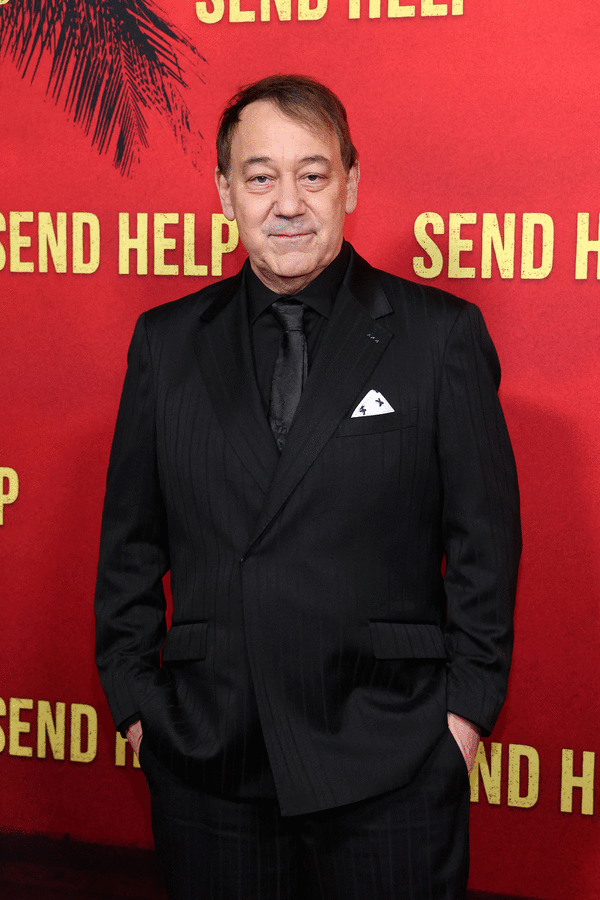
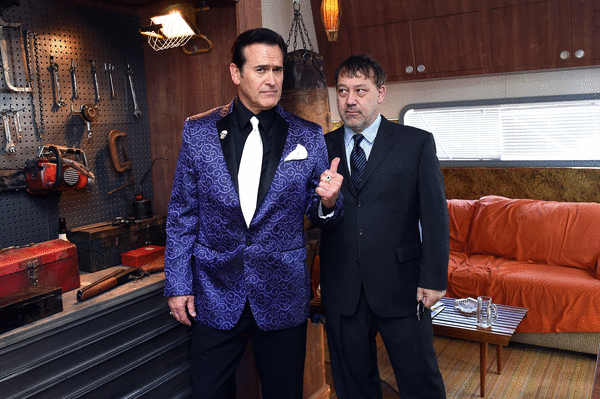




DETROIT — Stay through the end credits of director Sam Raimi's wild new horror thriller "Send Help," starring Rachel McAdams and Dylan O'Brien as warring co-workers stranded on a deserted island together following a horrific plane crash, and you'll see a dedication: "In memory of Scott Spiegel."
Spiegel was childhood friends with Raimi and his ragtag crew of young filmmaking friends — along with Bruce Campbell — who were making "Three Stooges"-inspired slapstick comedies as junior high and high school kids in Birmingham and Royal Oak in the 1970s. Raimi and Campbell were both into movies and movie culture, but Spiegel was on a whole 'nother level with his fandom, and his technical prowess.
All of them went on to Hollywood careers: Raimi turned into one of the industry's top directors, kicking off the modern superhero motherlode with his "Spider-Man" trilogy, and Campbell became a campy cult hero, thanks to his roles in Raimi's "Evil Dead" films.
Spiegel wasn't as well known to the masses, but he made a considerable mark on the movie business in his own right: He was a writer, director and a guy who knew everybody, and after he introduced his producing partner Lawrence Bender to a young Quentin Tarantino, Tarantino publicly thanked Spiegel for giving him a career.
Spiegel died of a heart attack in September, as "Send Help" was in postproduction, and Raimi decided to honor his friend's memory by dedicating the film in his name.
"We spent years learning from Scott," says Raimi, on a Zoom call last week from his home in Los Angeles. "Scott showed us the way."
Without Spiegel showing Raimi and his friends the way in those early years when they were all young, creatively fertile movie obsessives, Hollywood might look very different than it does today.
A critical component
Raimi was born and raised in Royal Oak, and he attended Wylie E. Groves High School in Birmingham, where he met Campbell as a youngster.
Campbell already knew Spiegel, and he brought him into the friend group. "Scott and I went all the way back," says Campbell, on the phone earlier this week. "There's nobody, not one guy, I've known longer than Scott Spiegel in my whole existence."
Campbell and Spiegel worked together at Walnut Lake Market, on Walnut Lake Road in West Bloomfield Township, where they were both stock boys, breaking down cardboard boxes behind the store for hours on end. While they were handling the boxes, they'd dream about making movies.
Every inch of Spiegel's "lair," as Campbell calls Spiegel's quarters in his mother's cottage on Walnut Lake, was lined with monster masks, horror magazines, model kits.
Campbell introduced Spiegel to Raimi, and Raimi was shocked to learn Spiegel, who was a year older than him, was as into the craft of filmmaking as he and his friends were.
In the basement of Spiegel's house, he had set up a movie screen, with a couch in front of the screen. He had built a fake wall with a projector set up behind it, which he would use to project movies. It wasn't gigantic but it was an impressive set up, especially for the time, and it showed how serious he was about movies.
"I couldn't believe that he'd gone to these lengths," says Raimi, now 66.
In addition to showing movies, Spiegel also made them, and was several steps ahead of Raimi and his friends.
"Bruce had done great experiments with stop motion. He would put some stuff on the ground, pretending to be on a car, and take a frame, scoot it forward, take another frame, scoot forward, and it was amazing looking. You know, incredible stuff," Raimi says. "But Scott made movies with stories and sets. I couldn't believe it."
"Scott was key, Scott was critical," says Campbell, 67. "Scott was the one who took it more seriously than we did way back when."
Spiegel's shorts — he made "Inspector Klutz Saves the Day" when he was 12, "Pies and Guys" and "Corny Casanovas" both when he was 14 — not only had sets and stories, but they included extra touches, like stock footage.
"He would make his movies in black-and-white so he could get this expensive-looking stock footage that he could buy from, like, Blackhawk Films, and cut it into his movies to make it look really professional," Campbell says.
Spiegel's films also had soundtracks. He would record "Three Stooges" shorts and then perform to the audio, which he would play back on set on a cassette player, and then sync the sound in the final edit. And his movies had credits attached, and he taught Raimi how to make credits using stencils, and how to light the background so they'd read correctly on camera.
"And that's how we made movies for many years," Raimi says.
A sense of showmanship
Along with their pals Josh Becker, Mike Ditz, John Cameron and Bill Kirk, Raimi and friends would make slapstick shorts, getting a little bit better with each subsequent title. They would take turns shooting, lighting, and acting; Campbell was "the only good looking one," Raimi says, so he became a de facto leading man. "People liked our movies better with him in them."
In 1975, Spiegel directed "The James Hoffa Story," a 13-minute short starring Campbell as the labor leader and Raimi and Spiegel as kidnappers who abduct Hoffa and dispose his body, only to learn they've taken the wrong man.
Three years later, Spiegel won a local filmmaking award, a Sassy, for a short film he made titled "Picnic," described in a Detroit News article at the time as "a pie-in-the-face epic." Accepting the award at a ceremony in Southfield, Spiegel remained true to the movie's theme — and his own always-up-for-a-prank nature — by purposely tripping and falling on his face while on his way to the podium.
Raimi not only picked up filmmaking tips from Spiegel, but a sense of showmanship.
"He was a great entertainer. He loved watching people being entertained, that was his greatest joy," Raimi says.
"I remember in high school he would say, 'We're gonna show 'Night Walker' at this party tonight. And I went, 'We're gonna show a Super 8 version of William Castle's great movie, 'The Night Walker,' at one of our parties? You're gonna stop the party and show it? And he'd be like, 'Yeah!'" Raimi says.
"So he would shut down the party, set up the background, run an extension cord, put the reel on, and show 'Night Walker,' because it had great scares in it. Scott loved to watch the audience and go, 'Here comes the scare.' And I'd see the movie screen lighting up the audience and go, 'Ahhhh!' And Scott loved that, he would howl to himself, and out loud. And I really started to enjoy the effect that horror had on the crowd — in the cruelest, most cowardly way, seeing other people get scared."
That's when Raimi started building surprise elements into his movies.
In his 1979 debut feature "It's Murder," Raimi worked jump scares into his filmmaking, and he quickly learned the effect it had on audiences.
"To watch that simple formula work, and to be the designer of it, was incredibly thrilling," he says. "Scott showed me the way."
Everyone's friend
Those lessons led Raimi to "The Evil Dead," his 1981 breakthrough, which Spiegel was unable to work on due to family commitments. (Spiegel was, however, in the test footage Raimi shot to raise money for the movie, so he was a part of the project in a spiritual sense.)
Raimi brought Spiegel on board for "Evil Dead's" sequel/ loose remake, 1987's "Evil Dead II," which combines elements of horror and slapstick humor, fine tuning the style that Raimi would go on to be known for, a through line that carries all the way up to "Send Help."
Spiegel was a key ingredient in that mix.
"Scott comes to write 'Evil Dead II,' we got these guys an office down the hall in our building, and they're howling with laughter all day long. Rob Tapert and I look at each other and go, 'These guys are writing a horror movie?'" Campbell says.
"But Scott's frame of mind was humor, and he and Sam were on a very similar wavelength," he says. "So that's why 'Evil Dead II' is such a spastic movie. It's really from Mars. And a lot of that is because of Scott Spiegel."
Raimi wanted Spiegel back for his third chapter in the "Evil Dead" series, "Army of Darkness," but Spiegel had scored himself a deal writing a Clint Eastwood movie. "The Rookie," written by Spiegel and Boaz Yakin, was directed by Eastwood and was released in 1991.
Spiegel was living in Los Angeles by then and had his own career trajectory, but it wasn't all peaches and cream.
"He experienced the downside of L.A. He got fired off a job," says Campbell. "It's like, 'Welcome to Hollywood.' Next thing you know, Quentin Tarantino's your best buddy, but now you get fired off a movie. So you've got a little taste of Hollywood, the good side and the bad side."
Spiegel, whose 1989 horror film "Intruder" was co-written and produced by Bender (and was based on Spiegel's days at the Walnut Lake market, working with Campbell), was well-connected. In addition to his Tarantino ties, Spiegel once lived in a house with Raimi, the Coen brothers, Holly Hunter, Frances McDormand and Kathy Bates, and he later formed a production company with Eli Roth.
He was known around town as a colorful character.
"Other people had bigger careers, but no one had bigger friends," says Campbell. "I mean, all the famous guys loved him because they thought he was such a quirky, kooky dude and he was such an original, you know what I mean?"
Spiegel would direct entries in the "From Dusk Till Dawn" and "Hostel" series, and Raimi brought him back for small roles in his films "The Quick and the Dead," "Spider-Man 2," "Drag Me to Hell" and, most recently, 2022's "Doctor Strange in the Multiverse of Madness." He was thinking about Spiegel for a voice role in "Send Help" when he heard the news of his death.
"I wanted to put him in this movie — I was thinking about a looping session that was coming up — but he passed away unexpectedly," Raimi says. So instead, he dedicated the film to Spiegel in its credits.
When he spoke at Spiegel's memorial, Campbell — who makes a blink-and-you'll-miss-it cameo in a background photograph in "Send Help" — brought a cardboard box to break it down the way he and Spiegel used to at the market. "There's a certain way that you rotate it four times and you rip it at the seams," Campbell says.
He's also been thinking a lot about Spiegel and those early, carefree days of making movies when they were kids — even more so since the death of Josh Becker, another part of their childhood clique, in December.
Campbell dedicates his new movie "Ernie & Emma" to Spiegel, along with Raimi and the rest of the crew of filmmaking friends he grew up with.
"It's a callback to the carefree days of Super 8, where we could do whatever the f— we wanted to do," Campbell says of the movie, which he wrote, directed, produced and starred in. "So I thought, 'All the boys are responsible for this,' so they're all in there."
Campbell is hitting the road and touring "Ernie and Emma" later this year, with a planned June engagement at the Redford Theatre. Raimi's "Send Help," meanwhile, hits screens this weekend.
Both are his friends' ways of ensuring Spiegel's memory lives on in darkened theaters, up in lights, on the big screen.
———
'SEND HELP'
MPA rating: R (for strong/bloody violence and language)
Running time: 1:53
How to watch: In theaters Jan. 30
———
©2026 The Detroit News. Visit detroitnews.com. Distributed by Tribune Content Agency, LLC.











Comments