Smells like grunge: How Nirvana and Pearl Jam upset the rock cart 35 years ago
Published in Entertainment News
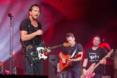
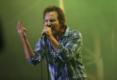
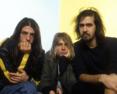
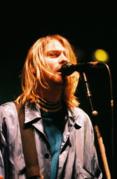
PITTSBURGH — Through the ‘80s the rock underground stayed down in the trenches that its name suggested.
Sonic Youth, Pixies, Dinosaur Jr., Husker Du, Melvins and the like spent the decade wrestling rock back from Aqua Net and studio polish and redefining what heavy, noisy, and emotional rock could be. Nobody outside the college-radio ghetto cared, but their experiments were a blueprint for two “grunge” behemoths, Nirvana and Pearl Jam, to drag the underground into the light.
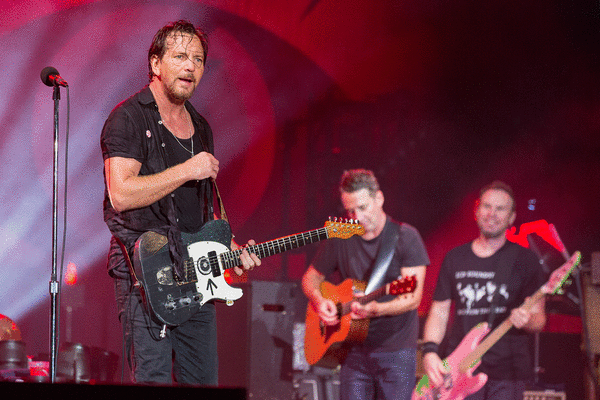
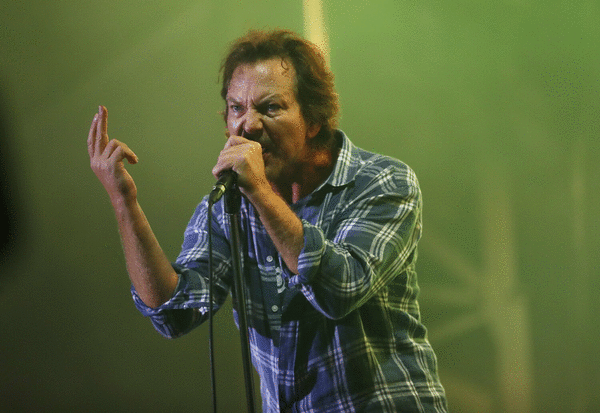
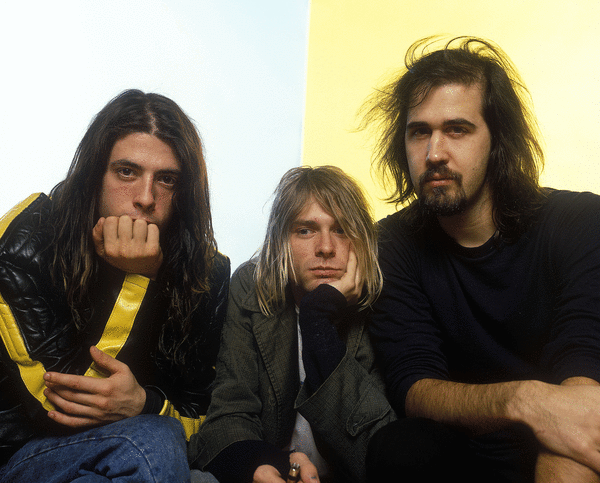
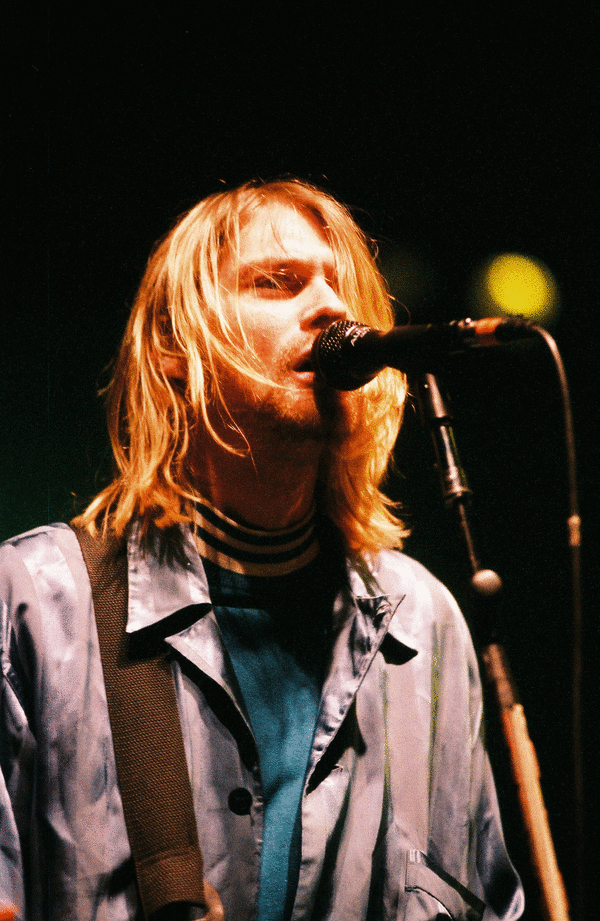
The tectonic shift began 35 years ago, in late 1991, when Pearl Jam and Nirvana emerged from the Pacific Northwest fog with “Ten” and “Nevermind,” respectively, just a month apart.
It didn’t happen overnight, but within a year, the underground found an exit sign, took a wrong turn and ended up on MTV, making the hair-metal bands of the day look more ridiculous than they already did.
While Nirvana has the claim to getting there first — its debut album, “Bleach,” came out in June 1989 — Pearl Jam co-founders Stone Gossard and Jeff Ament had been kicking around since the mid-’80s in Green River and then Mother Love Bone.
Ament explained their evolution to Seattle music zine The Rocket in 1986, saying, “The hardcore scene pretty much died out about a year ago and everyone just went back to doing what they wanted to do.”
For Green River, that meant injecting just enough hardcore urgency into the stomp of Aerosmith and Led Zeppelin. They rubbed elbows with Mudhoney, the gloriously sludgy Sub Pop act whose 1988 single “Touch Me I’m Sick” was a sneering, fuzz-soaked precursor to “Smells Like Teen Spirit.”
The punk-metal amalgam wasn’t limited to Seattle, as Jane’s Addiction was taking a similar route in LA and Smashing Pumpkins in Chicago. Both bands would help make “grunge” a household word.
Sonic Temple
Pittsburgh got its first whiff of this on July 9, 1989 when Nirvana — still a baby band with baby problems, like remembering how to play the intro to “About a Girl” — rolled into Sonic Temple, a storefront venue on South Avenue in Wilkinsburg. It was about a month after “Bleach,” which hinted at something volcanic to come between the heavy riffs and Kurt Cobain’s raw-throated, angsty vulnerability.
The summer of ‘89 version of the band — Cobain, bassist Krist Novoselic, guitarist Jason Everman and drummer Chad Channing — played to about 20 people, a crowd that could have fit into the bathroom at a Poison concert.
Manny Theiner, always a little ahead of his time, booked them as he would any promising Sub Pop act at the time.
"Nirvana were not booked on the basis of ‘Bleach’ already being out,” Theiner says. “They were booked on the basis of 1. being on Sub Pop. 2. having the ‘Love Buzz’ 7-inch — it was at WRCT and WPTS — and 3. the ‘Bleach’ promo cassette being in our hands well in advance of the release. They were a band like any other, on the road with a reputable label and releases out which sounded good. I guess we were right, because ‘Bleach’ already sold 40,000 copies before anyone had heard ‘Nevermind.’”
The band’s 12-song set, according to a review at LiveNirvana.com, included all but three of the 11 “Bleach” songs. “Krist kept messing up the intro to ‘About a Girl,’ so he stepped into the doorway of the band room, away from all the staring eyes and the pressure, so he could concentrate and play the intro right.”
At the end of the show, it notes, “Cobain smashed his sunburst Fender Mustang beyond repair.”
The poor couch
If punk in the ’70s was the Molotov cocktail lobbed into the boardroom, the hardcore and noise-rock that followed in the ’80s was the smoldering wreckage left behind.
The majors grabbed Husker Du and the Replacements in the mid-’80s and the Earth shook a little more when noise-rock kings Sonic Youth jumped to Geffen in 1990 for “Goo.”
It cracked the door for Nirvana’s move to DGC Records for “Nevermind,” an album recorded partly at Sound City in L.A. with the souped-up production of Garbage drummer Butch Vig.
“Smells Like Teen Spirit,” the definitive grunge anthem, hit radio on Aug. 27, 1991, and the iconic video, shot at a high school gym, premiered on MTV’s alt-rock show “120 Minutes” on Sept. 29.
“I think what happened is, everybody was ready for a change,” says Pittsburgh musician Todd Kaczorowski, who formed The Ten Band in 2003. “As soon as ‘Teen Spirit’ hit on MTV, the world changed. The look, the flannel, the combat boots. That video came out and, overnight, everybody was like ‘THAT's what I want to be, and that's what I want to do.’ ”
Although the band was happy with the end result, mixed by Andy Wallace (Slayer), Cobain would later say, “I'm embarrassed by it now. It's closer to a Mötley Crüe record than it is a punk rock record.”
The initial shipment in the U.S. was just 46,000 copies and it debuted down at No. 144 on the Billboard 200, so there wasn’t a massive buzz for Nirvana’s second and, sadly, last Pittsburgh show on Sept. 30 at Graffiti, the 500-capacity showcase on the corner of Baum and Bigelow Boulevards in Oakland.
It was six days after “Nevermind” and one day after the “Teen Spirit” video. For this tour, Nirvana was a trio, with Cobain, Novoselic and drummer Dave Grohl, who had landed in Seattle after the breakup of his Washington, D.C., band Scream.
Pittsburgh promoter Mike Elko, who booked the Graffiti show, got a call from Nirvana’s agent with a sweet offer.
“He says, ‘Listen, you gotta pay them $1,000.’ I'm like, ‘Well, how do I know what they are?’ He goes, ‘Don't worry, the record label is going to make sure you have people come in.’ Remember how the record labels used to buy like 100, 200 tickets for people to come see new artists? That's what happened.’”
The rest of the 300 or so tickets sold for $10 advance and $12 at the door. New York band Das Damen opened, and then Nirvana hit the stage with the Vaselines’ song “Jesus Wants Me for a Sunbeam,” soon to be one of the highlights of the 1994 “MTV Unplugged in New York” under the new moniker “Jesus Doesn’t Want Me for a Sunbeam.” Nirvana continued with an even mix of songs from “Bleach” and “Nevermind,” a version of “Smells Like Teen Spirit” faithful to the record being the fourth.
Based on a bootleg, Cobain didn’t say anything between songs. The show is just as memorable for what went down in the basement dressing room due to a discrepancy between the band and Graffiti owner Tony Policicchio over the merch sales.
“They didn't want to pay their percentage of merchandise and I couldn’t pay the band until they paid that percentage of the merchandise,” Elko says. “They got into a little bit. After a heated half-hour between Tony and the band, they finally settled it and I went down to pay the band and, in the meantime, after I walked out of the dressing room, they threw matches on a couch and caught the dressing room on fire.”
The fire marshal came and boarded the tour bus to arrest the band for starting the fire. The venue chose not to press charges and they were on their way — to the top of the charts.
“Nevermind” went to No. 1 four months later in January 1992, establishing Cobain as the collective panic attack of Generation X — angry and frustrated with no clear articulation of why.
Record labels scrambled to react, ushering in a new era of modern rock with exciting new bands and ungodly retreads.
Cobain, wearing fame like a cardigan sweater, was never built for stadium heroism and struggled with the weight of Nirvana’s fame, leading to the more abrasive followup, “In Utero,” in late 1993. Had the logical profession played out, Nirvana would have made its third Pittsburgh appearance as the headliners of Lollapalooza in the summer of 1994.
Instead, Cobain, viewing the festival as too corporate, backed out, leaving the Pumpkins as a weak headliner on a sagging tour.
Lolla Nation wanted Nirvana. It got tragedy instead.
In a profound mental and physical decline, Cobain died of a gunshot wound on April 5, 1994, devastating a generation (and a young daughter), and spawning speculation to this day. Was that a suicide note or was it was murder?
PJ’s ascendence
There was never a Sonic Temple moment here for Pearl Jam.
“Ten” came out in late August 1991 and barely anyone blinked, the album being sandwiched between the mega-hyped Metallica “The Black Album” and Guns N’ Roses’ double-barrelled “Use Your Illusion I” and “Use Your Illusion II.”
The alternative universe was consumed with Perry Farrell’s first Lollapalooza tour with Jane's Addiction, Nine Inch Nails, Siouxsie and the Banshees, Rollins Band, Fishbone and Living Colour.
Pearl Jam began a club tour which it aborted to join the tour of small arenas with Red Hot Chili Peppers and Smashing Pumpkins. The Pearl Jam connection was the Chili Peppers’ original drummer, Jack Irons, who had turned San Diego singer Eddie Vedder onto the band by giving him their demos. He also got them on the Chili Peppers tour. Irons joined Pearl Jam from 1994 to 1998.
So this was one red-hot triple bill, right? Eh, not really.
Based on reviews, the late-arriving crowds were there to see the Chili Peppers, who were set to release “Blood Sugar Sex Magik” on the same day as “Nevermind.”
The Pumpkins, which released debut “Gish” in May, were getting a dismal reaction, prompting Billy Corgan into conflicts with the crowds.
In Indiana, according to The Star Press, Corgan said from the stage, “This is great. We’ve never played a funeral before.”
According to The St. Louis Dispatch, “The Smashing Pumpkins seemed way out of its league.”
“Opening acts Pearl Jam and Smashing Pumpkins were yawns,” according to The Indianapolis News.
Pearl Jam’s Pittsburgh debut, at the AJ Palumbo Center on Oct. 25, drew a little over 3,000 people. The Pittsburgh Press said Pearl Jam “turned in an above-average mix of wah-wah guitar, feedback, deft touches of melody and hard rock” and declared the Pumpkins a “third-rate mix of Led Zeppelin and Sonic Youth.”
Sonic Youth, incidentally, had gone from the Electric Banana (1986-87) and Graffiti (1990) to the Civic Arena stage that February to open for Neil Young and Crazy Horse with Social Distortion. It was a rough-go for the noise-rock titans who did not seem happy with the situation.
Where Pearl Jam stood out on that tour was in the death-defying antics of Vedder, who was stage-diving and scaling balconies and lighting rails. Grohl would tell Spin, “It was one of the scariest things I've ever seen live in my entire life.”
The drummer got a firsthand look at Pearl Jam in December 1991. Nirvana was breaking big and the Chili Peppers wanted them on their California dates to help fill arenas. Pearl Jam was to be bumped, but Corgan pulled the Pumpkins instead to avoid an encounter with his ex and Cobain’s current girlfriend, Courtney Love.
For four dates only, ever, Nirvana and Pearl Jam were on the same bill.
Vedder and company took off a few months later with its “Saturday Night Live” debut in April ‘92 and MTV Unplugged in May — sending the album into the Top 10. It stayed on the charts for 264 weeks, peaking at No. 2.
By the time Pearl Jam got back to Pittsburgh, on Aug. 16, 1992, the band was running hot enough to cause a small riot. Security found itself in a cage match with fans jumping the rails in one of the wildest half-hours in Star Lake history.
“I will never forget the throng of people that just went rushing up over that hill to get onto the lawn,” Kaczorowski says. “When Pearl Jam came out, it was like a throng of people. It was like things that you saw in Woodstock that I was too young to experience. You knew without a doubt that something had changed, the world had changed substantially.”
They may have lacked Nirvana’s cool cred, but the band’s heavy crunch and Vedder’s earnest style — turning deeply personal stories like “Alive,” “Black” and “Jeremy” into anthems — set it up for decades of arena-rock glory.
Grunge wave
That second Lollapalooza, the first to play Pittsburgh, was headlined by the Chili Peppers, but had a second grunge band on the main stage in Soundgarden.
Soundgarden’s path through Pittsburgh had been a slow escalation: Upstage in ’89, City Limits in ’90 with Voivod, Metropol with Danzig the same year, and then finally the big festival stage in ’92 with alt radio and MTV play for “Outshined” and “Rusty Cage.”
Meanwhile, there was Alice in Chains, the sludge-metal prophets who played a “soporific” set, according to the PG, at Star Lake on the Clash of the Titans bill in June ’91 with Slayer, Anthrax and Megadeth. The show drew a mere 4,700, but then “Dirt” happened a year later and Alice roared back to headline the fiery ‘93 Lollapalooza with Primus, Dino Jr., Tool and Rage Against the Machine also on that bill.
On the fringes of the grunge carnival were the second-tier prophets — Screaming Trees lumbering their way to Star Lake to open for the Spin Doctors (a matchup that still baffles), Stone Temple Pilots (debuting here at the Civic Arena in ‘93 and working its way up to Star Lake in 2000) and Hole (debuting here at Metropol playing Lolla, post-tragedy, at Star Lake in ‘95).
Despite the rock press declaring the death of grunge in ‘95, the top bands (Pearl Jam, Smashing Pumpkins, Alice in Chains, Soundgarden) didn’t go away and the market was flooded with post-grunge bands like Bush, Candlebox, Live, Hootie & the Blowfish and, ultimately, Seven Mary Three, Creed and Nickelback.
Pittsburgh flannel
The Pittsburgh music scene watched the grunge invasion from 2,500 miles away and reacted, for the most part, by maybe rocking a little more flannel.
The marquee bands here were serving hippie jams (Rusted Root), heartland rock (the Clarks, the Gathering Field), synth-rock (the Affordable Floors) and retro-garage (the Cynics).
But there were a few bands picking up on that same vibe felt in Seattle. Kaczorowski spent the early ‘90s in the band Voodoo Wagon, a fusion of heavy things that weren’t punk, new wave, hardcore or hair metal.
“Voodoo Wagon was into blues, Zeppelin, Southern rock, but also heavily influenced by the Chili Peppers, so we took all that sort of stuff, and turned it into a heavier rock thing,” he says.
He would go on to do that in Rumblefish as well.
There was Kelly Affair, a heavy outfit featuring Mike Michalski (Heretics, Little Wretches) and Bob Petri, a Jim Morrison acolyte who died of alcohol poisoning on New Year’s Day 1991. His replacement, John Bechtol, turned self-inflicted wax burns on his shaved head into performance art. The band imploded over creative differences in February ‘95.
One month later, D.O.S.E. emerged at the Graffiti Rock Challenge as Pittsburgh’s most marketable answer to grunge.
Singer Jason Trunzo told the PG then “the whole ‘alternative’ thing has not been clearly defined here in Pittsburgh” and that the city “is in need of a band of our caliber.” “Sex With Sara,” its debut album and prize for winning that Challenge, was not the ticket out of the Pittsburgh clubs and by fall ‘96 D.O.S.E was gone.
That same year, though, Anti-Flag dropped “Die for the Government,” joining the likes of Don Caballero and the Karl Hendricks Trio as the preferred Pittsburgh exports from the rock underground.
Thirty-five years later, we still have Pearl Jam trips to Pittsburgh, we get Jerry Cantrell of Alice in Chains, the Stone Temple Pilots without Scott Weiland and we have all the tribute bands like Ten.
Ten played its first gig at the South Side Street Spectacular in July 2003 just for fun.
“We had no idea if anybody was even going to be interested in this thing. And it went absolutely insane,” Kaczorowski said. “There were people stage diving, there were girls, there were girls on stage taking their shirts off. It was mass hysteria.”
Two decades later, Ten is still touring, playing big venues well beyond Pittsburgh
“We do a rehearsal, we hit the road, jump on stage and we're rock stars for the night. And it's insane. It blows my mind that people still come to see it and have some such passion for it. We nearly sold out the House of Blues in Cleveland last month just playing primarily the ‘Ten’ album, and people were just as passionate and jumping up and down and going crazy like it was 1992.”
Just don’t book them with a Nirvana tribute band. As he sees it, the Nirvana crowd leans more into punk, new wave and noise rock, while Pearl Jam is right in line with blues-rock, Zeppelin, Aerosmith.
“There's nothing super alternative about Pearl Jam. They were classified as alternative, but I don't even know if that is right. It's rock ’n’ roll music.
“So, the two crowds will not mix. If you put Pearl Jam and Nirvana tribute bands on the same bill, you have an awful show, because you've got two different crews of people.”
© 2026 the Pittsburgh Post-Gazette. Visit www.post-gazette.com. Distributed by Tribune Content Agency, LLC.




Comments