Q&A: Joshua Ray Walker thought he was going to die. A new film tells the story
Published in Entertainment News
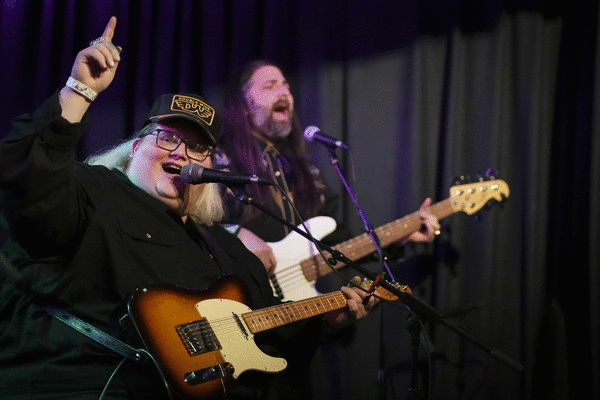
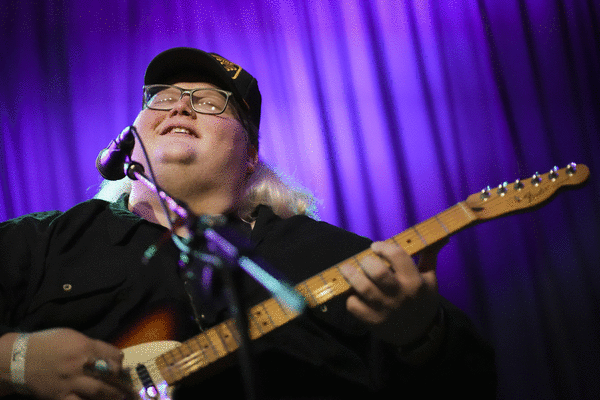


FORT WORTH, Texas — Joshua Ray Walker is proud to have something to look back on.
In January 2024, the Dallas singer was diagnosed with stage 3B colon cancer and spent the next few months undergoing treatment. While prepping for surgery in September, it was revealed that the cancer had spread to both lungs.
However, a month later, Walker shared his pre-surgery diagnosis was incorrect and that his lungs are cancer-free. By the end of the year, he was back on the road.
Now, Walker’s cancer journey has been immortalized in “Thank You For Listening.”
The 27-minute film is described as an “intimate portrait of an artist grappling with mortality while confronting the legacy he will leave behind.” The film is produced by Texas Monthly and is directed by Austin native Bob Ray and Dallas native Gene Gallerano.
“Thank You For Listening” will have its world premiere at the Dallas International Film Festival at 4:30 p.m. April 25 at the Texas Theatre. Tickets for the screening, which also includes entry to a Charley Crockett documentary immediately after, are on sale now.
Ahead of the film’s premiere, the Star-Telegram spoke with Walker and the filmmakers behind the project.
[This interview has been edited for clarity and length.]
Star-Telegram: Bob and Gene, how did this project come about?
Bob Ray: Gene met Josh before I met Josh. Gene and I met at South by Southwest. As an alum of the fest, I was introducing movies and moderating Q&A’s and things like that. Gene and I just hit it off. I think he said something about my hair, which was kind of mulletish at the time. Gene had a pretty dope, flashy, silvery jacket, maybe gold. I was like, “Oh [expletive], this guy’s got style too.” We just kind of hit it off. He invited me to the after party. I dashed over on my bicycle. He said, “Hey, let’s take a picture. So when we make a movie together, we’ll have this memory.”
I’m sure you’ve been to film festivals too, and I equate the excitement of the whole event akin to a cocaine party, where everyone’s agreed to write a book together and start a band together and be in a zine together and do everything together. You’re like, sure. I thought that’d be the end of it.
Then, lo and behold, about three weeks later, Gene calls me up and was like, “Hey, you want to co-direct this movie together? I got this cat, this interesting dude I met on a plane a while back.” Told me all about it, and I was like, “Hell yeah, let’s do it.” We kind of called each other’s bluffs until we had no room to bluff and just had to do it.
Gene Gallerano: A couple months before that, I met Josh on a plane. I had seen him on Instagram before, and thought, ‘What a really interesting guy. I would love to talk with him.’ In my mind, I had already decided that I was going to make a more Americana/country music “Once.” But I didn’t know Josh, didn’t know anything really about him at all.
Then I saw him on a flight to Europe. I was going to mix the thing at SXSW where I met Bob. I introduced myself and said, “As soon as we take off, I’m gonna come up and sit with you.” We talked for about six hours and I thought it was a great meeting of the minds. Josh, I believe, was going to do a big tour. I just thought it was great. As soon as we landed, I was hitting him with everything and sent all the links and all this stuff.
Then I heard no word whatsoever at all [laughs]. I was like, “I can’t believe this. What happened? Is my meter off? Or did he just big time me?” I sent him a follow-up a few days later, then a week later, then two weeks, three weeks. After five weeks or something, I was like I guess that’s it. Then right after, I think SXSW , or somewhere in there, Josh came out of the blue and said, “Gene, I’m so sorry. When I landed, I ended up getting really sick, and I got diagnosed with cancer and I’m gonna undergo treatment. I’m off the road for a period of time, do you still want to make a movie?”
That changed the system that we fantasized about on one plane ride. But I said yes, and the first person to pop in my mind was Bob, who I had just met. I was like, “Do you want to come on this adventure?” Bob was crazy enough to say yes, and that was kind of the beginning of it. I do feel like even that casual conversation at 30,000 feet, you could feel Josh and the Texas spirit, the Americana and the poetry and the pain and all that fun stuff informs his work.
S-T: Josh, you were about to embark on this hard journey battling cancer. I’m curious about reaching out to Gene about the film. Why did you want this period of your life filmed?
Joshua Ray Walker: Well, I had every intention on getting back to Gene anyway [laughs]. When we met, I was going to Europe, so I had like a month’s worth of shows. Then the week that I got back from Europe, I flew out to Reno, and my appendix exploded. It took from mid-September to early January to figure out really what was going on. Making a movie just wasn’t on my mind at all, but I wanted to document that time period. That’s kind of something we talked about from the beginning. I was like, I don’t know what this is going to be.
When we started, the likelihood of me living through it was really high. Doctors were saying that stage 3B colon cancer is curable, and I might not even have to go through all my chemo, it was pretty optimistic. And it just kind of kept getting worse.
Then at the end of treatment, they said it was stage four, and I had like 10 weeks when I thought that was the case. Then I went in for another surgery, and then it wasn’t the case. But at the beginning, I was just like, this might be one of the toughest things I go through. I feel like I’ll want to look back at it in 20 or 30 years and have that time period documented, because it all felt very surreal while it was happening. I just kind of wanted some evidence that it had happened. Then while we were filming, and when the diagnosis got worse, I was like, well now I definitely want to keep filming, because this might be the last documentation of me being around.
I mean, we had hours and hours of interviews for this thing. I wasn’t going through therapy at the time. I couldn’t afford it, but I feel like I worked through a lot of stuff in the interviews for this movie that just don’t fit in a 27-minute film. I think it was good for me, too. I had to make somewhat of an inventory of my life and experiences and got asked some hard questions while facing death that I think were important for my perspective throughout. I’m glad I did it. It was a positive experience throughout treatment to have this project to work on.
S-T: Bob and Gene, you guys knew Josh somewhat before making the film. When it comes to actually asking him questions in the film, how do you go about it? Like, not reassuring him, but making sure that you’re giving his story justice and having a deft hand when telling such an intimate story about his life.
BR: That’s a good question. I’ve made two feature documentaries prior to this, and I’m in post on the one that I shot a while back. I come from a narrative background. My first feature film was a narrative, and it was just, you could do whatever you want.
I always loved documentaries. Once I started shooting a doc, the weight of the decisions that you make creatively that impact someone’s life for the rest of their life, start to add up onto your shoulders and your soul and your heart, especially if you have a lot of empathy and you care about others. You can’t just make these decisions that you would make in a narrative, because it makes a better narrative. You have to straddle that line between creating an artifact that represents someone else’s life, that will outlive them, and that will also affect their life on a day-to-day basis moving forward.
On top of that, Josh is an artist, so not only do we have an obligation to create an artifact that exists, that represents him as a human, we have to sort of represent his artistic and creative output as well. That’s always been important to me. You got to try to figure out where that line is. It still needs to be entertaining — we’re not writing a history book that kids are forced to read in sixth grade. People choose to watch this. But also, I think some people are wired for it, I guess.
I don’t know if it’s nurture or nature, but Josh and I have a really good bond, and we can talk about really deep stuff. I have interviewed hundreds of people through the course of my filmmaking career. I go for the deep questions. I feel like people open up to me in an honest way, because they know I’m coming from a position of sincerity and compassion and not just curiosity and exploitation.
Josh and I would talk about everything from the highest highs to the lowest lows, including contemplating ending your own life. I find the human condition really compelling, even the darker parts of it. I don’t want to dwell on them, but I think it’s comforting. It’s comforting to be asked by someone who you feel is sincere and cares, because you’re sort of unloading a little bit and then they’re bouncing it back to you. I try to create that relationship with people, and with Josh it’s easy. I mean, I [expletive] love Josh. Josh is amazing. He’s just got a beautiful soul. He’s a great communicator. He lays it all out there, guts and all. He’s welcoming in that regard, and in my book that makes, a wonderful human, but also a spectacular subject for a documentary.
GG: I think that Josh is a world-class storyteller, and that makes the job pretty easy on a lot of fronts. I also think Josh really wanted to, even if he was unaware of what he was trying to articulate during that time, I think he knew that he was feeling something. I mean, I remember Josh always saying he believes that songs are up in the air, and you kind of just are hoping that you’re the one that gets to pluck them out, something like that, Josh?
JRW: Yeah, I think that’s kind of the case for all ideas. But, yeah, I mean, it was easy, I trust Gene and Bob. I’m a fairly trusting person. If I look someone in the eye and say, “Are you going to make me look bad?” And they say, “No.” I’m like, “Okay, I trust you.” I just kind of went for it. We didn’t have a ton of time to shoot either. Those first couple interview days, I didn’t want to hold back and then waste time. Pretty much as soon as they started asking questions, I didn’t really hold anything back, I guess.
GG: It had multiple phases too. The whole crew, everyone traveled themselves. No one lived in Dallas, other than Josh at this point. We all flew ourselves in, or drove ourselves in. We did our very first day, and we did an interview with Josh, and it was so moving. Everyone in the room, you could feel the air shift. Everyone had the same understanding that something really powerful was happening in that room. We all wanted to just ride it out and see where the story took us. It did start at a very different spot, because, as Josh mentioned, his diagnosis originally was that it was treatable and he was going to be probably OK outside of this period of treatment.
Originally, we had decided we’re going to do some kind of hybrid narrative fiction, non-fiction thing, and we’re talking about big, larger story ideas and how we’re just kind of really laying out track for something. Then at one point, Josh called and said, I think it was right before he was supposed to get his last dose of treatment. He said that they think that it has spread, and that the system had radically changed, and that he went up to stage four, and the timeline has radically shifted. I remember, I was in Kansas City crying on the phone. I was like, “Oh, man, this is a disaster.” I didn’t give a [expletive] about the movie at that point. I was just thinking about this guy that we had come to know and love so much and care about. Josh, to his credit, somewhere, said, “Well, it’s the act three twist.”
I kind of took that as him saying, let’s see this through and let’s make sure that we tell the best story possible. Bob and I knew pretty much immediately that we didn’t have time to mess around with any kind of larger ideas at the moment — we needed to tell this story as quickly as possible. We decided that a short film would be probably the fastest way to do that. With what we understood, you’re thinking like, I want to finish this movie before Josh, potentially, is no longer with us. I don’t want to make a movie in memory of him that he never gets to see or be a part of or celebrate with us. That really took the project to another level in a lot of ways.
S-T: There’s a lot about legacy in the film. Josh, your grandfather gave you this guitar to start your musical journey. There’s also something about him and your dad both having cancer. What do you want the legacy of the film to be?
JRW: It’s a snapshot of the last three years of my life. I think it’s something that if I continue to have quasi-successful music career that continues to grow, it’ll be a nice time capsule of what I was going through during this time, which was kind of the initial thing that I wanted. I wanted something to look back on, and now it’s going to live out there for other people to see. Hopefully, for people who don’t know my music, it’s a good representation of me as a person and artist. But as a musician, I think it’s an opportunity for people who already know my music to know a little bit more about me.
Because, I’m open in interviews and stuff, but it’s different to watch someone when they speak and to see more of their life. I’m a visual learner. I take in most of my media visually. It’s just a nice portrait, a nice representation of this time period that once we get through the festival circuit, I probably won’t want to watch for a long time [laughs]. Same with records. Once the mastering is done, I don’t ever listen to a record again. This will be a time capsule that 20 years from now I can look at and it’ll be important to me.
S-T: Last thing, this is playing the Dallas International Film Festival. What’s the distribution plan for this post-festival? How can people see it?
GG: I hope through a variety of ways. I mean, this is our kickoff. Look, Texas Monthly came on and they have been nothing but the most generous of spirit and ideas and fantastic partners. But I mean, this is really just the launching point for it. I hope it goes on a big tour of film festivals, music festivals. We keep talking with Josh about trying to get it in tandem with some of his shows.
I hope that we can kind of activate it in a lot of different places that aren’t just the obvious as well. Maybe really follow this thing all the way through the end of next year. There’s some big things happening, and big things happening for Josh. I hope this is a tremendous testament to his spirit and his music and his soul, and I think that hopefully it’ll be able to share that as Josh moves through his music career as well. We’ll make part two in like 15 years. No cancer.
JRW: Yeah, the stage adaptation [laughs].
———
“Thank You For Listening” screens at 4:30 p.m. April 25 at the Texas Theatre.
———
©2026 Fort Worth Star-Telegram. Visit star-telegram.com. Distributed by Tribune Content Agency, LLC.







Comments