Democrats winning on healthcare post-shutdown, some analysts say
Published in Health & Fitness
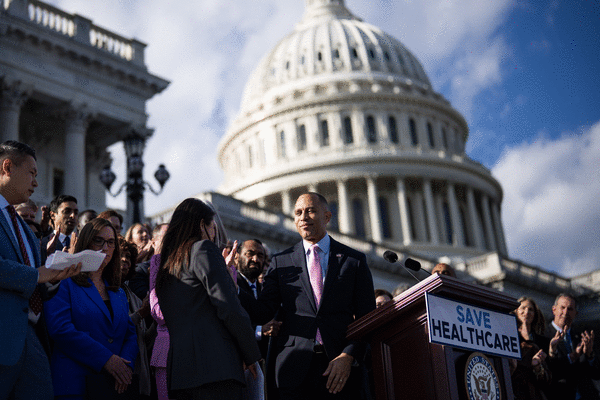
Democrats emerged from the shutdown empty-handed on a health care subsidy extension, but the party is well-positioned for messaging ahead of next year’s midterms, according to analysts and early polling data.
Putting the focus squarely on health care could force Republicans into a binary choice — either they reach a compromise that achieves some Democratic goals or the GOP majority is unable to put forth anything on rising heath care costs. Though it’s early for such predictions, either could boost Democrats next November.
For one thing, the various Republican plans under development might not have happened if Democrats hadn’t dug in their heels, said Grant Reeher, a political science professor at Syracuse University.
“It did focus the attention in a way that obviously has sustained itself after the shutdown,” Reeher said. “What I would predict would be some kind of compromise is going to happen on this issue.”
In the weeks following the shutdown, Republicans have some momentum on health care costs, but they are far from unified.
Sens. Bill Cassidy, R-La., and Michael D. Crapo, R-Idaho, the chairs of two powerful committees with health jurisdiction, have a proposal that would place funds for Affordable Care Act enrollees directly into health savings accounts with the goal of diverting the money from insurance companies and allowing patients more flexibility.
Meanwhile, according to multiple reports, President Donald Trump last week considered a two-year extension of Affordable Care Act subsidies with certain guardrails around income but quickly backed off after negative early reviews from Congress.
“Somebody said I want to extend it for two years,” Trump later told reporters on Air Force One. “I don’t want to extend it for two years. I’d rather not extend them at all.” He went on to say that some kind of an extension may be necessary to get something done.
In an effort to coalesce on a solution, the Senate Health, Education, Labor and Pensions Committee has scheduled a hearing for Wednesday on the rising cost of health care, after a Senate Finance Committee hearing late last month produced no consensus.
Reeher said he was surprised that some had framed the shutdown as a Democratic defeat. In his view, the party was actually successful in keeping attention on the issue.
“In that sense, then I think it was a mission accomplished for the Democrats in that way,” he said. “I’m scratching my head a little bit about why it was perceived as such a cave.”
Some Republicans sense that the issue is critical.
“If we want to be viable in the midterms, I think it’s something we have to think about,” Jeff Van Drew, R-N.J., told reporters last month. “It’s the right thing to do. I don’t want to be the party that takes away people’s health care.”
Democrats’ early leads
Democratic leadership is betting real change won’t happen while Republicans are in control of Congress. Speaking on the Senate floor late last month, Minority Leader Charles E. Schumer, D-N.Y., teed up Democrats’ arguments to that effect.
“When people’s monthly payments spike next year, they’ll know it was Republicans that made it happen, and more than that they’ll know Democrats were fighting on their behalf to lower costs and rebuild the sunny American optimism that our country desperately needs,” Schumer said.
Early polling is showing that Democrats are favored, momentum they are hoping to harness as the debate over health care rolls on.
A Marist poll conducted in November found that 55 percent of respondents would vote for a Democratic candidate if the election were held then, compared with 41% of respondents for a Republican.
Data from early November from Navigator Research and Global Strategy Group found that 47% of Americans blame Trump and Republicans for rising premiums, while 21% blamed Democrats and 19% blamed both parties.
Jesse Ferguson, a Democratic strategist at the consultancy Dover Street Strategies, doubted that Republicans will produce a solution.
“If there’s one thing that’s been true, it’s that when there’s a national conversation about health care, voters don’t like what the Republicans are offering,” Ferguson said. “And that’s been true for 15 years.”
Sen. Brian Schatz, D-Hawaii, said late last month that while “hope springs eternal,” he had yet to see real movement from Republicans on health care.
“I just think we should take the president and the leadership of the Republican Senate at their word that they don’t want to fix this problem,” he said.
Some Democrats, however, appear to be ready to work across the aisle.
After the White House last Monday quietly pitched the two-year subsidy extension with added guardrails for eligibility, moderate Democrats chimed in with cautious optimism.
“I think it’s very positive that President Trump is talking about coming to the table to address this issue,” Sen. Jeanne Shaheen, D-N.H., said on CNN. She also noted that the majority of subsidy recipients are in Republican districts.
Sen. Maggie Hassan, D-N.H., called the White House proposal a “starting point for serious negotiations.”
“The fact that President Trump is putting forward any offer at all to extend the Affordable Care Act’s tax credits shows that there is a broad understanding that inaction in this regard will cause serious harm to the American people,” she said.
_____
©2025 CQ-Roll Call, Inc., All Rights Reserved. Visit cqrollcall.com. Distributed by Tribune Content Agency, LLC.







Comments