Research shows proton beam therapy improves cancer survival, lowers side effects
Published in Health & Fitness
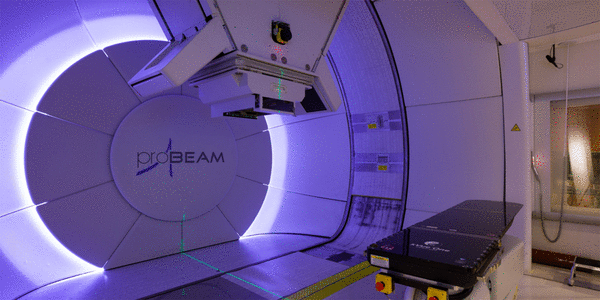
Proton beam radiation therapy performed 10% better at stopping cancer of the throat compared to traditional X-ray radiation, a new study shows, with 15% fewer side effects.
“With this study, it is my personal belief that proton beam therapy is a new standard-of-care treatment for patients with oropharyngeal cancer,” said Dr. Jason Molitoris, a radiation oncologist with the University of Maryland Medical System. “It’s a significant step forward in the field.”
Molitoris led Maryland’s contribution to the national study, published Dec. 11 in The Lancet. Sixteen Maryland patients joined more than 400 others nationwide, who received either proton beam or X-ray radiation therapy. The University of Texas MD Anderson Cancer Center led the study.
After two years, 91% of patients treated with proton beam therapy remained cancer-free, the study found, compared to 81% with traditional radiation. These results remained consistent after five years of monitoring the patients.
For comparison, Molitoris told The Baltimore Sun that cancer treatments approved in the past offer as little as a 3% to 5% improvement in patients remaining cancer-free.
The study sought to prove that proton beam could be as effective as traditional therapy, did not miss cancer cells and cured patients, he said. Treating throat cancers often causes significant side effects because of radiation damage to salivary glands, vocal chords and carotid arteries.
Proton therapy delivers radiation to a tumor without continuing through the body to affect healthy tissue, according to the informational website radiologyinfo.org.
Protons make up part of atoms and carry a positive charge. Once they enter the body, protons release a powerful charge into the tumor, and only a minimal dose to surrounding tissue.
Oropharyngeal cancers affect parts of the throat you can see in your mirror, down to the voicebox, according to the National Cancer Institute. It also extends upward to include the soft palate, and the back of the tongue. Risk factors include family history, smoking or chewing tobacco and human papillomavirus.
The next study, he said, will determine the relative cost of the therapies. While proton therapy costs more initially, there may be significant savings, Molitoris said, from reducing side effects. These include dry-mouth treatment due to salivary gland injury or throat damage requiring a feeding tube during recovery.
Maryland has committed to billing insurance companies the same for proton as for X-ray therapy, he added.
_____
©2025 Baltimore Sun. Visit baltimoresun.com. Distributed by Tribune Content Agency, LLC.









Comments