As health care premiums soar, Calif. Democrats are eager to blame Republicans
Published in Health & Fitness
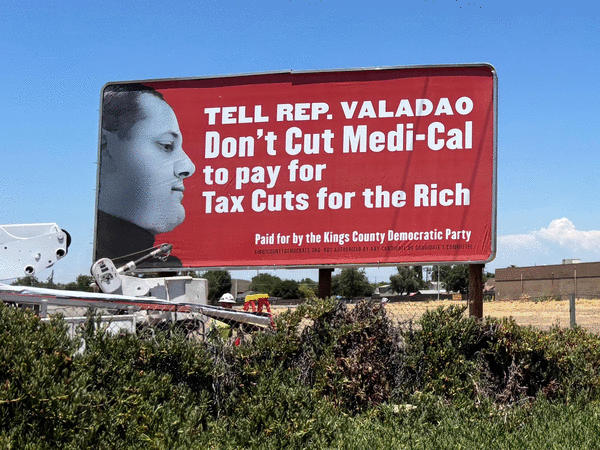
California’s endangered House Republicans have spent December trying to show how they understand, and are trying to ease, the pain constituents feel as they confront skyrocketing health care costs.
But those Republicans are feeling political pain, as the enhanced federal premium subsidies for tens of thousands of Californians end next week.
How voters see the efforts of Reps. Kevin Kiley, David Valadao and other vulnerable state GOP House members looms as crucial to their reelection chances next year
“There are likely going to be big consequences next year for changes in health care policy,” said Thomas Holyoke, professor of political science at California State University, Fresno.
The war for the voters is on, full blast. Valadao supports extending the credits and has been a big player in a small group of Republicans trying to do so. But in his Central Valley district, Democrats last week unveiled a mobile billboard in Bakersfield portraying Valadao as “the congressman who stole health care.”
Kiley has also been in the forefront of GOP efforts to continue the credits. He insisted his efforts to continue the subsidies are not part of any political calculus.
“I don’t know what the politics are and that should never really be the basis for policy. What I do know is that we have a lot of people who are going to suffer if Congress doesn’t act,” he told The Bee.
Both Republicans and some others have seen their congressional boundaries redrawn as a result of Proposition 50, which voters approved last month. The new lines pour more Democrats into some Republican-held areas.
Kiley’s current district, which stretches from east of Sacramento down to Death Valley, has been chopped into six pieces, and the Roseville Republican is not sure where he’ll run.
Republicans and the end of subsidies
Enhanced subsidies for Affordable Care Act marketplace policies expire next Thursday, meaning premiums for Californians will on average double.
The key reason for the inaction has been a reluctant Republican leadership. House GOP leaders last week refused to allow a vote on an extension. Democrats joined with a small group of Republicans to force a vote next month, but its chances in the Senate are unclear.
The House Republican alternative, a mix of savings plans likely to go nowhere in the Senate, won House approval last week on a largely party-line vote.
Kiley in November proposed the Fix It Act, bipartisan legislation that would continue the subsidies for two years while implementing reforms and an income cap. He also backed one- or three-year extensions.
Valadao also supports extensions. He said last week such fixes don’t “solve the problem of affordability (but) we can’t allow them to expire without a plan in place.”
Fallout from the Big Beautiful Bill
The political problem for the California Republicans on health care lies not just in how they’re handling the subsidies issue.
They voted this summer for the Big Beautiful Bill, which continued the expiring Trump tax cuts but also made deep cuts in Medicaid, the health care program for lower-income people and some others called Medi-Cal in California.
All 43 California House Democrats and its two senators, both Democrats, opposed the bill. All nine House Republicans voted for it.
The issue is particularly sensitive in Valadao’s current district. About two-thirds of the district’s population used Medi-Cal in 2023. More than 207,000 hospital visits, or 46% of the total, were covered by Medi-Cal, according to estimates by the nonpartisan California Health Care Foundation.
At the time, Valadao cited aiding the successful effort to get twice the amount proposed for a fund to help rural and at-risk hospitals.
“Ultimately, I voted for this bill because it does preserve the Medicaid program for its intended recipients — children, pregnant women, the disabled, and elderly,” he explained. He also cited the tax breaks most people will retain because of the bill.
Who benefits from the debate?
While the efforts on subsidies by Valadao and Kiley could help them somewhat politically, “it doesn’t negate their votes for the Big Beautiful Bill, which gives Democrats a potent line of attack,” said Erin Covey, U.S. House analyst for the nonpartisan Cook Political Report.
Holyoke also cited the fallout from that bill. He saw the Valadao and Kiley effort on subsidies as damage control.
“I don’t want to take away from them the fact that many of their constituents really need the subsidies to afford their health care, so by challenging the House Republican leadership, they are doing right by their constituents,” he said.
Democrats aren’t letting up.
“House Republicans have broken their promise to lower costs, and in fact are actively pushing policies to make life more difficult for hardworking families,” said Rep. Suzan DelBene, D-Washington, DCCC chair.
Kiley calmly cites his record on trying to keep the subsidies going.
“I agree 100% that this is the pressing urgent problem in front of us,” he said.
_____
©2025 The Sacramento Bee. Visit sacbee.com. Distributed by Tribune Content Agency, LLC.









Comments