Back to reality: Better TV depictions of CPR may save lives, new Pitt study finds
Published in Health & Fitness
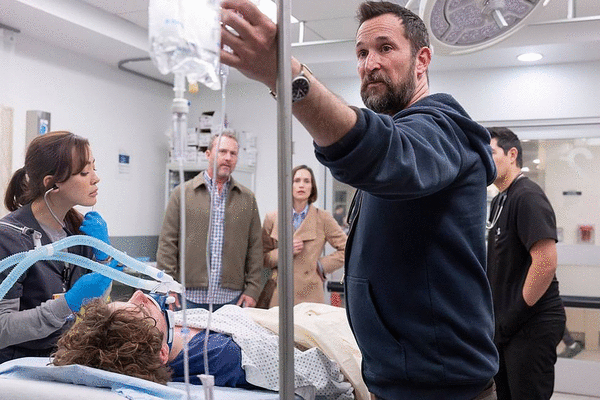
Physicians have said the HBO Max drama "The Pitt" offers one of the most accurate depictions of medicine on television.
But there are plenty of shows that don't offer such realism — and they may be having real-world consequences when it comes to the public understanding of best practices for bystander CPR.
Bystander cardiopulmonary resuscitation can double or triple a person's chances of surviving a cardiac arrest, the American Heart Association has found, but many are hesitant to intervene in an emergency situation or may have misconceptions about what bystander CPR involves.
Seeing television as a potential driver of public health attitudes, researchers at Pitt watched hundreds of hours of scripted American TV to add hard numbers to depictions of bystander CPR. The team hopes the findings can clarify common CPR misconceptions, and that these misconceptions can later be corrected. This is the first time a study has analyzed bystander CPR depictions in scripted media.
"We want people making these shows to be more aware of the influence they have on public health," said Ore Fawole, research coordinator and incoming medical student at Pitt for fall 2026, and lead author on a new paper about bystander CPR in the media published this month in an American Heart Association journal.
Whether through a medical drama like "The Pitt" or the Pittsburgh-set tear-jerker "This Is Us," which tackled dementia and its impact on families, certainly series can help fuel larger conversations about our health. Some research draws a more direct link between public health and media, including a 2011 study that found birth control story lines on Indian television were associated with a drop in the fertility rate in the country.
For the new study, University of Pittsburgh Public Health researchers watched 169 American scripted TV episodes — "Breaking Bad," "CSI," "The Walking Dead" and "Yellowstone" among them — that included the words "defibrillator," "resuscitation," "cardiac arrest," "CPR," "mouth-to-mouth resuscitation" and "cardiopulmonary resuscitation" and analyzed how these shows depicted cardiac arrest and bystander CPR.
They found that correct bystander CPR was illustrated in 30% of the episodes, and that many scenes showed people age 21 to 40 experiencing a cardiac arrest, while the average age for the event is 62 years old. TV depictions were also more likely to show cardiac arrest occurring in public, despite about 80% of them happening at home.
Bystander CPR is misunderstood in general.
In 2008, the American Heart Association updated its guidelines for the practice to include only chest compressions and calling 911. This is distinct from CPR given by a trained medical provider, which involves checking for a pulse and giving rescue breaths with a barrier over the mouth.
Pitt researchers found that nearly half of the viewed episodes showed bystanders giving rescue breaths to victims and 42% checking for a pulse, both outdated techniques for bystander CPR.
"The important thing for bystanders is to make it as simple as possible," said Saad Mahmood, emergency medicine physician and chief medical officer at Allegheny General. "We know that many people do not receive CPR from bystanders." Mahmood is also a board member of the Greater Pittsburgh chapter of the American Heart Association.
When Beth Hoffman, assistant professor at Pitt Public Health and senior author on the paper, volunteered to teach CPR to youth, she noticed this confusion and misconception, and some students saying the first step should be to check for a pulse.
Students who told Hoffman and her colleagues they'd seen CPR performed on TV inspired her to look into what these portrayals actually looked like, and how they may influence perceptions of cardiac arrest.
The study also found that white men were most likely to receive CPR on television, despite Black men being more likely to suffer out-of-hospital cardiac arrests in real life.
The research did not explore success rates of bystander CPR for cardiac arrest, an important component in understanding the event, said Faina Linkov, associate professor in the health sciences at Duquesne University, specializing in chronic disease.
Just 10% of people survive a cardiac arrest when they happen at home, and 20% survive them in public or at a hospital.
"It's a pretty lethal event," said Linkov. "If you watch TV, people go into cardiac arrest and they are magically revived, alert and well within minutes, whereas in real life that doesn't actually happen."
The brain is a fragile organ with high oxygen demands: Just a few minutes of lost oxygen can mean future memory problems, seizures and movement disorders.
"People need to be aware of the potential harms of TV portrayals of cardiac arrest," she said. "They can create false expectations for bystanders and families, and they underestimate seriousness."
Fawole, who as a Pitt undergrad double-majored in film and natural science, thinks there's potential for TV shows to work on correcting these inaccuracies.
"Shows like 'The Pitt' have shown that you can be authentic and still have a lot of viewers and a big following," said Hoffman. "So I think there are opportunities."
If it's logistically difficult for actors to portray accurate chest compressions — doing it right involves depressing the chest 2 inches and often breaking ribs — Hoffman suggested that media companies could partner with public health agencies to add public service announcements after episodes about correct bystander CPR and where to find resources.
Fawole also touched on the possibility of mandating correct CPR portrayals on television for everyone, noting that many incorrect steps in bystander CPR don't meaningfully change plot.
"I'm sure they would be more than willing to change what we're seeing," she said.
Hoffman and her team also want to dive more into viewers' takeaways from these medical shows and how these perception shifts may be changing behavior. And continuing her work with kids, she said she sees the study's results as an opportunity to broaden the conversation on media literacy.
"Anything we can do to change the way CPR is shown in media can only improve CPR rates," said Mahmood.
_____
© 2026 the Pittsburgh Post-Gazette. Visit www.post-gazette.com. Distributed by Tribune Content Agency, LLC.




Comments