Can Earth be saved from a future extinction-level asteroid?
Published in Lifestyles
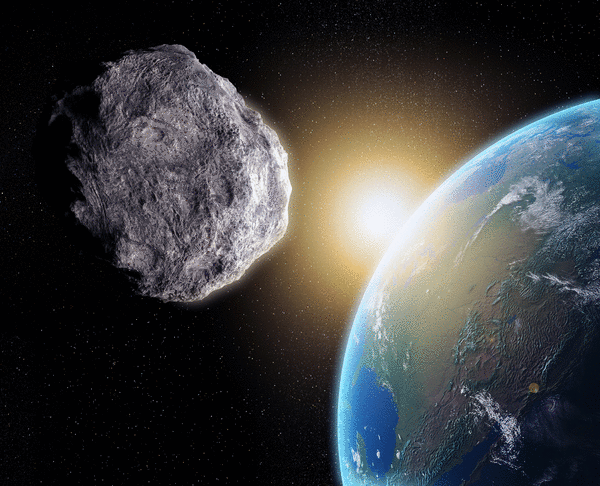
In 1998, Bruce Willis saved the world by blowing up an asteroid threat in “Armageddon.” In 2022, NASA did the real thing, crashing a spacecraft into asteroid Dimorphos to prove that we don’t have to end up like the dinosaurs.
On March 6, scientists from Johns Hopkins’ Applied Physics Laboratory in Laurel, Maryland, and NASA published proof that the Double Asteroid Redirection Test, or DART mission, significantly changed the orbit of asteroid pair Dimorphos and Didymos around the sun.
“Here, we present the first-ever measurement of human-caused change in the heliocentric orbit of a celestial body,” the authors wrote, “adding to humanity’s planetary defense capabilities.”
The DART mission slammed a thousand-pound spacecraft moving at 14,000 miles per hour into Dimorphos while telescopes on Earth and in orbit recorded the impact. Watching the asteroid pair cross in front of the sun and using radar measurements, the science team estimated that DART slowed the asteroid pair by 10-12 microns per second — about the width of a single cotton fiber — or 1200 feet per year. The impact lengthened Dimorphos’ orbit around Didymos by 30 minutes, enough to measurably slow the pair’s orbit around the sun. Their data could help NASA plan to deflect asteroids that may one day threaten the planet, they wrote in the March 6 issue of Science Advances.
Space dust and small particles equal to the mass of five cars hit Earth every day. Most burn up in the sky as shooting stars, LiveScience.com reports. Fewer than 10,000 make it down to Earth as meteorites, prized by rockhounds and scientists. Rocks as big as a small house enter the atmosphere every six to 10 years, sometimes exploding spectacularly due to friction and heating. A life-ending collision, like the one that ended the dinosaurs and the Cretaceous period 66 million years ago, might find Earth every 100 to 200 million years, scientists estimate.
“If [an asteroid] is ever on its way to hitting the Earth, we can more confidently now say that we have the ability to push them around and away from the Earth,” the study’s lead author Rahil Makadia, told Scientific American. “But what we didn’t know was the extent to which this would happen and whether or not we would be able to measure it at all.”
University of Maryland researchers published their study of Dart’s final images before crashing into Dimorphos on the same day in The Planetary Science Journal. They discovered a fan-shaped pattern of streaks in the close-up, created by rocks and dust flung off of Didymos.
©2026 The Baltimore Sun. Visit at baltimoresun.com. Distributed by Tribune Content Agency, LLC.























Comments