Q&A: Waymo engineer Jake Tretter talks robotaxi rollout in Detroit
Published in Automotive News
WASHINGTON — Waymo's decision to deploy its ride-hailing service in the Motor City has been an exciting development for some, and an unnerving one to Metro Detroiters worried about the safety of self-driving cars.
Waymo LLC, a subsidiary of Google parent company Alphabet, has already launched in several other major U.S. cities, including Phoenix, San Francisco and Atlanta. On Nov. 3, the service announced its plans to expand to Detroit.
The futuristic tech outfit has had a solid safety record so far and marked another milestone this month, offering highway rides for the first time in select places. But the novelty of robot cars and the discomfort of who to blame and how to feel if something goes wrong fuels concern from some consumers.
Waymo Technical Program Manager Jake Tretter, in a recent video interview with The Detroit News, sought to address some of those concerns and explain how the company's expansion into the 313 will proceed. Tretter and his team are based out of Waymo's Novi office.
Prior to joining Waymo, Tretter was an engineer and manager at General Motors Co. for over a decade, including a stint working on the automaker's hands-free driving Super Cruise technology.
The following partial transcript has been edited for length and clarity.
Question: Thanks for chatting, Jake. To start, can you tell me about your work and Waymo's work in Metro Detroit?
Answer: We've had a longstanding presence in the Metro Detroit area, both from an engineering standpoint and test-driving. I've been with Waymo for a little over seven years, and our team here primarily does vehicle integration. We take the Waymo Driver system and integrate it into different vehicle platforms.
We've also been doing a lot of data collection in snow and winter weather over the years to prepare for some of the further expansions we want to make into other climates.
Q: I'm going to have a few pretty basic questions here. What exactly is the Waymo Driver system? What is the integration you're talking about?
A: Let me step back a little bit. The 'Waymo Driver' is our name for all the hardware — so all the sensors, LiDAR (light detection and ranging), camera, radar — bundled together with the software and foundational AI (artificial intelligence) and ML (machine learning). We are able to integrate the Driver onto various vehicle platforms.
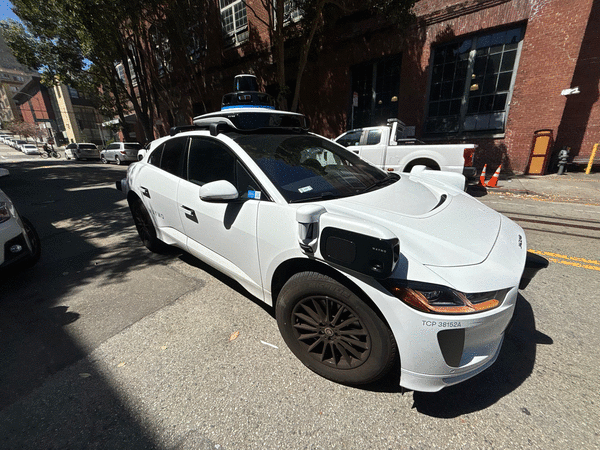
If you're familiar with the white Jaguar I-PACE SUV driving around some cities, like Washington, D.C., that's our fifth-generation Driver. Our sixth-generation Driver is what's coming next. It will be on a Zeekr vehicle. We've also announced Waymo Driver integration on the Hyundai Ioniq 5.
What the team in Michigan does is not only mechanically allowing all those bits and pieces to fasten to the car. There's also integration with the steering, the brakes, the cybersecurity, all the communication pathways within the vehicle, and making sure that's all completely seamless.
That work happens in Novi and at our headquarters in the San Francisco Bay Area.
Q: Which vehicles are going to be part of Waymo's Detroit rollout?
A: We'll have the Jaguars and our new sixth-generation, more weather-proof Driver on the Zeekr RT. Folks may have already seen some of those cars bouncing around late this summer, but that was part of our Novi test and validation operations, which we've had for years and years.
Q: Can you talk about the pace of rollout? What will each phase look like? I imagine you know the frequently asked questions to expect after rollouts in other places.
A: First and foremost, we build a highly detailed, high-definition map of the area that we want to serve. The LiDAR and sensors on the car, by virtue of driving around the city, build this map for us. That gives a sense of, like, 'where's everything at?' That's a reference tool we use, kind of the foundation layer.
Then, we like to understand any uniqueness about a city. What we've really noticed, taking this technology from San Francisco to LA, is it generalizes really well to most or all U.S. cities right now. But every city has unique things. Austin, for example, has horizontal traffic lights. So we want to make sure we're collecting the appropriate number of miles and following our safety framework before we actually open up a service to riders.
That validation happens with what we call an 'autonomous specialist.' That's a human operator driving the car manually. Once we gain confidence through our safety framework, we move to a kind of configuration where the car will be driving itself, but there's still an autonomous specialist in the driver's seat.
We do that for a period of time before we go completely driverless and open this up to passengers and the public for rides.
Q: What is the timeline for all that? Will a Detroiter be able to go on the Waymo app sometime in 2026 and hail a ride?
A: I know that's top of mind for everybody, but it changes city by city and based on the vehicles that we have. We've already announced Miami and Dallas, and those will be a faster entry to market than something like northern climates, where we need to validate our performance in snow and ice.
We're taking a cautioned, measured approach in these types of geographies to make sure that we've got a really dialed-in system. And, by the way, this is not all done on public roads. We do a ton of closed-course testing, too.
We want to build trust with the community, and that's part of why we're talking to you today. We want to start early, build that trust and understanding, and then slowly roll out the technology as we vet it to be ready.
Our goal is to do it as soon as possible, but we don't have dates to announce for Detroit right now.
It's harder to lose the trust and try to regain that than it is to slowly build that trust and make sure that we're working in unison with the community and policy and legislators.
Q: Can you share more details on which areas of Detroit, and broader metro or suburban Detroit, will get Waymo service?
A: First and foremost, the focus is going to be the dense urban core, like near Comerica Park, Ford Field and Little Caesars Arena. All that stuff right downtown. That's the densest area that people would use a service like this.
We want to start there, prove out the viability, and then expand slowly from there on. You've probably seen similar expansions that we've done in the San Francisco Bay area or LA, where we start with a territory that we really are interested in serving, and then we slowly grow it as we ramp up the fleet.
One of the biggest things we want to make sure of is that when people hail a car, they can get it quick. If you start out with a huge area with not many cars, you're going to have really long wait times.
Q: What would happen if I tried to hail a ride to or from an area Waymo doesn't serve yet?
A: When you use the app, you'll type in an address and it'll say, 'Sorry, we don't serve that area right now,' and you'll be able to get updates when we expand to your area. It's very clear to passengers that they are not going to be stranded. They can't hail a car to or from an area that is not in service.
Q: Is there anything about your Detroit rollout that you think is important to highlight?
A: Snow. We really have an emphasis on sixth-generation Driver capabilities in snow. We were testing last winter, and so we've got a ton of data, a lot of cool snapshots.
All the sensors on the sixth-generation driver have much more powerful heaters. They have a kind of washer fluid. They have wipers. Basically, every sensor is like its own mini car window or front windshield, so we can melt off snow and ice. We can clear that with the wiper. We can spray it to remove road grime and salt buildup and things like that.
We're excited about advancing this on a bit of a larger scale this winter and proving it out, so we can have a service that serves and meets Detroiters needs all year round, not just part of the year. That's a big focus for us.
©2025 www.detroitnews.com. Visit at detroitnews.com. Distributed by Tribune Content Agency, LLC.







Comments