Keep Chinese vehicles out of US, auto lobby tells Moolenaar panel
Published in Automotive News
WASHINGTON — The nation's top automotive lobbying group urged lawmakers Thursday to keep Chinese automakers and battery firms out of the United States.
"The Alliance for Automotive Innovation urges Congress and the Trump Administration to prevent Chinese government-backed auto and advanced battery manufacturers from gaining entry to manufacture here in the U.S., and we look forward to working with Congress to counter China’s influence and global strategy," the group said in a letter to U.S. House members.
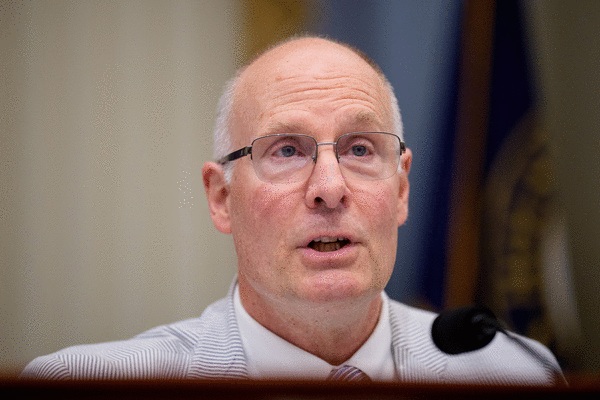
The group submitted the letter as lawmakers gathered for a hearing titled "Trojan Horse: China's Auto Threat to America." U.S. Rep. John Moolenaar, R-Michigan, led the panel as it discussed the global rise of China's automotive industry and the country's dominance of several key technologies and materials, like electric vehicles and advanced batteries. The United States, lawmakers and expert witnesses noted, has not kept pace.
"China's auto sector is not a commercial success story. It is a political project of the (Chinese Communist Party)," Moolenaar said in an opening statement. "In just five years, China has gone from a minor exporter to the world's largest auto exporter, shipping 6 million vehicles abroad last year at below-market prices that U.S. and allied automakers cannot match."
The sixth-term congressman, who chairs the U.S. House Committee on Strategic Competition between the United States and the Chinese Communist Party, has become an outspoken China hawk in Michigan and in Washington. He described the country's market-distorting rise and suggested ways for the United States to mount a comeback.
"With massive subsidies, control over raw materials and supply chains and a predatory regulatory regime, Beijing has turned its auto industry into a tool of the state. We've seen this playback before in steel, shipbuilding, drones, polysilicon, displays and many other sectors," Moolenaar said.
He continued: "Each time, subsidized Chinese capacity flooded global markets, bankrupted competitors, and left the United States dependent on China. We cannot allow the same to happen to autos."
His suggestions for policy to combat China's rise included stronger enforcement — and if necessary, "rewriting" — of American trade agreements to keep Chinese vehicles from flooding U.S. and allied markets.
That may already be happening in Mexico, where imports from China accounted for more than 20% of new light-duty vehicle sales in November, per data from Mexican bank Banco BASE. Chinese imports represented close to 0% of sales before 2018.
Moolenaar also suggested codifying a Biden-era Commerce Department rule that bans Chinese hardware and software from U.S. vehicles and investing in the United States' own domestic manufacturing capacity.
The Alliance for Automotive Innovation, in its letter signed by president and CEO John Bozzella, made similar recommendations to the committee and added several more. Notably, the lobbying group urged continued support for the United States' emerging EV market even as the Trump administration pulls back on environmental regulations and subsidies that promoted a shift to the new powertrain.
"(W)hile the association strongly supports efforts underway ... to revise vehicle emissions and fuel economy standards to ensure customers have the freedom to choose the vehicles and powertrains that best meet their needs," the letter said, "we also understand the importance for the U.S. to lead in electric vehicle technology to not only better serve our own consumers that prefer these vehicle types, but to export and compete around the world in countries that are moving towards this technology.
"This includes support for the advanced manufacturing production tax credit and federal funding for the buildout of reliable and dependable charging infrastructure."
The full letter — which also discusses autonomous vehicles, artificial intelligence, critical minerals and more — is available below. A recording of the U.S. House hearing is available on the committee website.
©2025 www.detroitnews.com. Visit at detroitnews.com. Distributed by Tribune Content Agency, LLC.






Comments