Dealers face prospect of Chinese autos: 'Eventually you'll get them'
Published in Automotive News
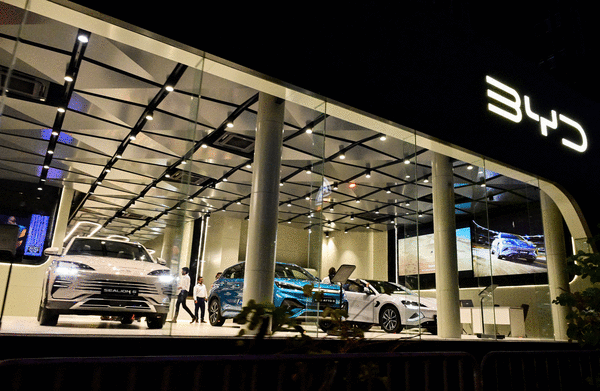
U.S. auto dealers are increasingly wary of a possible industry shakeup ahead: Chinese vehicles entering the American market.
They have seen the signs. Chinese automakers showed off their electric vehicles at a January tech gathering in Las Vegas, with one company saying it planned to announce a U.S. production expansion within a couple of years. Just days later, President Donald Trump came to Detroit and indicated he was open to letting Chinese manufacturers open factories here.
Dealers have recently watched Chinese car companies gobble up market share just south of the border in Mexico. And to the north, Canada is ready to start allowing in a limited number.
"It has been a hot topic," said Rob Cochran, a Pennsylvania retailer who chairs the National Automobile Dealers Association, at the group's recent conference in Las Vegas as models from brands including BYD and Zeekr loomed on massive screens behind him. "The implications for legacy (carmakers) and for all of us who participate with them are significant. The question is, where does it go from here?"
NADA, the powerful trade group with more than 16,000 members nationwide, has spent much time studying China's emerging car industry, Cochran told his fellow dealers at the convention.
Last summer, then-NADA Chairman Tom Castriota, a Florida Chevrolet dealer, wrote a letter to colleagues discussing how he had visited China and other countries where its vehicles are sold and learned about "the economic threat China currently poses as a global automotive power." Policies that opened a door to the U.S. market, he warned, "could have serious and damaging consequences for many of the brands we sell."
Thus far the organization has maintained this hardline stance against Chinese auto imports and supported federal policies including high tariffs that have kept them at bay. NADA's top ally in Congress, Sen. Bernie Moreno of Ohio — a Republican former car dealer — said last month at a Ford Motor Co. factory that there would be no Chinese vehicles sold here "as long as I have air in my body."
"Of particular concern is unfair competition, national security and consumer privacy," Amy Hunter Wright, NADA's vice president of public affairs, said in an email this week.
Yet NADA CEO Mike Stanton also recently stated that the group would not interfere with dealers adding Chinese franchises if the vehicles are ultimately allowed in the United States.
Michael Dunne, CEO of Dunne Insights LLC and an expert on the Chinese auto industry, said dealer interest in Chinese vehicles has ratcheted up since last month when Trump made the comments in Detroit indicating he's open to them being built here.
Retailers don't want to miss out on the latest up-and-coming foreign brand, like Hyundai Motor Co. and Toyota Motor Corp. once were in the United States, Dunne said.
Selling Chinese vehicles would also help dealers combat rising affordability concerns in the U.S. market. But many are also keenly aware that adding such low-cost Chinese cars could hurt sales at their existing stores.
A recent survey by The Presidio Group, a dealership mergers and acquisitions adviser, underscored these conflicted feelings, finding that almost half of dealers surveyed viewed Chinese brands coming to the United States as both an opportunity and a threat.
”You’re winning with your right hand and losing with your left hand, and is it worth it?” said Dunne, who gave a presentation to dealers titled "Automotive Earthquake: How Soon Will Chinese Cars Hit U.S. Roads?" at the recent NADA gathering.
Retailers shouldn't assume that Chinese automakers would only want to sell EVs here, Dunne said. In Europe, the companies pivoted to selling hybrids to get around the European Union's tariffs on EVs.
And in Mexico, where Chinese brands now hold around 15% market share, the vast majority of vehicles sold are either fully gas-powered or plug-in hybrids, said Luis Lozano, the former head of Toyota in the country who now works as a consultant based in Mexico City. That shift happened after BYD and other companies realized their fully electric models weren't very popular in the country.
Lozano has recently hosted U.S. dealers, bankers and others interested in learning more about Chinese cars at a track outside Mexico City, where they can drive several models and learn about how brands such as MG Motor, BYD and Chery Automobile gained a foothold in the country so quickly.
"It's a good opportunity for U.S. dealers to know how to deal with Chinese brands, having a look at the southern boom," he said, adding of the United States: "Eventually, you'll get them."
There are lessons to be learned with how Mexican car dealers have dealt with the influx of Chinese brands, Lozano said. Many welcomed them with open arms and were aggressive in setting up new showrooms. But they have discovered challenges in several areas, including some brands imposing strict top-down sales strategies that frequently shift, and problems after the sale in some instances, like with securing parts for repairs.
"Mexican dealers have learned very quickly to be more selective as to the Chinese brands that are going to be accepted," Lozano said.
Some of the largest publicly traded dealer groups in the United States have been exploring the potential for Chinese-branded dealers in the country.
Companies including Lithia Motors and Penske Automotive Group noted on recent earnings calls that they are already gaining experience selling the vehicles in the United Kingdom. But there would be hurdles, even if they could be sold here.
Bryan Deboer, CEO of Lithia, the country's largest dealer group, recently told analysts that franchise rules in the United States would likely dissuade his company from being an early adopter. It would be difficult to set up profitable standalone sales and service operations in the United States, whereas in the United Kingdom it is easier and cheaper because the vehicles can be sold side-by-side with other existing brands.
Still, he said, the company hasn't ruled out the idea: "We do have building relationships with a number of different Chinese brands," he said, adding that the company would "keep our minds open and look at what opportunities that present us in the future."
©2026 www.detroitnews.com. Visit at detroitnews.com. Distributed by Tribune Content Agency, LLC.







Comments